History

St Bartholomew's Day Massacre
Written by Perlego with AI-assistance
Related key terms
1 of 5
9 Key excerpts on "St Bartholomew's Day Massacre"
 eBook - ePub
Holy Bible (Part 2/2)
»The New Covenant & New Testament« & »The Book of Daniel« & »The Book of Psalms«
- Johannes Biermanski(Author)
- 2016(Publication Date)
- Ebozon Verlag(Publisher)
~ ~ ~ ~ ~ ~ ~The Massacre of St. Bartholomew.The promoters of the St. Bartholomew Massacre.The ever-memorable Synod of La Rochelle has closed its sittings; the noon of Protestantism in France has been reached; and now we have sadly to chronicle the premature decline of a day that promised to be long and brilliant. Already we are within the dark shadow of a great coming catastrophe.The springs and causes of the St. Bartholomew Massacre are to be sought for outside the limits of the country in which it was enacted. A great conjunction of principles and politics conspired to give birth to a tragedy which yields in horror to no crime that ever startled the world . The first and primary root of this, as of all similar massacres in Christendom, is the divine vicegerency of the Pope . So long as Christendom is held to be a theocracy, rebellion against the law of its divine monarch , in other words heresy, is and must be justly punishable with death .But, over and above, action in this special direction had been plotted and solemnly enjoined by the Council of Trent. "Roman Catholic Europe," says Gaberel, "was to erase Reformed Europe, and proclaim the two principles - the sovereign authority of the kings in political affairs , and the infallibility of the Pope in religious questions . The right of resisting the temporal, and the right of inquiring into the spiritual, were held to be detestable crimes, which the League wished to banish from the world." (Gaberel, vol. ii., p. 341.)instead of consummating its horrors in one terrible week , it extended them over many dismal years. Philip never ceased to urge on Catherine de Medici and Charles IX. to do in France as he was doing inAt the head of the League was Philip II.; and the sanguinary terocity of the King of Spain made the vast zeal of the French court look but as lukewarmness. A massacre was then in progress in the Low Countries, which took doubtless the form of war, but yielded its heaps of corpses almost daily, and which thrills us less than the St. Bartholomew only because,
- George P. Fisher(Author)
- 2015(Publication Date)
- Routledge(Publisher)
The Massacre of St. Bartholomew .*FRANCE , in the age when Protestantism was spreading in Europe, found herself in a place where two seas met If the ship of state did not go to pieces, like the vessel which threw St. Paul upon the coast of Malta, it had to struggle through a long and” frightful tempest from which it barely escaped. In the other European countries the situation was different. There was intestine discord, but not to the same extent; or with consequences less ruinous.In Germany, the central authority was too weak to coerce the Lutheran states. The war undertaken by Charles V. for that purpose was brief, and comparatively bloodless. The final issue was the freedom of the Protestants for a long period, until imperial fanaticism, in the early part of the seventeenth century, brought on the terrible Thirty Years’ War, which exhausted what was left of the vitality of the German Empire, and ended in the establishment of Protestant liberties at the Peace of “Westphalia (1648). In England, as late as Elizabeth’s reign, not less than one-half the population preferred the old Church; but in the wars of the Roses, the nobles had been decimated, and regal authority strengthened; and the iron will of the Tudor sovereigns, Henry VIII. and Elizabeth, coupled with an inbred hatred of foreign rule, ecclesiastical and secular, and supported by the fervent love of a great party to the Protesant faith, kept the nation on one path, and stifled various attempts at insurrection, which might otherwise have blazed up in civil war. In Scotland, the league of the nobles with the reformers, aided by the follies of Mary Stuart, proved strong enough to uphold against the opposing faction the revolution which had made Calvinism the legal religion of the country. In Sweden, Protestantism speedily triumphed under the popular dynasty erected by Gustavus Vasa. In the Netherlands, there was a fierce battle continued for the greater part of a century; but the contest of Holland was against Spain, to throw off the yoke that she was determined to fasten upon that persecuted and unconquerable race. In Italy and in the Spanish peninsula, Protestantism did not gain strength enough to stand against the revived fanaticism of its adversary, and was swept away, root and branch. eBook - ePub
Local Politics in the French Wars of Religion
The Towns of Champagne, the Duc de Guise, and the Catholic League, 1560–95
- Mark W. Konnert(Author)
- 2017(Publication Date)
- Routledge(Publisher)
CHAPTER FOUR St Bartholomew and its aftermathAlthough, of course, the St Bartholomew’s Massacres play a central role in the history of the religious wars and in the fate and direction of the Huguenot community in France as a whole, in the towns of Champagne, with several exceptions, they were a non-event. As with the Massacre of Vassy, it is not my intention to rehash the events of August and September 1572, nor to assign guilt or even to trace the consequences of the massacres. All these aspects have been ably carried out elsewhere and are the subject of a longstanding and vast historiography.1 In Champagne proper, only Troyes suffered any real violence, though the city of Meaux in Brie, on the westernmost fringe of the gouvernement was also the site of a massacre. Although Meaux has not been included among the cities which are among the primary focus of this study – documentation on the internal affairs of the city is sparse, and though it is within the gouvernement of Champagne, geographically and historically its ties are much closer to Paris and the Ile de France – it does serve as an instructive contrast with the cities which did not experience a massacre.2The Parisian massacre of course was and is the focal point of interest when it comes to the events of August 1572. Yet, as modern research has shown, towns which did experience a similar massacre are in a distinct and small minority. In all, other than Paris, massacres occurred in twelve provincial cities.3 In Paris, of course, the massacre grew out of uniquely Parisian circumstances: the clerical and Catholic nature of the capital’s civic identity, longstanding tension and hostility between the religious communities, the presence of Catholic preachers who whipped up anti-Huguenot fervour, and of course the catalyst for the events of 23 August, the marriage of Marguerite de Valois and Henri de Navarre, the presence of a large number of armed Huguenot nobles, and the attempted murder of Coligny. This constellation of circumstances was obviously not present in the same way in other cities. As Mack Holt has usefully pointed out, the twelve cities which did experience a massacre were ones in which there had once been significant Protestant minorities, and which in some cases had actually been taken by Huguenot forces in previous civil wars. Thus, the experience of Paris was duplicated in at least this aspect, that Catholic majorities felt keenly the threat of religious pollution.4 eBook - ePub
Game of Queens
The Women Who Made Sixteenth-Century Europe
- Sarah Gristwood(Author)
- 2016(Publication Date)
- Oneworld Publications(Publisher)
42 The Massacre of St Bartholomew’s Day France, 1572–1574Queen Elizabeth was at Robert Dudley’s great castle of Kenilworth when she had news of an event that shook her world, one of those events which really do change history: the Massacre of St Bartholomew’s Day. The story had seemed at first to lie between Catherine de Medici and Jeanne d’Albret but in the end, the repercussions would reach out to touch everybody.In the early months of 1571 William of Orange, the exiled leader of the Netherlands Protestants, was trying to orchestrate an armed invasion of the Netherlands from Germany. Although his brother was with the Huguenot rebels in La Rochelle, Orange needed to draw the French crown also to his side, invoking an old anti-Spanish hostility still arguably more potent than religious division. The idea had immense appeal for a young king anxious to prove his mettle in battle and soon Charles IX was to be heard complaining that Catherine was ‘too timid’. Newly married to Elizabeth of Austria, devout young daughter of the Holy Roman Emperor, Charles was beginning to resent his mother’s dominance.1 A few days after the formal entry into Paris that celebrated his marriage in March 1571, Charles made a speech to his parlementcommending Catherine’s ‘tireless work, energy and wisdom’ in taking care of affairs of state for all the time he had been too young to do so himself; the implication being that such days were coming to an end.Catherine de Medici was temperamentally opposed to expensive warfare (yet another thing on which she agreed with Elizabeth of England) but she was prepared to use the possibility of French support for the Dutch Protestants as a lever to induce Jeanne d’Albret to agree to the marriage of her son Henri to Catherine’s daughter Margot. (No one cared about Margot’s reluctance to marry a heretic. Catherine threatened to make her daughter ‘the most wretched lady in the kingdom’ if she refused, but Jeanne’s reluctance was another story.)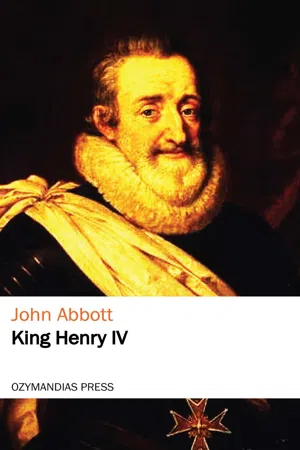 eBook - ePub
- John Abbott(Author)
- 2018(Publication Date)
- Ozymandias Press(Publisher)
The annals of the world are filled with narratives of crime and woe, but the Massacre of St. Bartholomew stands perhaps without a parallel.It has been said, “The blood of the martyrs is the seed of the Church.” This is only true with exceptions. Protestantism in France has never recovered from this blow. But for this massacre one half of the nobles of France would have continued Protestant. The Reformers would have constituted so large a portion of the population that mutual toleration would have been necessary. Henry IV. would not have abjured the Protestant faith. Intelligence would have been diffused; religion would have been respected; and in all probability, the horrors of the French Revolution would have been averted.God is an avenger. In the mysterious government which he wields, mysterious only to our feeble vision, he “visits the iniquities of the fathers upon the children, even unto the third and fourth generation.” As we see the priests of Paris and of France, during the awful tragedy of the Revolution, massacred in the prisons, shot in the streets, hung upon the lamp-posts, and driven in starvation and woe from the kingdom, we can not but remember the day of St. Bartholomew. The 24th of August, 1572, and the 2d of September, 1792, though far apart in the records of time, are consecutive days in the government of God. eBook - ePub
- R. J. Knecht(Author)
- 2014(Publication Date)
- Routledge(Publisher)
27Effects of the massacres
The massacre of St Bartholomew in Paris and other towns seriously weakened the Protestant cause. Many Huguenots, who could not believe that God would have allowed such a slaughter of His own children, abjured their faith. Even the two young princes of Navarre and Condé, the nominal leaders of the Huguenot movement, who had survived the massacre at court, were received into the Catholic faith. But unlike many of their co-religionists, they acted under compulsion, having been given one of three choices by Charles IX: abjuration, death or life imprisonment. On 3 October Navarre had to beg forgiveness from the pope and on the 16 October he ordered Catholicism to be re-established in Béarn. Thereafter he behaved as if the massacre had never taken place, fraternizing with Guise and others.28A contemporary reported that 5,000 Huguenots lapsed following the massacre. Ten years later, Jean de L’Espine said that the French Protestant churches had lost two-thirds of their members, an estimate confirmed by findings from Rouen. The Catholic parish registers reveal a flood of rebaptisms of Calvinist children making their reintegration into the Catholic fold. Many adult Huguenots formally abjured in the cathedral. At least 3,000 Protestants in Rouen became reconciled to the Catholic church. Others preferred to emigrate, mainly to England. Charles IX tried to spur further conversions by banning all Calvinists from royal offices, but Catholic hopes that the massacre had destroyed the Protestant church in France were soon dashed. The chain of Protestant strongholds across southern France and up the west coast to Poitou ensured its survival as well as the continuation of the civil wars. Yet the Huguenots had suffered a crippling blow from which they never fully recovered. When the Reformed church in Rouen resumed its regular meetings in 1578 it was only a fraction of its size in the 1560s; from a community of 16,000 souls it had sunk to one of around 3,000 and the decline was to prove permanent.29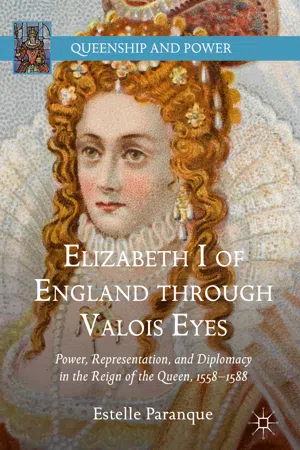 eBook - ePub
Elizabeth I of England through Valois Eyes
Power, Representation, and Diplomacy in the Reign of the Queen, 1558–1588
- Estelle Paranque(Author)
- 2018(Publication Date)
- Palgrave Macmillan(Publisher)
© The Author(s) 2019 Estelle Paranque Elizabeth I of England through Valois Eyes Queenship and Power https://doi.org/10.1007/978-3-030-01529-9_4Begin Abstract4. “a germayne sister”: The Impact of the St. Bartholomew’s Day Massacre’s on Representations of Queen Elizabeth—August 1572–June 1574
End AbstractEstelle Paranque1(1) New College of the Humanities, London, UKEstelle ParanqueFrancis Walsingham, the English ambassador at the French court and one of Elizabeth’s closest advisers, related of the horrors of the St. Bartholomew’s Day Massacre in an emotional account of the atrocity: “women, children, maids, young infants and sucking babes, were […] murthered, and cast into the river.”1 However, in a report to Lord Burghley, Sir Thomas Gargrave revealed that the reaction on the other side of the Channel was ambivalent, at best. He wrote that the people of the north of England “are, as I think, like others in other parts of the realm; one sort is pleased with the late affront in France; another sort lament, and are appalled at it; others would seem indifferent, and those be the greatest number.”2Four days earlier—two weeks after the massacre—Elizabeth had received the French ambassador in her private chamber, attended by her private councillors and some important gentlewomen of the court “in complete silence.”3 Though it may be assumed that the entire court was “clothed fully in mourning attire,” it is notable that La Mothe Fénélon, whose main aim when writing his report of the meeting was to reassure his masters that their relations with Elizabeth would survive the atrocity, made no reference to the queen’s and her courtiers’ dress.4 This was an early example of the diplomatic dexterity he had to employ in the wake of the St. Bartholomew’s Day Massacre in the interests of preserving the French crown’s good relations with Elizabeth.5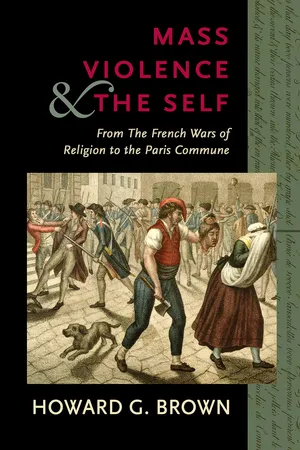 eBook - ePub
Mass Violence and the Self
From the French Wars of Religion to the Paris Commune
- Howard G. Brown(Author)
- 2019(Publication Date)
- Cornell University Press(Publisher)
Wars, Massacres, and Troubles served to make the conceptual transition from the martyrdom of Anne du Bourg in 1559 to the more indiscriminate massacres of the first civil war launched by the massacre at Vassy in 1562.“The Massacre at Vassy the first of March 1562” is a print of even greater intimacy and pathos than its predecessor (see plate 1 ). By removing the fourth wall between the action and the audience, the printmakers bring the viewer almost into the scene itself. Also, the figure depicted hiding behind the pulpit to the right of center seems to stand in for the viewer regarding the explosion of violence from within its midst. The intimacy of the scene allows the artists to depict a variety of facial expressions, including the fear of the man on the ground in the lower right corner and the throes of death on the woman run through with a sword in the lower foreground. The gasping, hands-over-mouth, wide-eyed horror shown on the figure embedded deep in the crowd at the center of the image clearly serves to prompt appropriate emotional responses from the viewer. The general panic is palpable from the many arms thrown in the air, the entangled mass of struggling bodies, and the wild scramble to escape across the roof. Other details in the scene also made it more likely that viewers would respond emotionally. Female Huguenots could have sensed the urgency of the woman in the center foreground as she tries to stop a Catholic soldier from bringing his sword down on the fallen man before him, or have empathized with the sheltering embrace given to a young child by the woman just behind her. Male Huguenot viewers would have especially identified with the sense of helplessness conveyed by the obvious inability of the worshiping men to protect women or children, let alone to defend themselves. Furthermore, famous details known from widely circulated pamphlets, such as the theft of the poor box and the blowing of trumpets, are included to bolster the veracity of the scene. Finally, the whole event is explained as a Guise-led massacre by the presence of both Francis, Duke of Guise (letter B ), and his brother Charles de Guise, Cardinal of Lorraine (letter E eBook - ePub
- James Thompson(Author)
- 2018(Publication Date)
- Jovian Press(Publisher)
As one reviews the months before the massacre one asks just how far Elizabeth herself may have been responsible for it. It was she who, by her tortuous and insincere policy alarmed Charles IX and Catherine, causing the Flanders expedition to be abandoned; it was this which caused Coligny to turn upon Catherine in the King’s council, saying, “This war the King renounced. God grant he may not find himself involved in another less easy to renounce.” The line comes straight from Elizabeth surely, but can be emphasized too strongly. That some blame must rest on the English cannot be denied, however. Did Catherine de Medici plan the massacre of St. Bartholomew to save herself from the wrath of the Huguenots? Or, in her terror did she seek toappease the wrath of the Catholic dragon with human lives? Was the massacre of St. Bartholomew the bloody price of Spain’s satisfaction?But there is another element to be considered in any endeavor to unravel the causes of that event. All the art of Catherine de Medici for years past had been expended in an endeavor to maintain control by balancing the parties against one another. At this minute she was insanely jealous of the admiral Coligny, whose political ascendency seemed all the greater because of the conduct of the Protestants who crowded Paris for the coming nuptials, enjoying their superficial popularity with too much arrogance in many cases, and angering the sentiment of the Parisians, the most Catholic populace in France.The massacre seems primarily due to the jealousy and hatred felt by Catherine de Medici toward Coligny on account of his great ascendency over Charles IX, coupled with panic after the failure of her deliberate attempt to have him murdered, and fear of war with Spain—a fear all the greater because of England’s desertion of France in Flanders at this critical moment, lest English commercial ascendency there should suffer.It was a crime of fear, a horrible resource in a difficult emergency; partly a craven attempt to placate Spain for what had been done against her; partly a crime of jealousy. Perhaps jealousy of Coligny was even a stronger motive than fear of Spain. The attempt upon Coligny’s life on August 22, would seem to indicate this.Was the general slaughter of the Huguenots the consequence of the failure of this attempt? If the shot of August 22 had killed the admiral, would the massacre have taken place? I think not. The failure to kill the admiral was the immediate occasion of the massacre of St. Bartholomew’s Day. If Coligny had been killed then and there, the massacre probably would not have happened.
Index pages curate the most relevant extracts from our library of academic textbooks. They’ve been created using an in-house natural language model (NLM), each adding context and meaning to key research topics.

