History

Sand Creek Massacre
Written by Perlego with AI-assistance
Related key terms
1 of 5
11 Key excerpts on "Sand Creek Massacre"
 eBook - ePub
- Jennifer Dawes(Author)
- 2019(Publication Date)
- Palgrave Macmillan(Publisher)
8The Sand Creek Massacre was a defining event in nineteenth-century American history and an atrocity that has led historians to draw parallels with My Lai9 and the Holocaust.10 It occurred within the wider context of, and as a direct result of, American Expansionism, the Colorado Gold Rush, the Plains Indian War, and the American Civil War.11 With the killing of several of the “peace-chiefs”—men who had staked their reputations on working towards peace with the whites—the massacre radicalized the Plains Indian leadership structure,12 and set the American West on the road to Wounded Knee,13 and the attempted extermination of the indigenous peoples of North America.14 Historically, the massacre has been contested and variously interpreted. It remains under-taught in schools and under-represented in the authorized history of nineteenth-century American history.15 Even the location of the massacre had been forgotten or contested by all except the tribal descendants of the victims.16 According to Cheyenne Chief Laird Cometsevah, while most of America tried to forget or ignore the event, tribal representatives of the Southern Cheyenne Tribe of Oklahoma, the Northern Cheyenne Tribe, and the Northern Arapaho Tribe, using indigenous methodologies, located, sanctified, and memorialized the site.17In 1995, a provisional site survey supported the tribes’ historic location of the massacre 18 on the Dawson Ranch (Eads, Colorado) situated on the high plains of southeastern Colorado (38 32’40.55”N /102 30’14.06W). Subsequently, in 1998, Senator Nighthorse Campbell introduced Senate bill 169519 which directed the National Park Service (NPS), in consultation with the tribes, to further verify the site location and provide a range of cultural resource management options. The option preferred both by the tribal representatives and NPS was the creation of a new national park that would preserve, interpret, and memorialize the site.20 In 2000, the Sand Creek Massacre National Historic Site (SCMNHS) was authorized, and it opened to the public in 2007 (Fig. 2.1 ).21 , 22Fig. 2.1 Experiencing Sand Creek Historic Massacre Site; Source: Spencer eBook - ePub
Civil War Places
Seeing the Conflict through the Eyes of Its Leading Historians
- Gary W. Gallagher, J. Matthew Gallman, Gary W. Gallagher, J. Matthew Gallman(Authors)
- 2019(Publication Date)
- The University of North Carolina Press(Publisher)
7More than 150 years later, the Sand Creek site remains a contested landscape, and, as I have argued in my work, memories of the massacre are still freighted with politics. The product of a collaboration between the National Park Service, the state of Colorado, local ranchers, and descendants of the massacre’s victims—members of the Northern and Southern Arapaho and Cheyenne tribes—the memorial very nearly never opened its gates. In 1998, when Park Service officials began studying the feasibility of commemorating Sand Creek, they discovered that the mists of time had shrouded the massacre’s precise location. The ensuing hunt proved contentious when methodological and epistemological disagreements over how to interpret the historical record divided the site searchers. The Sand Creek descendants, relying upon ethnographic research conducted within their communities and turn-of-the-century maps penned by George Bent, insisted that they had never lost track of the massacre site. Tribal elders shared with me that through the years they had heard women and children crying in the shadow of a rise overlooking a lazy bend in the creek, which they identified as the “traditional site.” The Park Service, by contrast, looked to testimony collected from Chivington’s troops and then relied upon a different map, penned by an officer named Samuel Bonsall, who took William Tecumseh Sherman on a tour of Western military sites in the wake of the Civil War. Bonsall’s diagram clearly marked the location of “Chivington’s Massacre” along the banks of Sand Creek just a bit less than a mile upstream from the bend that the descendants believed had hosted the violence.8The descendants felt betrayed by representatives of the federal government, who, they explained to me, were recapitulating historical crimes. Connecting past and present, Otto Braided Hair, director of the Northern Cheyenne Sand Creek Office, raged, “They tried to wipe us out at Sand Creek. Now they’re trying to commit cultural genocide.” For Braided Hair, it seemed the Park Service wanted to dictate the particulars of tribal history to tribal peoples, robbing them of cultural authority by insisting that they trust sources generated by the shock troops of settler colonialism and housed in imperial archives. The Park Service, in short, relied for information on Sand Creek’s perpetrators rather than on its victims. The descendants, meanwhile, looked to maps produced by George Bent, a venerated member of the Cheyenne tribe and a massacre survivor. This contest over competing cartographies was resolved only when the Park Service floated a compromise: a commemorative landscape featuring a perimeter capacious enough to encompass otherwise incommensurable accounts of Sand Creek. On April 28, 2007, the Sand Creek historic site, the 391st unit in the National Park System, opened to the public. Approximately 200,000 people have made their way there in the years since. I have frequently been among them, navigating the dusty back roads of southeastern Colorado. Each time I arrive, I rediscover a memorial built atop some of the painful ironies, the open wounds, that define our national narrative.9 eBook - ePub
A Misplaced Massacre
Struggling over the Memory of Sand Creek
- Ari Kelman(Author)
- 2013(Publication Date)
- Harvard University Press(Publisher)
53On July 24 of that year, the Pioneers Association unveiled its memorial, designed by John Howland, who had served in the 1st Colorado Regiment during the Civil War. With Colorado’s governor, John Shafroth, waylaid by a rockslide in the mountains, the state supreme court’s chief justice, Robert Steele, oversaw the ceremony before a parade of elderly veterans and a crowd of admirers numbering in the thousands. The press reported that “a hush of patriotic awe” fell over the throng as the American flag shrouding the monument slipped away. A twenty-one-gun salute pierced the thin air, a band played “Marching through Georgia,” balanced next by “Dixie,” and Senator Thomas “T. M.” Patterson then remarked, in the spirit of reconciliation: “We are all Americans today, and we all glory in one flag and in one country.” Ignoring Sand Creek’s impact on the Arapahos and Cheyennes, General Irving Hale, who spoke later, suggested that the “Civil War … made freedom universal.” The Pioneers Association had, it seemed, sanded down the massacre’s rough edges and carved John Chivington’s narrative of the slaughter into stone by including Sand Creek among the twenty-two Civil War “battles” in which Coloradans had participated.54Eighty-nine years later, though, amid a storm of publicity generated by Senator Campbell’s plans for memorializing the massacre, Sand Creek seemed misplaced yet again, this time among the list of engagements arrayed on the Pioneers Association monument. On May 5, 1998, the Colorado legislature, whose members sometimes walked by the Civil War memorial on their way to work in the capitol building, decided to correct an “insult to the memory” of the “Native Americans who were killed at Sand Creek” and also to the “Colorado Civil war veterans who fought and died in the actual Civil War battles that are listed on the memorial.” The state legislature passed a joint resolution noting, “Sand Creek was not, in fact, the site of a battle, but of a massacre” and therefore would “be removed from the memorial.” Put another way, the words Sand Creek” would literally be erased from the list at the foot of the statue. A local sculptor would detach the plaque on which the twenty-two “battles” appeared, grind away the offending text, sandblast the remaining twenty-one, apply a patina to match the original color, and then reinstall the bronze plate at the foot of the statue. It seemed in that moment that generations of public remembrance could be scraped away and recast, the sins of the past wiped clean, all for the bargain price of $1,000.55 eBook - ePub
After One Hundred Winters
In Search of Reconciliation on America's Stolen Lands
- Margaret D. Jacobs(Author)
- 2021(Publication Date)
- Princeton University Press(Publisher)
My colleague Benjamin Madley has documented more than 370 massacres—of five or more Indigenous people—in California alone between 1846 and 1873 in his book American Genocide. Most likely, unless you are a California Indian, you have never heard of any of these. In September 1864, for example, just two months before Chivington’s troops opened fire on the Arapahos and Cheyennes at Sand Creek, settlers killed 300 California Indians just north of Millville. Our lack of knowledge of all this violence surely has something to do with Michael Ignatieff’s insight that “all nations depend on forgetting.” We have been calling this abject violence “westward expansion” for a very long time. For most of us, it is deeply uncomfortable to contemplate that what we have been celebrating as “winning the West” is really mass murder, committed in order to appropriate the land. I never heard about Sand Creek as a child, but more and more settlers in Colorado and the nation have learned at least something about it in the last few decades. But why do we know about Sand Creek when we know little to nothing about countless other massacres? What made the difference is that two settler soldiers, Captain Silas Soule and Lieutenant Joseph Cramer, broke ranks and reported the abominable violence they witnessed at Sand Creek. Soule and Cramer had opposed the action from the beginning, but they were forced to lead their men on the overnight march from Fort Lyon to Sand Creek. Once the massacre began, however, Soule and Cramer commanded their men to refrain from charging or firing. Soule and Cramer witnessed the carnage and confirmed the accounts of George Bent and other survivors. Silas wrote to his mother a few weeks after the atrocities at Sand Creek, a week before Christmas. He began by apologizing for his tardy reply to her last letter. “The day you wrote,” he told her, “I was present at a Massacre of three hundred Indians mostly women and children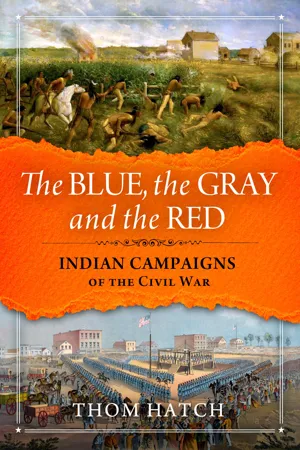 eBook - ePub
- Thom Hatch(Author)
- 2020(Publication Date)
- Turner(Publisher)
NINE BLOOD ALONG SAND CREEKT he most widely known and notorious incident between Indians and soldiers that occurred during the Civil War was without question the attack by Colorado militia Colonel John M. Chivington on an Indian village along the banks of Sand Creek, Colorado Territory, five days after Thanksgiving in 1864. This act of betrayal and barbarity, equally shared in responsibility by government and military authorities as well as rank-and-file soldiers, would serve as combustible fuel dumped onto the smoldering coals of distrust and hatred and would ignite the plains in flames of violence for years to come.The Indians involved in this engagement at Sand Creek were primarily members of the Southern Cheyenne and Arapaho tribes, who had for generations roamed this territory that eventually became Colorado.The Cheyenne, an Algonquin tribe, in their earliest days occupied villages in parts of Minnesota, where they farmed, hunted, gathered wild rice, and made pottery. At some point in the 17th century, they became tired of constant warfare with the Sioux and Ojibway and began migrating to the Great Plains where they acquired guns and horses and became nomadic hunters. In about 1832, the tribe split into two distinct bands—the Northern Cheyenne, who settled around the North Platte River in northern Nebraska and assumed a lifestyle similar to their allies, the Sioux; and the larger group, which became known as the Southern Cheyenne, and established their domain between the Platte and Arkansas rivers, from central Kansas to the Rocky Mountains.The lifestyle and customs of the Southern Cheyenne were similar to other plains tribes, although they did not consider their women to be chattel. Girls generally married young, and a celebration was held with the birth of each baby. Children were cherished. The elders patiently taught the necessary skills that would enable them to grow into beneficial members of the tribe. Religion was part of every aspect of their daily life, expressed by many traditional ceremonials, the central element being the sacred pipe, which was believed to be the link between man, nature, and the supreme deity. eBook - ePub
The Indians of the Pike's Peak Region
Including an Account of the Battle of Sand Creek, and of Occurrences in El Paso County, Colorado, during the War with the Cheyennes and Arapahoes, in 1864 and 1868
- Irving Howbert(Author)
- 2018(Publication Date)
- Perlego(Publisher)
As I have already said, the Indian is at a great disadvantage in carrying on warfare during the winter. He has no trouble in this direction in his warfare with his own race, as every tribe is alike in this respect. In this way the white people had a great advantage, and it would have required only a few cases of summary punishment such as we gave them at Sand Creek, to have settled Indian troubles for all time. We who inhabited the frontier in the early sixties knew this and realized that nothing struck such terror to the Indian tribes as to be attacked in the winter, and had the battle of Sand Creek been followed up as it should have been, the frontier settlements of Colorado would thereafter have had little trouble with any of the Indians of the plains.Four years later, the absurdity of the policy of permitting the Indians to murder and rob during the summer, make peace in the fall, and remain unmolested during the winter, accumulating ammunition for the following summer's warfare, finally dawned upon the military authorities and a new policy was adopted. As a result, on the 27th of November, 1868, General Custer, under the direction of General Sheridan, commander of the military division of the Missouri, made an attack upon the Cheyennes camped on the Washita, south of the Arkansas River, in which one hundred and three Indians (a number of whom were squaws) were killed, fifty-three squaws and children were captured, and 875 ponies were taken. This attack was at the same time of year and was almost identical with that made by Chivington at Sand Creek. General Sheridan says in his report: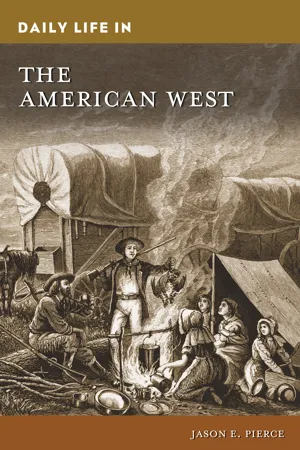 eBook - ePub
- Jason E. Pierce(Author)
- 2022(Publication Date)
- Greenwood(Publisher)
Rocky Mountain News declaring that Chivington’s campaign would be remembered as one of “the brilliant feats of arms in Indian warfare” (quoted in West 1998, 306). Only later, thanks to survivors such as George Bent, would the truth slowly start to emerge. Congress eventually investigated the massacre and denounced the soldiers’ actions. In the end, however, official blame fell on the victims, the Cheyenne, for not being on designated reservations in Indian Territory, where they would supposedly be safe. None of the men who participated in the massacre were charged with any crime. Chivington, for his part, did not entirely avoid the taint of his actions; his association with the massacre eventually doomed his political career, sending him skulking back to his native Ohio.More immediately, the aggrieved Cheyenne vowed revenge and sent riders out to their allies, both north and south, with calls to strike back at the treacherous whites who had broken the peace. What the people of Denver most feared, an unrestrained war on the plains, was exactly what they created with the Sand Creek Massacre. War parties burned isolated ranches, stole livestock, and killed any whites they encountered. Venturing east of Denver meant taking one’s life in one’s hands. The stage stop at Julesberg, an important waypoint on the road to Denver, was completely destroyed (West 1998, 307).To the north, the Lakota, allies of the Cheyenne, had their own simmering dispute with the whites encroaching on their lands. This encroachment began, as most did in the West, with the discovery of gold. This time, the new California would be in Montana, where the discovery of gold in 1862 on Grasshopper Creek, near the modern town of Bannack, set off a predictable frenzy, as it had in California, Oregon, and Colorado before. Montana, however, proved more difficult to reach than Colorado, so prospectors had two options: move along the Missouri River, a long and circuitous route, or take the Oregon Trail to Fort Laramie before breaking off and heading northwest to the goldfields. John Bozeman, a former prospector who had decided it was more profitable to go into the freighting and guiding business, proclaimed that his new trail offered numerous advantages over the longer Missouri River route. As was often the case, the Bozeman Trail followed a route Indians had been using for thousands of years. While still some 500 hundred miles long, it did offer a more direct route, with easy travel over open plains and plenty of grass and water for animals. However, prospectors would pass through the Wind River Country, in the heart of territory promised to the Lakota in the 1851 Fort Laramie Treaty. Great herds of buffalo called the area home, which the Lakota considered their own, and whenever whites moved through an area, as the Lakota knew, the buffalo herds soon diminished. With Lakota eager to dissuade the whites from using it, the Bozeman Trail, unsurprisingly, soon became the most dangerous of passages.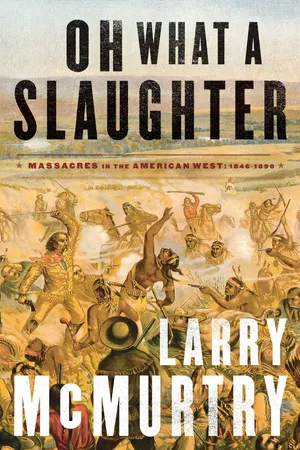 eBook - ePub
Oh What a Slaughter
Massacres in the American West: 1846--1890
- Larry McMurtry(Author)
- 2010(Publication Date)
- Simon & Schuster(Publisher)
The Cheyenne fought gallantly, well into the afternoon—a few of the warriors managed to slip away. When the firing tapered off, the looting began. As at Mountain Meadows, fingers and ears were lopped off, to be stripped of rings and ornaments. Almost every corpse was scalped and many were sexually mutilated. A kind of speciality of Sand Creek was the cutting out of female pudenda, to be dried and used as hatbands.Chivington and his men returned to Denver, to celebrity and wild acclaim. The scalps—one hundred in number—were exhibited in a Denver theater. Chivington, very much the hero of the hour, claimed to have wiped out the camp.In fact, though, quite a few Cheyenne and Arapaho survived Sand Creek, including all of William Bent’s sons. The Indians hurried off to tell the story to other tribes, while the one-hundred-day volunteers celebrated.Chivington’s most fervent admirer, Colonel George Shoop, confidently announced that Sand Creek had taken care of the Indian problem on the Great Plains—his comment was the prairie equivalent of Neville Chamberlain’s famous “peace in our time” speech, after Hitler had outpointed him at Munich. Shoop was every bit as wrong as Chamberlain. Sand Creek, far from persuading the Indians that they should behave, immediately set the prairies ablaze.It sparked the outrage among the Indian people that led inevitably to Fetterman and the Little Bighorn. The Indians immediately launched an attack against the big freighting station at Julesburg, in northeastern Colorado. But for another blown ambush by the young braves, they might have wiped out the station. As it was, they killed about forty men. The trails into Denver that had been dangerous enough before Sand Greek became hugely more dangerous.In the twelve years between Sand Creek and the Little Bighorn there were many pitched battles. Some, like Custer’s attack on the Washita in 1868, in which Black Kettle and his tough wife were finally killed, went to the whites; others, such as Fetter-man or the Battle of the Rosebud, went to the Indians. All up and down the prairies, from the Adobe Walls fight in Texas to Platte Bridge in Wyoming, a real war was now in progress. Charles Bent became one of the most feared of all Dog Soldiers, killing and torturing any whites he could catch. eBook - ePub
- Frederic L. (Frederic Logan) Paxson(Author)
- 2014(Publication Date)
- Perlego(Publisher)
Of the four classes of persons whose interrelations determined the condition of the frontier, none admitted that it desired to provoke Indian wars. The tribes themselves consistently professed a wish to be allowed to remain at peace. The Indian agents lost their authority and many of their perquisites during war time. The army and the frontiersmen denied that they were belligerent. "I assert," wrote Custer, "and all candid persons familiar with the subject will sustain the assertion, that of all classes of our population the army and the people living on the frontier entertain the greatest dread of an Indian war, and are willing to make the greatest sacrifices to avoid its horrors." To fix the responsibility for the wars which repeatedly occurred, despite the protestations of amiability on all sides, calls for the examination of individual episodes in large number. It is easier to acquit the first two classes than the last two. There are enough instances in which the tribes were persuaded to promise and keep the peace to establish the belief that a policy combining benevolence, equity, and relentless firmness in punishing wrong-doers, white or red, could have maintained friendly relations with ease. The Indian agents were hampered most by their inability to enforce the laws intrusted to them for execution, and by the slowness of the Senate in ratifying agreements and of Congress in voting supplies. The frontiersmen, with their isolated homesteads lying open to surprise and destruction, would seem to be sincere in their protestations; yet repeatedly they thrust themselves as squatters upon lands of unquieted Indian title, while their personal relations with the red men were commonly marked by fear and hatred. The army, with greater honesty and better administration than the Indian Bureau, overdid its work, being unable to think of the Indians as anything but public enemies and treating them with an arbitrary curtness that would have been dangerous even among intelligent whites. The history of the southwest Indians, after the Sand Creek Massacre, illustrates well how tribes, not specially ill-disposed, became the victims of circumstances which led to their destruction.After the battle at Sand Creek, the southwest tribes agreed to a series of treaties in 1865 by which new reserves were promised them on the borderland of Kansas and Indian Territory. These treaties were so amended by the Senate that for a time the tribes had no admitted homes or rights save the guaranteed hunting privileges on the plains south of the Platte. They seem generally to have been peaceful during 1866, in spite of the rather shabby treatment which the neglect of Congress procured for them. In 1867 uneasiness became apparent. Agent E. W. Wynkoop, of Sand Creek fame, was now in charge of the Arapaho, Cheyenne, and Apache tribes in the vicinity of Fort Larned, on the Santa Fé trail in Kansas. In 1866 they had "complained of the government not having fulfilled its promises to them, and of numerous impositions practised upon them by the whites." Some of their younger braves had gone on the war-path. But Wynkoop claimed to have quieted them, and by March, 1867, thought that they were "well satisfied and quiet, and anxious to retain the peaceful relations now existing."The military authorities at Fort Dodge, farther up the Arkansas and near the old Santa Fé crossing, were less certain than Wynkoop that the Indians meant well. Little Raven, of the Arapaho, and Satanta, "principal chief" of the Kiowa, were reported as sending in insulting messages to the troops, ordering them to cut no more wood, to leave the country, to keep wagons off the Santa Fé trail. Occasional thefts of stock and forays were reported along the trail. Custer thought that there was "positive evidence from the agents themselves" that the Indians were guilty, the trouble only being that Wynkoop charged the guilt on the Kiowa and Comanche, while J. H. Leavenworth, agent for these tribes, asserted their innocence and accused the wards of Wynkoop. eBook - ePub
The Wild West
History, myth & the making of America
- Frederick Nolan(Author)
- 2019(Publication Date)
- Arcturus(Publisher)
That such resistance was doomed from the start, the Indians could not know; but it was. Not only were the Indians comprehensively outnumbered and catastrophically outgunned but also because of the very nature of their concept of warfare. In almost every tribe there existed a cult of bravery, one that considered individual acts of courage or cunning far more admirable than mere killing. Their inter-tribal wars were a state of permanent hostility punctuated by raids to capture booty and to exhibit courage; because symbolic death –‘counting coup’ by touching an enemy with a stick and escaping unharmed – was valued far more than killing an enemy, deaths in battle were comparatively few. It was a concept the white man never could and never would understand. Their outlook was brutally pragmatic: dead men don’t shoot back.So in Colorado, when white settlers became convinced the local Arapaho and Cheyenne were only waiting for their opportunity to attack them, as Little Crow had attacked the settlements of Minnesota, white leaders reacted quickly. Prominent among these was a former Methodist minister named John Milton Chivington (1821-1894). A hero of the war against the Confederates in New Mexico who had been named commander of the Military District of Colorado, Chivington was, it was said, keen to run for Congress and anxious to earn promotion to the rank of brigadier general.Massacre at Sand Creek
On 28 September, 1864, Chivington sat in on a council at Denver between Governor John Evans and Indian peace leaders Black Kettle and White Antelope of the Cheyenne, and Left Hand of the Arapahos. Expressing their desire for peace and safety, the Indians were instructed to submit to the authorities at Fort Lyon, and await instructions for formal surrender. They handed over half of their weapons to the military and made camp on Sand Creek, 40 miles north of the fort; it was estimated approximately five hundred men women and children in about one hundred lodges were present.But public feeling in Denver was running high against the Indians – any Indians. Wagon trains had been scourged, helpless settlers killed. Nobody – least of all a blustering religious fanatic looking for glory and promotion like Colonel John Chivington – cared whether it had been done by the Comanche, the Sioux, the Kiowa or Cheyenne: the only good Indian was a dead Indian. Heading a six-hundred-man force of rag-tag ‘volunteers’ he made a forced march upon Fort Lyon. When he expressed his intention of making a dawn attack on the unsuspecting Cheyenne encampment, of ‘collecting scalps’ and ‘wading in gore,’ some of his officers protested that such an act would be ‘murder in every sense of the word.’ Chivington reacted violently. ‘Damn any man who sympathizes with Indians!’ he raged. ‘I have come to kill Indians and believe it is right and honorable to use any means under God’s heaven to kill Indians!’ eBook - ePub
Tapestry of Memory
Evidence and Testimony in Life-Story Narratives
- Nanci Adler(Author)
- 2017(Publication Date)
- Routledge(Publisher)
17 Chief Dull Knife and Chief Little Wolf have a special place in the hearts of tribal members. The tribal college is named after Chief Dull Knife, and the tribe’s government building after Chief Little Wolf.18 Regarding the Sand Creek Massacre, see Jerome A. Greene and Douglas D. Scott, Finding Sand Creek: History, Archeology, and the 1864 Massacre Site (Norman, OK: University of Oklahoma Press, 2004); Thom Hatch, Black Kettle: The Cheyenne Chief Who Sought Peace but Found War (Hoboken, NJ: John Wiley & Sons, Inc., 2004); Donald J. Berthrong, The Southern Cheyennes (Norman, OK: University of Oklahoma Press, 1963); and Stan Hoig, The Sand Creek Massacre , (Norman, OK: University of Oklahoma Press, 1961).19 Crazy Dog Society organized and carried out the project.20 Regarding changing views on the Battle of the Little Bighorn, see Charles E. Rankin, ed., Legacy: New Perspectives on the Battle of the Little Bighorn (Helena, MT: Montana Historical Society Press, 1996).21 The aim of the project is to preserve tribal histories and cultures. Former Senator Conrad Burns of Montana endorsed the project by getting a $1,000,000 Department of the Interior appropriation. The important point in this project is that the tribal project team, not museum curators, chose the theme and designed the exhibit. The Crow tribe also produced an exhibit called “Parading through History: The Apsaalooke Nation.”22 Western Heritage Center, American Indian Tribal Histories Project (Aberdeen, SD: Coyote Publishing & Printing, Inc., 2005), NC-2.23 In 1889, 138ranchers and settlers signed a petition for the revocation of the Tongue River Indian Reservation, and 70 prominent citizens of Miles City filed a similar petition. Meanwhile The Yellowstone Journal
Index pages curate the most relevant extracts from our library of academic textbooks. They’ve been created using an in-house natural language model (NLM), each adding context and meaning to key research topics.

