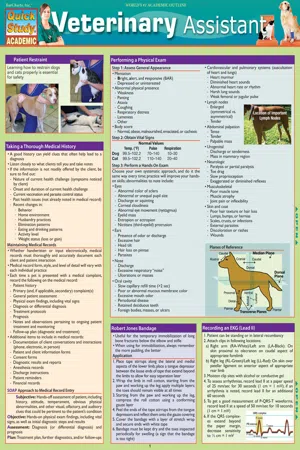
Looking to begin a career in veterinary medicine as an assistant? We're here to help you in achieving this goal with our newest 6 page study guide, which provides the most comprehensive information on properly treating pets in a medical setting. Discussions of various veterinary terms and procedures, as well as useful guidelines and rules, are included within each page; additional information is broken down into full-color images, charts, and graphs for easy reference.
- 44 pages
- English
- ePUB (mobile friendly)
- Available on iOS & Android
eBook - ePub
About this book
Information
Topic
MedicineSubtopic
Veterinary Medicine
Preventive Health Care
Determining Age
- Determining age can be challenging if presented with a stray pet or a pet with an unknown history
- With puppies and kittens, it’s important to verify the age (even if the owner claims to know the age) for the purpose of preventive health-care schedules
- Determining age is not an exact science (unless, of course, you definitively know the date of birth)
- For both puppies and kittens, determine if the animal is still nursing; if not, consider it at least 4 weeks of age
- Ask the owner how long he/she has had the puppy/ kitten in his/her possession, and add 4 weeks to this figure; this gives you a baseline from which to work
- Puppies: Examine the teeth
- If deciduous incisors and canines have not yet erupted, then the puppy is less than 6 weeks of age
- If deciduous incisors and canines are in place yet no permanent teeth are showing, the puppy is 6−11 weeks of age
- Permanent incisors erupt at 12−16 weeks of age
- Permanent canines erupt at 16−20 weeks of age
- A puppy with a full complement of permanent teeth can be considered at least 6 months of age
- Kittens: Examine the teeth or determine body weight:
- Using teeth
- If the deciduous incisors and canines have not yet erupted, then the kitten is 5 weeks of age or less
- If deciduous incisors and canines are in place yet no permanent teeth are showing, the kitten is 6−12 weeks of age
- Permanent front incisors erupt at 12−16 weeks of age
- Permanent canine teeth erupt at 16−20 weeks of age
- A kitten with a full complement of permanent teeth can be considered at least 6 months of age
NOTE: For both puppies and kittens, these are approximate eruption timelines; variations can occur
- Using body weight
- As a general rule, 1 pound of body weight should equal approx. 1 month of age (EX: a 3-pound kitten is 3 months of age)
- This correlation remains valid up to around 5 months of age
- Keep in mind that parasitism or malnourishment can cause a kitten to weigh less than it should for its true age
- Using teeth
Vaccinations
- Dog and cat vaccines are classified as either “core” or “noncore”
- Core vaccines should be given to every pet
- Noncore vaccines are considered optional, and the decision whether to use them should take into account a pet’s breed, geographic location, age, lifestyle, and risk of exposure to the disease agent
- Bacterins (EX: leptospirosis, Lyme) and adjuvanted, killed viral vaccines (EX: rabies, FeLV) pose the greatest risk for vaccine reactions
Dog Vaccines
- Core
- Rabies
- Distemper
- Adenovirus type 2
- Parvovirus
- Noncore
- Leptospirosis
- Bordetella
- Lyme
- Parainfluenza
- Other
Cat Vaccines
- Core
- Rabies
- Viral rhinotracheitis
- Panleukopenia
- Calicivirus
- Noncore
- FeLV/FIV
- Chlamydophila (Chlamydia)
- Other
| Sample Puppy/Kitten Vaccination Series* | Sample Adult Dog/Cat Vaccination Schedule* * May vary between veterinary practices | |||||
| Vaccine Type | 6−8 wks | 10−12 wks | 13−16 wks | 15−16 mos | Annually | Every 3 Years |
| Core | ||||||
| Distemper/ Viral rhinotracheitis | 1st | 2nd | 3rd | 4th | — | Yes |
| Adenovirus type 2/ Panleukopenia | 1st | 2nd | 3rd | 4th | — | Yes |
| Parvovirus/ Calicivirus | 1st | 2nd | 3rd | 4th | — | Yes |
| Rabies (dogs and cats) | — | — | 1st | 2nd | If 1-year licensed vaccine is used | If 3-year licensed vaccine is used |
| Noncore | ||||||
| Leptospirosis (4-way) | — | 1st (12 wks) | 2nd | 3rd | Yes | — |
| Bordetella and parainfluenza (intranasal) | — | 1st (12 wks) | 2nd | 3rd | Annually or semiannually | — |
| FeLV | — | 1st (12 wks) | 2nd (16 wks) | 3rd | Up to 2 years of age | — |
Preventive Deworming
Puppies & Kittens
- All puppies and kittens should be dewormed every month starting at 2−4 weeks of age and finishing at about 16 weeks of age
- A fecal exam should be performed prior to 12 weeks of age to check for coccidia infestation
- Heartworm prevention can be started as early as 8 weeks of age Adult Dogs & Cats
- A negative fecal examination does not necessarily mean a pet is free of intestinal parasites
- Adult dogs should be given heartworm-preventive medication year-round to assist in nematode control
- Adult cats that are allowed to roam and hunt should be dewo...
Table of contents
- Patient Restraint
- Taking a Thorough Medical History
- Performing a Physical Exam
- Robert Jones Bandage
- Recording an EKG (Lead II)
- Drawing Blood & Administering IV Injections (Cephalic Vein)
- Preventive Health Care
- Oncology
- Nutrition
- Dental Care
- Occupational Safety
- Diagnostic Imaging
- Parasitology
- Laboratory
- IV Fluid Rate Calculations
- Pharmacology
- Anesthesia
- Surgery
- CODE BLUE – Emergencies
Trusted by 375,005 students
Access to over 1.5 million titles for a fair monthly price.
Study more efficiently using our study tools.
Frequently asked questions
Yes, you can cancel anytime from the Subscription tab in your account settings on the Perlego website. Your subscription will stay active until the end of your current billing period. Learn how to cancel your subscription
No, books cannot be downloaded as external files, such as PDFs, for use outside of Perlego. However, you can download books within the Perlego app for offline reading on mobile or tablet. Learn how to download books offline
Perlego offers two plans: Essential and Complete
- Essential is ideal for learners and professionals who enjoy exploring a wide range of subjects. Access the Essential Library with 800,000+ trusted titles and best-sellers across business, personal growth, and the humanities. Includes unlimited reading time and Standard Read Aloud voice.
- Complete: Perfect for advanced learners and researchers needing full, unrestricted access. Unlock 1.5M+ books across hundreds of subjects, including academic and specialized titles. The Complete Plan also includes advanced features like Premium Read Aloud and Research Assistant.
We are an online textbook subscription service, where you can get access to an entire online library for less than the price of a single book per month. With over 1.5 million books across 990+ topics, we’ve got you covered! Learn about our mission
Look out for the read-aloud symbol on your next book to see if you can listen to it. The read-aloud tool reads text aloud for you, highlighting the text as it is being read. You can pause it, speed it up and slow it down. Learn more about Read Aloud
Yes! You can use the Perlego app on both iOS and Android devices to read anytime, anywhere — even offline. Perfect for commutes or when you’re on the go.
Please note we cannot support devices running on iOS 13 and Android 7 or earlier. Learn more about using the app
Please note we cannot support devices running on iOS 13 and Android 7 or earlier. Learn more about using the app
Yes, you can access Veterinary Assistant by Chris Pinney in PDF and/or ePUB format, as well as other popular books in Medicine & Veterinary Medicine. We have over 1.5 million books available in our catalogue for you to explore.