History

Zionism
Zionism is a political and cultural movement that emerged in the late 19th century with the aim of establishing a Jewish homeland in the historic land of Israel. It sought to address the persecution and discrimination faced by Jewish communities in Europe and elsewhere. The movement played a significant role in the establishment of the modern state of Israel in 1948.
Written by Perlego with AI-assistance
Related key terms
1 of 5

11 Key excerpts on "Zionism"
 eBook - ePub
Understanding Israel
Political, Societal and Security Challenges
- Joel Peters, Rob Geist Pinfold, Joel Peters, Rob Geist Pinfold(Authors)
- 2018(Publication Date)
- Routledge(Publisher)
If such understandings of Zionism began to develop as early as the 1950s, and were given renewed emphasis during the 1990s when the discourse of “post-Zionism” was at its height, it seems hardly possible to shy away from similar questions in the early twenty-first century. Perhaps historical Zionism—whether it is assessed negatively or positively—has run its course and we are today in a “post-Zionist” age? Can there be any possible meaning to the word today, other than as an indication of some form of Israeli patriotism or, as some would have it, unquestioning loyalty to (usually right-wing) government policies? Of course, disagreements over the reality or desirability of the continued existence of Zionism after 1948 is really a debate over what Zionism in actual fact was (or is), and what it can or cannot be, should or should not be, in historical circumstances in which one of its key desiderata has been fulfilled.Modern Zionism emerged in the nineteenth century, in an age of ideologies and “isms.” It was conceived in response to what was known during that century (and into the first half of the twentieth) as “the Jewish question,” or the “Jewish problem.” In addition to casting itself as a response—in its more ambitious forms, a solution—to the Jewish problem itself, it was also as a response to previous responses, which Zionists deemed to have been partial or complete failures.4 Zionism, in short, was in its very essence a child of the nineteenth century, and an attempt to provide solutions to the predicaments and distress confronting Jews and Jewish life in the nineteenth century. Its aims—though various and at times conflicting—can collectively be deemed revolutionary: It sought a total and complete transformation of Jewish life, culture, social structures; everything from Jewish geography—where Jews lived—to the language they spoke, to so intimate and fundamental a matter such as the Jew’s body itself—were all to be transformed.Despite constituting a child of the nineteenth century, the bulk of Zionism’s achievements would come about over the course of the twentieth century, most notably during its first fifty years, before the ruptures of World War II, and then in its immediate aftermath. By the second half of the twentieth century, it was already a very different world—the changes in Jewish life were particularly dramatic with the transfer of the centers of Jewish life from Eastern Europe to North America and Israel, the establishment of the Jewish state, and the extermination of six million Jews at the hands of the Nazis. The dramatic events that shaped the end of the twentieth century and the beginning of the twenty-first have come at an ever-accelerating pace. All of this raises a critical question regarding Zionism: As a set of proposed solutions to a list of nineteenth- (and perhaps twentieth-) century problems, in what sense can we talk about Zionism in the twenty-first century? Some seven decades after the establishment of the State of Israel, any attempt to assess Zionism in the twenty-first century is equally bound to begin with an attempt to understand just what Zionism has meant and what it might mean today and in the future. eBook - PDF
Zionism and Judaism
A New Theory
- David Novak(Author)
- 2015(Publication Date)
- Cambridge University Press(Publisher)
48 3 Secular Zionism: Political or Cultural? Secular Zionism The modern Zionism that emerged in the late nineteenth century was clearly a secular nationalist movement. The most extreme secularists were openly contemptuous of Judaism or the Jewish religious tradition, thinking that Judaism had turned the Jews into a passive apolitical people, which is a state of mind from which Zionism should liberate the Jews. For these extreme sec- ularists, the Jewish religious tradition was not even owed any thanks, not even retrospectively, as they thought it had made the Jews a passive, apolitical people for far too long. Others, such as the influential Zionist theoretician Jacob Klatzkin (d. 1948), acknowledged that Judaism had performed the great national- ist task of protecting the Jewish national identity of Diaspora Jews from dissolution and assimilation in the past, without which there wouldn’t be any Jews left in the world to actually found a Jewish state when the opportunity to do so did arise in the present. However, with the Enlightenment’s devaluation of all traditional religion (especially Judaism) for modern men and women (especially the Jews), Klatzkin thought that Judaism had done its job for Jewish identity in the past, but is no longer capable of even doing that in the present. What is now needed, he thought, is for Judaism to be replaced by modern Zionism as Secular Zionism 49 true Jewish nationalism itself. So he writes: “To regain our land is for us an end in itself – the attaining of a free national life.” 1 Most tellingly, concerning Judaism, Klatzkin insists: “God has no heir (yoresh).” 2 He then goes on to speak of “a new criterion for Judaism, a nationalist criterion [behinah l’umit] for departing from Judaism.” 3 Even many religious Zionists affirmed the primacy of nation- alism for the Jewish people. eBook - PDF
- Alan Dowty(Author)
- 2004(Publication Date)
- Praeger(Publisher)
In modern times, Jewish political activity entered a new phase. In mid- 19th-century North America and western Europe, where European Jews benefited from emancipation and economic mobility, Jews founded defense organizations and agencies that lobbied on behalf of their oppressed brethren in Romania, Russia, and the Middle East. In the Pale of Settlement, the 1880s and 1890s witnessed the birth of radical Jewish politics, which mooted a wide variety of solutions to the "Jewish Problem," ranging from territorial nationalism to communist internationalism. Zionism's revolu- tionary rhetoric and call for the use of force in self-defense were part of the warp and woof of Jewish politics in eastern Europe. Many other aspects as- sociated with the Zionist movement—political factions, mass member- ships, using the press and the pamphlet to marshal public opinion—were developed prior to and alongside of international Zionism. The conditions of sovereignty in Israel transformed the means by which Jews exercise power, but the psychological underpinnings of cen- turies of Jewish political behavior were still in place. In his recent book The Jewish State: A Century Later, Alan Dowty notes that Israeli politics is in- formed by the Jews' traditional fear of Gentiles, sense of perpetual vulner- ability and imminent catastrophe, and unwillingness or inability to conceive of Gentiles (here, Arabs) as a collectivity with equal status to the Jews. This sense of isolation strengthened greatly after 1977, with the ac- cession to power of the Likud Party and its leader, Menachem Begin, who, as I will discuss in the section "Historical Consciousness," made the Holo- caust central to Israeli political discourse. eBook - PDF
The Martin Buber Reader
Essential Writings
- A. Biemann(Author)
- 2016(Publication Date)
- Palgrave Macmillan(Publisher)
Zionism and Nationalism (1929)*1 There are not only two fundamental views regarding the national problem and the national reality, as it is often claimed, but three: The first view, the view of the so-called non-Zionists, argues that Israel is less than a nation in the modern sense. The second view argues that Israel is iden ti- cal with anation. And the third argues that Israel is more than a nation; in other words, the national characteristics of the modern concept of a nation apply also to the reality of Israel but do not suffice. Israel is a unique creation [Gebilde] that includes all characteristics of a nation in the modern sense, without being defined by them; rather, it carries its own laws .... Zionism is not identical with Jewish nationalism. We are very right to call ourselves Zionists and not Jewish nationalists; for Zion means more than nation. Zionism is the belief in a uniqueness. "Zion" is no generic term like "nation" or "state," but a name that denotes something unique and incomparable. Nor is it a mere geographical expression like Canaan or Palestine. eBook - ePub
- Ernest Krausz(Author)
- 2017(Publication Date)
- Routledge(Publisher)
The tendency of the Yishuv to segregate itself to the point where it became an autonomous social entity also arose out of ideological imperatives. Even the common cultural basis of the Yishuv —the Hebrew language—emerged as a modern spoken language not through a gradual process of evolution, but through a deliberate process of cultivation itself ideologically motivated. One definition of ideology states it is a set of “ideas by which men posit, explain, and justify ends and means of organized social action with the aim to preserve, amend, uproot or rebuild a given reality.” 1 If we accept this definition, then the uniqueness of the Yishuv lies in that the fact that its very existence was the outcome of “organized social action” aimed at a deliberate transformation of reality. This approach can also clarify the relation between ideology and the institutional organization of the Yishuv. For the most part, this organization was not the product of the social and historical heritage of an established community, but the outcome of conscious action on the part of different movements which joined on a common ideological basis. The most comprehensive ideological framework was the concept of “Zionism” in its broadest sense: the drive to establish a national center for the Jewish people in the Land of Israel through a process of immigration and settlement, and to form an autonomous community possessing its own political and cultural distinctiveness. Beyond this broad consensus, Zionism split into a number of political and ideological movements which differed from one another regarding “minimalist” or “maximalist” approaches, different visions of the new Jewish society to be created, and different views about the appropriate means for the realization of Zionist goals. The fact that the fulfillment of Zionism depended upon the construction of a new society made Zionism an ideology of radical change, although its adherents included conservatives
- Tomis Kapitan(Author)
- 2015(Publication Date)
- Routledge(Publisher)
The Zionist imperative to have a state for the Jewish people is itself a rejection of liberalism. So conformity with the liberal idea of the state as equal handed as between members of different ethnic groups is upheld, by Ben-Gurion, only by subterfuge. This solves neither the moral problem of discrimination nor the political problem of discrimination. For, the World Zionist Organization/Jewish Agency is, though not de jure, at least de facto, an integral part of the Jewish state, being effectively controlled by the government (Mallison 1968, 556–629). It will be useful to list other instances in which this tension is evident. They serve to make clear that the Zionist nature of the state of Israel is, in the circumstance of ethnic diversity, an impediment to equality. But first a clarification of the Zionist nature of the Israeli state. In saying that the state of Israel is Zionist in nature, I mean that it is a state designed to provide the Jews with the basic conditions for promoting what the state itself sees as the interests of the Jews as an ethnic group. Under different circumstances the basic conditions for realizing this ultimate end would be quite different. They would be different where there are no ethnic competitors for the land from what they would be where there is ethnic diversity. In the period immediately after the UN Partition Resolution of 1947, the actual circumstances were that the Jews were not the only people on the land they thought they had a right to. In fact, they were a minority on that land. A process of state formation on the basis of the Jewish community in Palestine—the Yishuv—was already under way. The Jews traced their rule over the land to the time of the Jewish kingdom of David and Solomon, some 3,000 years earlier eBook - PDF
Israel's Jewish Identity Crisis
State and Politics in the Middle East
- Yaacov Yadgar(Author)
- 2020(Publication Date)
- Cambridge University Press(Publisher)
5. 17 Gavison, The Law of Return, 98. 18 Gavison, The Law of Return, 97–8, 165ff. 48 Politics of Religious Conversion and Limits of Zionist Nationhood political culture (or, for that matter, even a ‘commonsensical’ notion of nationalism) would take as the primary meaning of a national Jewish identity, such as knowledge of the Hebrew language, the political history of Jews, and the civic working of the Israeli state, as well as active participation in public, national life. The paradox entailed herein is that Zionist thought tended to view Jewish religion – the onus of this conversion process – as a malaise, a debilitating exilic yoke put on the back of the Jewish nation, which inhibits, instead of invigorating, the nation’s political agency. The political culture upheld by the state thus encourages the non-Jew (who is not a Palestinian-Arab) to become a Jew, as in a member of the Jewish nation, directs her to the Rabbinate for this act of conver- sion, and dismisses the essential meaning entailed in the rabbinic process as archaic religious mambo-jumbo, that has nothing to do with modern, national, political Jewish identity, which is often mani- fested in the notion of ‘Israeliness.’ No wonder, then, that an insightful ethnographer titles the whole procedure as a series of ‘winks.’ 19 In passing, I should note that a more substantially meaningful defin- ition of Jewish politics, or of collective Jewish political identity and agency, such that would culminate in an understanding of the state as ‘Jewish’ – as in manifesting or embodying a meaningfully charged sense of a Jewish ‘essence’ (whatever this may be) – is in principle liberated from the demographic concerns that so preoccupy the state of Jews. eBook - PDF
When Politics are Sacralized
Comparative Perspectives on Religious Claims and Nationalism
- Nadim N. Rouhana, Nadera Shalhoub-Kevorkian(Authors)
- 2021(Publication Date)
- Cambridge University Press(Publisher)
Thompson, Gardner. 2019. Legacy of Empire: Britain, Zionism, and the Creation of Israel. London: Saqi Books. Trabulsi, Fawwaz. 1969. “The Palestine Problem: Zionism and Imperialism in the Middle East.” New Left Review (September–October): 53–90. 86 Nadim N. Rouhana UN News. 2017. “General Assembly Demands All States Comply with UN Resolutions Regarding Status of Jerusalem.” December 21. https://news.un.org/en/story/2017/12/ 640152-general-assembly-demands-all-states-comply-un-resolutions-regarding-status. Veracini, Lorenzo. 2006. Israel and Settler Society. London: Pluto Press. 2019. “Israel-Palestine through a Settler-Colonial Studies Lens.” Interventions 21, no. 4: 568–81. Whitelam, Keith. 1996. The Invention of Ancient Israel: The Silencing of Palestinian History. New York: Routledge. Wolfe, Patrick. 2006. “Settler Colonialism and the Elimination of the Native.” Journal of Genocide Research 8, no. 4: 387–409. 2012. “Purchase by Other Means: The Palestine Nakba and Zionism’s Conquest of Economics.” Settler Colonial Studies 2, no. 1: 133–71. Yiftachel, Oren. 2002. “‘Ethnocracy’: The Politics of Judaizing Israel/Palestine.” Constellations 6, no. 3: 363–90. Zreik, Raef. 2016. “When Does a Settler Become a Native? (With Apologies to Mamdani).” Constellations 23, no. 3: 351–64. Religious Claims and Nationalism in Zionism 87 4 On the Uses and Abuses of Tradition Zionist Theopolitics and Jewish Tradition Yaacov Yadgar INTRODUCTION One of the intriguing curiosities of the human sciences – especially social sciences – is the persistence of the religious-secular binary. Although this conceptual dualism has been critically deconstructed and shown to be misleading, the discourse it produces endures. Critical studies of the history, politics, epistemology, and ontol- ogy of the religious-secular dichotomy have convincingly proven that “religion,” “secular,” “politics,” and other categories adjoining this dichotomy are far from universal, ahistorical, neutral facts of humanity. eBook - ePub
The Invention of the Land of Israel
From Holy Land to Homeland
- Shlomo Sand, Geremy Forman(Authors)
- 2013(Publication Date)
- Verso(Publisher)
Contrary to the consensus that has taken form and deepened within Israeli society, particularly after the conquests of 1967, these scholars have all maintained that the Jews have connections to “the Land” in its entirety and have national rights in “the Land,” but do not possess rights to all “the Land.” This distinction may be important, as it stems from a moral sense of discomfort vis-à-vis ongoing control over a population that enjoys no rights, and yet it has never proved capable of translating itself into meaningful and effective politics. The primary reason for this was that most intellectuals of the later Zionist leftfailed to understand that, although religious connections did not necessarily have to be translated into rights, ties of ownership in patriotic garb did, as such rights are always included within the paradigms of ownership over homeland territories, and these paradigms are deeply embedded in all national pedagogies. That is to say, in the case of Israeli political culture, the area considered to constitute the Land of Israel is ultimately regarded as the property of the Jewish people, and abandoning parts of this imagined land is considered the equivalent of an owner of private property willingly giving up some of his assets. While such a scenario is of course possible, most people would agree that it is nonetheless rare and problematic.Despite the rationalizing discourse that has accompanied it since its inception, Zionist colonization never spent much time on ethical nuances that had the potential to limit or even to entirely prevent its hold on the land. As with all other colonizations, the only boundaries that have restrained the Zionist enterprise have been those dictated by the limits of its own power, not those resulting from concessions or from the quest for pacific compromise with the local inhabitants.We still know very little about the meaning of the “concession” of property in Zionist thought, which now brings us to two additional questions: (1) According to the Zionist imagination, what tracts of land have, without question, always belonged to the Jewish people? 2) What land did the nationalist vision deem sacred, and did this land ever have concrete borders?ZIONIST GEOPOLITICS AND THE REDEMPTION OF THE LANDSettlement Zionism, which borrowed the term “Land of Israel” from the Talmud, was not overly pleased with the borders it had been assigned by Jewish law. As already noted, the lines that cordoned off sacred land were short, extending only from Acre to Ashkelon. Furthermore, the land contained by these boundaries was not sufficiently contiguous to serve as a national homeland. For the Olei Bavel eBook - PDF
History Of Zionism
A Handbook And Dictionary
- Hershel Edelheit(Author)
- 2019(Publication Date)
- Routledge(Publisher)
Rather, they fit themselves into the already existing pattern of Jerusalem Jewry? 5 The same held true for the trickle of Jews who immigrated during the years before 1880: They augmented an already existing community and kept Eretz Israel relevant to the Jewish psyche worldwide.7 6 By way of summary we may note three elements that predated the rise of Zionism in the nineteenth century. (1) Jews in all eras considered Eretz Israel to be a national home and, more importantly, a land of national destiny to which they would 13 ultimately return. (2) Regardless of conceptual changes in their definition of the nation and of national redemption, Eretz Israel remained central to Jewish nationalism throughout the eras. (3) Finally, although this cannot be fully elucidated here, a Jewish presence in Eretz Israel existed virtually throughout the era discussed here. The centrality of Eretz Israel to the Jewish people even found an echo in non-Jewish writings in the early modern era, most prominently in Napoleon's call for Jews to return to Eretz Israel under the sponsorship of revolutionary France? 7 At the time, however, Jews were involved in an experiment with a different defmition of redemption, namely civic emancipation and assimilation. That effort would transform the Jewish people and would, ironically, give a new impetus to a revolutionized Jewish nationalism. 14 Land and State in Jewish Tradition Notes All translations from the Bible and the Talmud are the authors' unless otherwise noted. 1. For an overview of the history of the Holocaust, see Abraham J. Edelheit and Hershel Edelheit, History of the Holocaust: A Handbook and Dictionary (Boulder: Westview, 1994). 2. Cf. Martin Sicker, Judaism, Nationalism, and the Land of Israel (Boulder: Westview, 1992) p. x, and, more broadly, Daniel J. Elazar and Stuart A. Cohen, The Jewish Polity: Jewish Political Organization from Biblical Times to the Present, Bloomington: University of Indiana Press, 1985.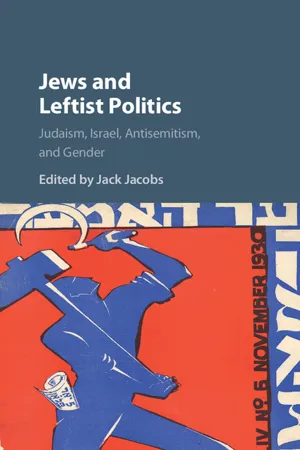 eBook - PDF
Jews and Leftist Politics
Judaism, Israel, Antisemitism, and Gender
- Jack Jacobs(Author)
- 2017(Publication Date)
- Cambridge University Press(Publisher)
In this chapter I have shown that as long as it was politically correct to do so, the Zionist settlers referred openly to their aims and institutions in colonial terms; that Zionist 51 Golan, “European Imperialism,” pp. 140–141. 52 Shlaim, “Balfour Declaration,” p. 260. 118 Yoav Peled practices were very much in line with colonial practices of exploiting and/ or excluding the indigenous population; and that Great Britain did func- tion as the Zionists’ “mother country,” albeit with the adjustments required by the specific conditions of Palestine at the time. Moreover, viewing Zionism as a colonial settlement movement, I would argue, not only accounts more successfully for the historical evidence, it help us better understand contemporary Israel as well. Opponents of the colonial thesis are hard pressed to explain, for example, Israel’s policy of settlement in, and permanent occupation of, the Pales- tinian territories captured in 1967, which many of them consider to be a colonial policy. Thus Lissak hints at “great changes” that took place in the character of the Zionist movement after 1967, but avoids trying to explain them: Notwithstanding the existence of similarities in certain respects between the Jewish settlement and one or another form of colonialism, this similarity was purely structural, and did not affect one way or another the unique character of the Zionist movement. This situation remained more or less true until 1967, but a discussion of the great changes which took place in this outlook at that time goes beyond the parameters of the present paper. 53 One easy explanation that comes to mind would point to the fact that the Labor Zionist movement lost control over the Israeli state in 1977 and Revisionist Zionism that took over has indeed pursued a policy of colo- nial settlement.
Index pages curate the most relevant extracts from our library of academic textbooks. They’ve been created using an in-house natural language model (NLM), each adding context and meaning to key research topics.

