Politics & International Relations

Frantz Fanon
Frantz Fanon was a prominent psychiatrist, philosopher, and revolutionary from Martinique. He is best known for his influential works on the psychological and social effects of colonization, particularly in his book "The Wretched of the Earth." Fanon's writings have had a significant impact on postcolonial studies and critical theory, and his ideas continue to be influential in discussions of power, oppression, and decolonization.
Written by Perlego with AI-assistance
Related key terms
1 of 5

10 Key excerpts on "Frantz Fanon"
 eBook - PDF
- Grant J. Rich, Uwe Gielen, Grant J. Rich, Uwe P. Gielen(Authors)
- 2015(Publication Date)
- Information Age Publishing(Publisher)
PART V OVERCOMING AFRICA’S COLONIAL HERITAGE AND RACISM Pathfinders in International Psychology, pages 229–240 Copyright © 2015 by Information Age Publishing All rights of reproduction in any form reserved. 229 CHAPTER 15 Frantz Fanon Architect of a Psychology of Oppression and Liberation Chalmer E. Thompson The well-being and the progress of Europe have been built up with the sweat and dead bodies of Negroes, Arabs, Indians, and the yellow races. We have decided not to overlook this any longer. —The Wretched of the Earth, Frantz Fanon (1961) The worldwide popularity of Frantz Fanon’s writings in the 52 years since his death in 1961 may come as a surprise to many. For one, he died at a young age, 36 years, and therefore did not have the opportunity that many other pioneers enjoyed in contributing to the profession after years of study. Two, Fanon spoke and wrote unapologetically about the need for the colonized people of the world to combat the violence exacted on them with violence. As psychology and psychiatry are professions steeped in Eurocentric tradi- tions, such attention would certainly (and has) garnered heavy criticism and rejection in some circles. Despite the relatively short span of his life, Fanon transformed the con- ventional practice of “colonial psychiatry” in his time, wrote extensively as a political strategist for the Algerian Front de Liberation Nationale (FLN; 230 C. E. THOMPSON National Liberation Front), and authored widely read books which would eventually become essential reading in postcolonial studies programs. Fanon is known to have influenced activists throughout the world including Che Guevara, Amilcar Cabral, Agostinho Neto, Nelson Mandela, Kwame Nkrumah, Mehdi Ben Barka, Steven Biko, Malcolm X, and Patrice Lumum- ba (Fanon-Mendès France, 2012; Turner & Alan, 1986), as well as members of the U.S. eBook - PDF
- G. Martin(Author)
- 2012(Publication Date)
- Palgrave Macmillan(Publisher)
4 The Algerian Revolution Frantz Fanon has been viewed in turn as psychiatrist, psychoanalyst, phi- losopher, political analyst, journalist-propagandist, and cultural critic. Such exceptional eclecticism and multidisciplinarity emerge clearly from the T h e P o p u l i s t- S o c i a l i s t I d e o l o g y 107 abundant corpus of scholarship on Fanon. What could be called the “first generation” of Fanonian studies (from the late 1960s to the mid-1980s) includes three major biographies and intellectual portraits; 5 in addition, it includes a number of pathbreaking studies on Fanon’s social and political thought. 6 The “second generation” of Fanonian studies, emerging at the dawn of the twenty-first century, includes a number of works that revisit and reinterpret Fanon’s life, times, and thought from a variety of postmodern- ist and postcolonial perspectives. 7 This chapter relies essentially on the first generation of Fanonian studies, focusing specifically on Fanon’s social and political thought. Fanon had a limited knowledge of African societies; he relied mostly on his impressions and intuition to provide “penetrating insights into the social dynamics of political conflict in postcolonial Africa.” 8 In his various writ- ings, Fanon insists on the fact that any liberation movement (or govern- ment) should have a specific doctrine, clearly defined goals and objectives, and some kind of blueprint: “Things must be explained to [the people]; the people must see where they are going, and how they are to get there . . . a program is necessary for a government which really wants to free the people politically and socially .
- H. Dekker, C. Kinnvall, T. Capelos, P. Nesbitt-Larking, C. Kinnvall, T. Capelos, P. Nesbitt-Larking(Authors)
- 2016(Publication Date)
- Palgrave Macmillan(Publisher)
Part III Themes 8 Lessons from the Postcolony: Frantz Fanon, Psychoanalysis and a Psychology of Political Critique Ross Truscott and Derek Hook Introduction In this chapter, we explore some of the possibilities and dilemmas in forging a psychology of the postcolonial, placing psychoanalysis – specifically Frantz Fanon’s (1952) Black Skin, White Masks, the most explicit psychoanalytical of his works – at the centre of such a prospective form of political psychology. Fanon’s work can be taken as a founding event for a postcolonial psychology, both a point of origin and a definition of what such a field of critical praxis might entail. To be specific, it is his ambivalent relation to psychoanalysis, his repe- tition of its concepts – aware always of their potential to transmit, re-inscribe and reify certain ideologically loaded Eurocentric ideas – against their origins, as it were, that we want to emphasise here. 1 As we are proposing a psychology of the postcolonial drawing on psychoanalytic ideas, it is worth noting at the outset the discordant relationship between psychology and psychoanalysis. Although associated in the popular imagination, psychoanalysis emerged not in the discipline of psychology but within and against nineteenth-century psychiatry – and Fanon himself was a psychiatrist. Freud did, of course, refer to psychoanalysis as a branch of psy- chology (e.g. Freud, 1895, 1933), and, significantly, his writings were published in English, edited and translated by James Strachey, as the Standard Edition of the Complete Psychological Works of Sigmund Freud. What should not be overlooked, though, is that it was only later, following the much resisted ‘question of lay analysis’ (see Freud, 1926a), the question of whether non-medically trained Ross Truscott acknowledges the financial support of the National Research Foundation 127 eBook - ePub
Identification Papers
Readings on Psychoanalysis, Sexuality, and Culture
- Diana Fuss(Author)
- 2013(Publication Date)
- Routledge(Publisher)
5
INTERIOR COLONIES :FRANTZ FANON AND THE POLITICS OF IDENTIFICATION
I CONCLUDE THIS BOOK ON IDENTIFICATION with two claims: first, that identification has a history—a colonial history; and second, that this colonial history poses serious challenges for contemporary recuperations of a politics of identification. I do not mean to imply that identification, a concept that receives its fullest elaboration in the discourse of psychoanalysis, cannot be successfully mobilized for a radical politics. I mean only to suggest that if we are to begin to understand both its political usages and its conceptual limitations, the notion of identification must be placed squarely within its other historical geneologies, including colonial imperialism. To assist me in this reading, I turn to one of the most important twentieth-century writers working at the intersection of anti-imperial politics and psychoanalytic theory, the practicing psychiatrist and revolutionary philosopher, Frantz Fanon. Psychoanalysis’s interest in the problem of identification provides Fanon with a vocabulary and an intellectual framework in which to diagnose and to treat not only the psychological disorders produced in individuals by the violence of colonial domination but also the neurotic structure of colonialism itself. At the same time, Fanon’s investigation of the dynamics of psychological alterity within the historical and political frame of colonialism suggests that identification is neither a historically universal concept nor a politically innocent one. A byproduct of modernity, the psychoanalytic theory of identification takes shape within the larger cultural context of colonial expansion and imperial crisis.Imperial Subjects
Contemporary theories of racial alterity and difference owe much to the rethinking of self-other relations that Fanon elaborates in his anticolonialist treatise, Black Skin, White Masks (1952). Most prominently, Edward Said’s enormously influential theory of orientalism, which posits the Muslim “Orient” as a phobic projection of a distinctly Western imaginary,1 echoes elements of Fanon’s own theory of colonial psychopathology in which the black man is subjugated to the white man through a process of racial othering: “for not only must the black man be black; he must be black in relation to the white man.”2 Assigned the role of embodying racial difference within a colonialist metaphorics of representation, the black man becomes for the white man the repository of his repressed fantasies, “the mainstay of his preoccupations and his desires” (B, 170). Under colonialism, Fanon contends, “the real Other for the white man is and will continue to be the black man” (B, 161).3 Yet significantly complicating this notion of “Black as Other” is a rather different reading of alterity in Fanon’s work with potentially even greater import for an anticolonialist politics. In this second theory of white-black relations, Fanon implicitly disputes his own initial formulation of racial alterity and asks whether, in colonial regimes of representation, even otherness may be appropriated exclusively by white subjects. Fanon considers the possibility that colonialism may inflict its greatest psychical violence precisely by attempting to exclude blacks from the very self-other dynamic that makes subjectivity possible. This alternative theory of (non)alterity elaborated in Black Skin, White Masks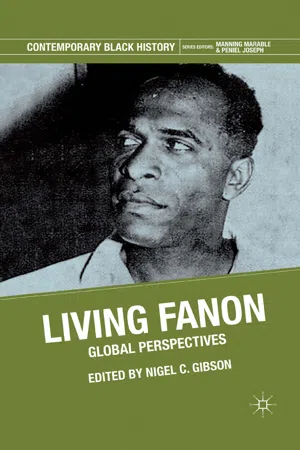 eBook - PDF
Living Fanon
Global Perspectives
- F. Fanon, F. Fanon, Kenneth A. Loparo, Nigel Gibson, F. Fanon, Nigel Gibson(Authors)
- 2016(Publication Date)
- Palgrave Macmillan(Publisher)
His name is mentioned by all Algerian intellectuals, yet leaves a bitter taste in the mouth. Fanon is famous for having been a hero/martyr, who died fighting for the cause of the oppressed, or the “natives.” However, in the light of such heroic recognition, his name becomes twice as powerful while his thought fades into the background. Fanon repeatedly warns of the risks of reproducing history, and of 154 KARIMA LAZALI sheltering within the self a submissiveness from which people had freed themselves in order to become subjects. Now this preoccupation becomes more relevant than ever, yet the fact that this is a preoccupation of the future, more so than of the past, tends to be ignored. I settle here for unraveling in what respects and how Fanon, as a clinician, invites everyone to take part in a great construction—that of the writing or rewriting of a collective history—in order to become an (authorial) subject, no longer in a position of servility. This involves refusing the predominance of one sole version of history in favor of a more ambiguous plurality that is open to interpretation, discussion, and even to the incessant dialogue between the self and the Other. For Fanon the psychiatrist, colonization represented an attack on the dignity of the person and on recognition of the person as a familiar figure. Indeed, a (dominant/ dominated) “us” and “them” is created within a relationship of impossible encounters and radical asymmetry (1991:132). What is excluded in a situation of colonial domi- nation is the possibility to hold one’s own in interpersonal exchanges, or a relation- ship of reciprocity between the self and the Other. This worldview obeys a division between humans and subhumans, between citizens and subcitizens. Though for some an unlimited appropriation is authorized, others are subjected to emptied homes and an imposed language, and are forbidden from moving around circulating the city. eBook - PDF
Postcolonial Theory and Psychoanalysis
From Uneasy Engagements to Effective Critique
- Mrinalini Greedharry(Author)
- 2008(Publication Date)
- Palgrave Macmillan(Publisher)
15 1 The Fanonian Psychoanalytic It seems obvious that any investigation of the relationship between postcolonial theory and psychoanalysis must begin with the work of Frantz Fanon. For some commentators, this is largely because of his psychoanalytically influenced book, Black Skins White Masks. For others, it is because of his sometimes experimental and often-politicized psychiatric practice in the Blida-Joinville hospital in colonial Algeria. However, though we readily acknowledge Fanon’s engagement with psychoanalysis and psychiatry, we have given relatively little atten- tion to how his engagement functioned as a strategy rather than an endorsement of psychological and psychoanalytical theories and methods. It may seem counter-intuitive to make this assertion at a time when those of us who read postcolonial studies are most familiar with Homi Bhabha’s reading of Fanon’s work. Bhabha presents us with a Fanon who ‘speaks most effectively ... from deep within the struggle of psychic representation and social reality’ (Location of Culture 183). There is no doubt that, for Bhabha, Fanon writes in the language of psychoanalysis. As commentators such as Henry Louis Gates, Robert Young and Neil Lazarus have noted, where Fanon does not conform to Bhabha’s creation of him, Bhabha excuses him and carries on. So it is that Bhabha’s Fanon ‘lapses’ into existentialist moments (‘Black Man’ 118), and reading Fanon’s re-reading of Lacan he finds Fanon, ‘turns too hastily from the ambivalences of identifi- cation to the antagonistic identities of political alienation and cul- tural discrimination’ (‘Black Man’ 121). Depending on one’s approach to Fanon, Bhabha’s wilful attempt to turn Fanon into a Lacanian psychoanalyst of colonial and racist cul- ture is either, as Gates suggests, ‘an oddly touching performance of a coaxing devotion’ (460), or as Cedric Robinson writes, less kindly, ‘an ungracious conceit’ (79). eBook - PDF
- Simon Clarke(Author)
- 2017(Publication Date)
- Red Globe Press(Publisher)
99 CHAPTER 7 Colonial Identity and Ethnic Hatred: Fanon, Lacan and Zizek Introduction How can psychoanalysis help us understand the construction of colonial identity? Why choose to hate? Why do we fear the theft of our enjoyment? In this chapter I examine some of the philosophical and theoretical developments in the area of racism, hatred and colo-nial identity-formation through the lens of the work of Frantz Fanon, Jean-Paul Sartre, Jacques Lacan and Slavoj Zizek. In some sense this chapter provides a bridge between Freudian, post-Freudian and object-relations schools in the practical application of psychoanalytic theory. Frantz Fanon, as Joel Kovel (1970) has noted, is in some respects the most powerful voice to have articulated the emerging con-sciousness of black peoples across the world (see Kovel, 1970: 65). In Black Skin White Masks, Fanon draws on the psychological work of Sigmund Freud, Jacques Lacan and Jean-Paul Sartre to explain the position of the ‘black man in the dominant white world’. Fanon suggests that it would be interesting to investigate how the image of the white person develops in relation to the black person with ref-erence to Lacan’s notion of the mirror stage. I start this chapter by examining Fanon’s work and in particular the influence of Jean-Paul Sartre’s existential philosophy in the development of the concept of ‘Negrophobia’. Using, as Fanon suggests, Lacan’s notion of the mirror stage I highlight the way in which colonial black identity is constructed in relation to ‘whiteness’, before going on to argue that the mirror has a double edge; the black person is persecuted as ‘other’ and oppressed as ‘I’. I also provide a brief introduction to Slavoj Zizek’s Lacanian philosophical commentaries on ethnic and intergroup hatred. Zizek’s work is an exemplar of the synthesis of psychoanalytic and sociological theory used in practical explanation of social phenomena. eBook - PDF
Symbolic Violence
Conversations with Bourdieu
- Michael Burawoy(Author)
- 2019(Publication Date)
- Duke University Press Books(Publisher)
Fanon expressed vividly what would indeed come to pass in postcolonial Africa. This was no empty speculation; it was how things turned out. By painting the national bourgeois road in such dire colors, Fanon hopes to convince us that the only progressive road is that of national liberation—the revolutionary transformation of the class structure and the realization of a participatory socialism. But how feasible was this? Even if the revolutionary forces won hegemony, could they bring about Fanon’s participatory socialism? Leaving aside colonial legacies that cannot be sim-ply swept aside—the argument of Bourdieu and others—what about inter-national forces? Fanon rather optimistically argued that postcolonial Africa can insist on and enforce reparations from Western capitalism, because the latter needs what Africa has to offer—not just its natural resources but also its consumer markets. Fanon was naive about the possibilities of participa- Colonialism and Revolution 91 tory socialism, but the naïveté sprang from a desperation that saw the pit-falls of the national bourgeoisie. Both Bourdieu and Fanon have a fascination with the peasantry and deploy that fascination for a critical analysis of contemporary socie-ties. Bourdieu creates a romantic anthropology of the Algerian peasantry that becomes the basis for his functionalist analysis of symbolic violence in French society. Fanon has his own romance, projecting the peasantry as a revolutionary class that will usher in participatory socialism. It is a romance inspired by what he sees as the degeneration of postcolonial Africa if it fol-lows the national bourgeois road. BETWEEN REVOLUTIONARY OPTIMISM AND CRITICAL PESSIMISM The conversation between Fanon and Bourdieu shows how theoretical in-fluences circulate between colony and metropolis, but especially the influ-ence of the colony on the metropolis.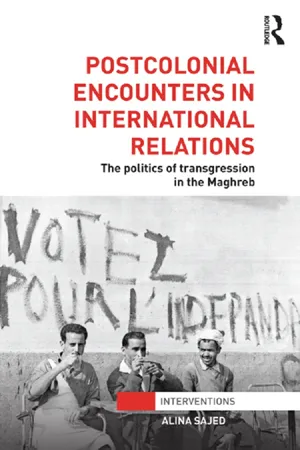 eBook - ePub
Postcolonial Encounters in International Relations
The Politics of Transgression in the Maghreb
- Alina Sajed(Author)
- 2013(Publication Date)
- Routledge(Publisher)
This critique, however, should not be read as a denial of hybridity or the embrace of monolithic oppositional identities. Rather it should be seen as a call for political solidarity in the context of the Algerians’ anticolonial war or as an injunction for colonized intellectuals to locate (not vacate) their politics. Fanon himself never disavowed his Martinican-ness, but he did not shirk away from situating himself politically as Algerian’. Criticisms such as David Scott’s deny Fanon’s conceptualization of anticolonial liberation its crucial tension between the awareness of ‘cultural heterogeneity’ and thus of the instability of ‘national culture’, and the need for ‘political solidarity’ vital in the act of decolonization (Benita Parry, quoted in Rao 2010: 130). 32 Given Fanon’s move between calls for solidarity and endorsement of armed struggle (and thus a vision of transcendence of colonial violence), and his cautionary (indeed visionary) analyses of postcolonial woes (and thus his awareness of the limits of this transcendence), it is not far-fetched to make the claim that this is a tension that continues to sustain the postcolonial/decolonial project eBook - ePub
Being Apart
Theoretical and Existential Resistance in Africana Literature
- LaRose T. Parris(Author)
- 2015(Publication Date)
- University of Virginia Press(Publisher)
Black Skin, White Masks to address several related aspects of the colonial encounter. He proposes that the colonial subject’s inferiority complex has been created by the history, politics, and culture of European empire and colonialism. He also posits the colonial subject’s self-alienation as the direct result of an oppressive environment stemming from the history and culture of European domination. It is no wonder that this aspect of Hegelian discourse held allure for Fanon, as it probes the connection between human alienation and world history in its recognition that “the particular form of alienation experienced by an individual depends upon his situation in world history and cannot be overcome save as historical-cultural processes follow out of the logic of their development” (Schrader 14). For Fanon, it seems that Hegel established the ideal conceptual framework with which to comprehend colonized subjects’ self-alienation as a product of global historical, cultural, and political forces.Human Recognition and Liberation
Fanon adapts Hegelian dialectics to the modern colonial predicament. Alienation becomes the colonial subject’s disalienation, a state of self-hatred created by the history and culture of European empire, and a state of (internalized) oppression that can be overcome only through the historical process of decolonization. This process of radical historical and societal change may be catalyzed through the antithesis of the colonial inferiority complex: a liberated consciousness that catalyzes the colonial subject’s quest for Freedom. This Freedom may be attained through a confrontation, indeed a demand for human recognition from the colonizer. Fanon distills key points from Hegel’s Phenomenology of the Mind to interpret the problematic of human recognition for the colonized by the colonizer. In Fanon’s estimation, Hegel stresses, “Man is human only to the extent to which he tries to impose his existence on another man in order to be recognized by him. As long as he has not been effectively recognized by the other, that other will remain the theme of his actions. It is on that other being, on recognition by that other being that his own human worth and reality depend. It is that other being in whom the meaning of his life is condensed” (Black Skin, White Masks 216–17). In the colonial setting, Fanon asserts, the colonizer will remain the principal catalyst of the colonized subjects’ actions until the colonizer recognizes natives as human; furthermore the meaning of the natives’ lives is located in the colonizer’s willful denial of their humanity. Unless the colonizer recognizes and acknowledges the natives’ humanity a violent confrontation will ensue: “It is solely by risking life that freedom is obtained; only thus is it tried and proved that the essential nature of self-consciousness is not bare existence” (Hegel qtd. in Black Skin, White Masks
Index pages curate the most relevant extracts from our library of academic textbooks. They’ve been created using an in-house natural language model (NLM), each adding context and meaning to key research topics.

