Politics & International Relations

H. L. Mencken
H. L. Mencken was an influential American journalist, essayist, and critic known for his acerbic wit and scathing commentary on American politics and culture. He was a prominent figure in the "Lost Generation" and a fierce advocate for freedom of speech and individual liberty. Mencken's writing often challenged conventional thinking and exposed the hypocrisies of society, making him a controversial but respected figure in American intellectual circles.
Written by Perlego with AI-assistance
Related key terms
1 of 5


5 Key excerpts on "H. L. Mencken"
 eBook - PDF
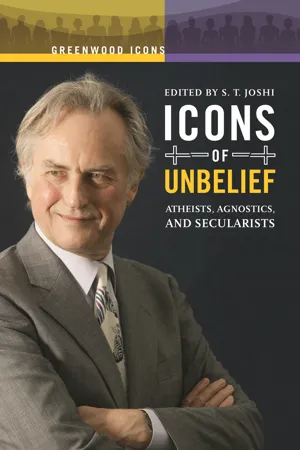
Icons of Unbelief
Atheists, Agnostics, and Secularists
- S. T. Joshi(Author)
- 2008(Publication Date)
- Greenwood(Publisher)
H. L. Mencken S. T. Joshi In a career as journalist and cultural critic that spanned nearly fifty years, Henry Louis Mencken (1880–1956) waged a relentless battle against religion and its unwarranted incursions into the realms of science, politics, and soci- ety. A native and lifelong resident of Baltimore, Mencken received no formal schooling after graduating from high school; instead, he immediately entered journalism, working first as a reporter for the Baltimore Herald and then, beginning in 1906, for the Baltimore Sun, a paper he helped to raise to inter- national prominence until he was forced to retire for health reasons in 1949. In 1910 he assisted in the founding of the Baltimore Evening Sun, and it was for this paper that he did the bulk of his newspaper writing. Mencken also gained celebrity as editor of and voluminous contributor to (mostly in the form of book reviews) the Smart Set (1908–1923) and the American Mercury (1924–1933). Because Mencken was almost entirely self-taught, he occasionally gives the impression of a cracker-barrel philosopher, tossing off outrageous or controversial statements in a deliberate attempt to provoke his audience. Mencken’s penchant for satire, parody, and whimsy, along with his modified use of what he called the “American language”—a language that eschewed the stodgy dignity of formal English by the use of racy slang, colloquialism, and neologisms—can occasionally make him seem flippant and irreverent and can also make it difficult to ascertain with exactitude the beliefs he him- self espoused. Moreover, given that much of his writing on religion (as on other subjects) occurs in the form of newspaper articles written for a specific occasion, his broader views on a number of vital issues pertaining to religion can be difficult to identify.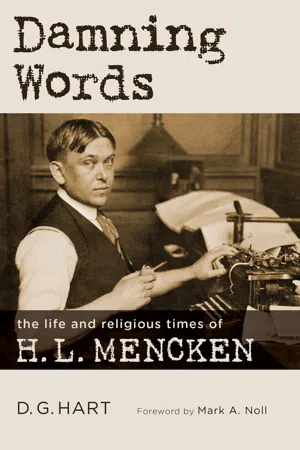 eBook - ePub
Damning Words
The Life and Religious Times of H. L. Mencken
- D. G. Hart(Author)
- 2016(Publication Date)
- Eerdmans(Publisher)
CHAPTER SIXThe Mencken ShowH. L. Mencken may have taken consolation from sitting in the front row of the show produced by the United States. But during the 1920s he left his center-aisle seat and walked into the limelight. His performances took their toll and were responsible for his poor showing in Notes on Democracy. Even so, fame compensated for his failings as a political philosopher. In 1925, for instance, Walter Lippmann hailed Mencken as “the most powerful influence on a whole generation of educated Americans.” To one editor, he was “America’s Dr. Johnson”; to another, “the nearest thing to Voltaire that America has ever produced”; and to still another, “the Genghis Khan of the Campus.” Indeed, with a circulation of sixty thousand, Mencken’s American Mercury was the item for undergraduates to be seen carrying around campus as a badge of independent thought, if not naughtiness. But his celebrity crossed over the world of language and letters into uncharted waters of popular culture. A story in New York’s Daily News concluded on the basis of interviews with female readers that Mencken was the third most fascinating man in the world, tied with Rudolph Valentino, Charlie Chaplin, and Douglas Fairbanks. Fred Hobson puts it well when he says that Mencken had reversed expectations in American literary life. “Perhaps for the first time in American life a critic, rather than a novelist or a poet, was the most famous and most influential American writer.” This fame did not mean, of course, that Americans across the board considered Mencken a gift to national life. The Justice Department’s file on him included testimony that Mencken was a “Bolshevik.” A Methodist minister called him a “menace” because “his ghastly fingers of death” were wrapped around the throats of America’s youth. Even Lippmann had to admit that Mencken was an “outraged sentimentalist.”The phenomenon of H. L. Mencken also meant the start of a line of books about the author. In 1925 Mencken was the subject of two assessments. The first book, a slim volume just under one hundred pages by the Irishman Ernest Boyd, evaluated Mencken as a critic and a philosopher. The second, by a former colleague at the American Mercury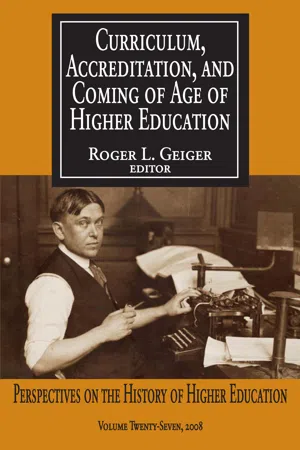 eBook - ePub
Curriculum, Accreditation and Coming of Age of Higher Education
Perspectives on the History of Higher Education
- Roger L. Geiger, Roger L Geiger(Authors)
- 2018(Publication Date)
- Routledge(Publisher)
7Mencken’s influence as a social critic began 100 years ago and lasted through most of the first half of the twentieth century. In Books That Changed America, Robert B. Downs labeled Mencken, “a satirist, humorist, devastating critic, and word juggler supreme.” He noted that readership swelled “as he damned ignorance and dishonesty in American politics, hypocrisy in the church, sham in the educational system, puritanism in every form, provincialism, arty art, do-goodism among social reformers, racial discrimination, and superpatriotism, while defending with equal vigor the right of the individual to live his life without interference from bureaucrats, prohibitionists, censors, bluenoses and their like.”8 Attesting to the continuing longevity of his style and his ideas is the steady stream of published volumes since his death in 1956—including anthologies, memoirs, volumes of letters, a diary, and seven biographies (two in the past five years).9While excellent edited works by Mencken and others have collected his written words on politics, journalism, religion, music, language, democracy, literature, and women, no published work has gathered his insightful, critical, and often humorous reflections on higher education.10 This is surprising in light of his extensive and perceptive writing on the subject, and it prompts several questions: What issues and ideas surfaced most prominently in Mencken’s writing related to higher education? What did Mencken write about those issues and ideas; and how did his writing reflect contexts of time, place, and person? How can we understand and reconcile the contradictions inherent in Mencken’s writing on higher education as he variously attacked and applauded individuals, institutions, and ideas?The opportunity to address these questions provides only one reason to revisit Mencken’s thoughts on higher education. His expository arguments are instructive and entertaining, and they can provide contemporary readers with unusual and often useful perspectives on current issues. Similarly, his selection of targets for praise and criticism reminds us that some debates concerning higher education are deservedly enduring, while others thankfully wane over time. And, perhaps most relevant, while experiencing the verbal assaults of today’s angrier and less articulate educational critics, contemporary educators may discover that from the pen of a remarkably talented journalist and intellectual, outrageous criticism can become outrageously funny. Mencken earned and deserved the frequent label, “humorist,” and the Philip Wagner’s judgment that: “From Mark Twain came the qualities that make Mencken the American humorist second only to Mark Twain himself.”11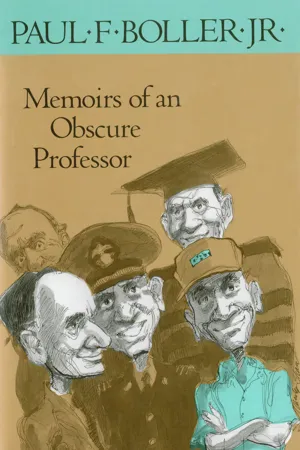 eBook - ePub
- Paul F. Boller(Author)
- 2013(Publication Date)
- TCU Press(Publisher)
5Purlings and Platitudes:H. L. Mencken’s AmericanaWhen I heard H. L. Mencken speak one afternoon during my undergraduate days at Yale in the late 1930s, I was a bit disappointed. He omitted a formal lecture for one thing, and for another opened the meeting up to questions from the audience without even making any preliminary remarks. Still, I enjoyed his witty answers to questions and recall chortling over his statement that Gertrude Stein “hasn’t got any ideas, and she can’t express them.”Mencken was only partly right about Stein, of course, but then he was only partly right about a lot of things and downright wrong about many things too. Franklin Roosevelt was surely far abler than Mencken was ever willing to concede; and even William Jennings Bryan, whom Mencken despised, was unquestionably wiser than HLM in detecting the absurdities of social Darwinism. But Mencken was right on target when it came to a number of important issues, and his blasts at humbug, hypocrisy, sanctimoniousness, and patrioteering seem to me as exhilarating to read today as they were in his lifetime. His championship of free speech and expression was important, too, and I was delighted when I learned recently that in 1936 he had teamed up with Texas Congressman Maury Maverick, a feisty New Deal Democrat, in framing a bill (which attracted little support) making it a felony for any public official to violate the Constitution and especially the Bill of Rights. The Chicago Tribune’s Mike Royko probably comes closer to HLM than anyone else writing in America today in his ability to puncture the pretensions of the new crop of pests clamoring for attention—the oracularly wise, aggressively virtuous, and vehemently compassionate—without neglecting the old pests, still with us, that Mencken loved to assault.Mencken’s “Americana” first appeared in the Smart Set intermittently and then became a regular feature of American Mercury in the 1920s. In 1920, the New Republic started a somewhat similar column called “The Bandwagon” which presented weekly reports on the silly statements and bizarre goings-on of the Great, the Near-Great, and the Not-So-Great. And in 1978, the Progressive came up with a monthly page entitled “No Comment,” which, like “The Bandwagon,” took on the rich, the powerful, and the prestigious as its main target. Mencken, by contrast, took on the masses as well as the classes. But he was tickled by anything absurd. The New Yorker’s
- Steven Biel(Author)
- 1995(Publication Date)
- NYU Press(Publisher)
58Even in his most limited conception of criticism’s functions, Mencken ultimately qualified his claim that nothing mattered but the personal delight in articulating a point of view. In the same passage in which he declared ego-gratification to be the critic’s essential goal, he explicitly connected this personal satisfaction to the public resonance of his writing: “He is trying to arrest and challenge a sufficient body of readers, to make them pay attention to him, to impress them with the charm and novelty of his ideas, to provoke them into an agreeable (or shocked) awareness of him.” Unlike many of his colleagues, who spoke more broadly of social renewal and a transvaluation of values, Mencken always saw the critic as appealing to and enlarging a civilized minority—a permanent opposition to the vulgar majority. The existence of a thriving intellectual community, operating in “an atmosphere of hearty strife,” was the best guarantee that criticism would engage the attention of a growing audience. Intellectual conflict, he argued, “melodramatizes the business of the critic, and so convinces thousands of bystanders, otherwise quite inert, that criticism is an amusing and instructive art, and that the problems it deals with are important. What men will fight for seems to be worth looking into.”59While it is customary to label Mencken an iconoclast and to distinguish him from the cultural radicals—Bourne, Brooks, Frank, and Mumford, for example—such a division seems arbitrary when Mencken is observed in his more expansive moments. He was equally committed to the work of cultural awakening and similarly involved in the critic’s task of encouraging artists to free themselves from the country’s anti-intellectual, antiaesthetic forces. Though he could present the critic’s aim modestly—“to find out what an author is trying to do, and to beat a drum for him when it is worth doing and he does it well”—he also wrote of the critic’s role in creating the necessary conditions for a vital culture. “He makes the work of art live for the spectator; he makes the spectator live for the work of art,” Mencken proclaimed. “Out of the process comes understanding, appreciation, intelligent enjoyment—and that is precisely what the artist tried to produce.” In 1924, he confessed his “faint shadow of a hope” that “leadership in the arts, and especially in all the art of letters” might “eventually” pass from Europe to the United States.60 If this was not quite the rapturous prophecy of the Seven Arts , neither was it the unmitigated cynicism of a pure iconoclast. A healthy native culture might not subvert the vapidity and Puritanism of the masses, but at least it would serve as an alternative—an intelligent and stable minority voice.61
Index pages curate the most relevant extracts from our library of academic textbooks. They’ve been created using an in-house natural language model (NLM), each adding context and meaning to key research topics.

