Chemistry

Trans fat
Trans fat is a type of unsaturated fat that contains trans-isomer fatty acids. It is formed through the process of hydrogenation, which turns liquid oils into solid fats. Trans fats are known for their negative impact on health, as they can raise bad cholesterol levels and increase the risk of heart disease.
Written by Perlego with AI-assistance
Related key terms
1 of 5
10 Key excerpts on "Trans fat"
 eBook - PDF
- Khetarpaul, Neelam(Authors)
- 2021(Publication Date)
- Daya Publishing House(Publisher)
Meaning of Trans fat A type of fat created when oils are hydrogenated, which chemically transforms them from their normal liquid state (at room temperature) into solids. During the hydrogenation procedure extra hydrogen atoms are pumped into unsaturated fat, thereby creating Trans fatty acids. This process converts the mixture into a saturated fat, which obliterates its polyunsaturate benefits. Chemically speaking, Trans fats are made of the same building blocks as non-Trans fats, but are a slightly different shape. From a molecular perspective, the different shape is caused by double bonds between carbon atoms being in the trans rather than the cis configuration. Trans fats are more of a straight shape, while the cis shape is more kinked. This ebook is exclusively for this university only. Cannot be resold/distributed. Trans fatty acids can be found in a wide array of processed foods including cookies and margarines. Any food with “hydrogenated oils” or “partially hydrogenated oils” on the label contains Trans fatty acids. Some researchers believe such foods may actually be more damaging than regular saturated fats to those watching their cholesterol, saying Trans fatty acids decrease the good (HDL) cholesterol and increase the bad LDLs. Other scientists argue that the evidence is inconclusive and that Trans fatty acids are no worse than butter. In either case, it would seem that “moderation” is the watchword when consuming foods containing Trans fatty acids. At the turn of the century, a dramatic change in the fatty acid composition of the food supply of industrialized countries occurred when a process was discovered to convert liquid oils into solid or semisolid fats. In this process, known as partial hydrogenation, oils are heated in the presence of nickel or other metal catalysts and exposed to hydrogen gas. eBook - PDF
- J H P Tyman(Author)
- 1999(Publication Date)
- Woodhead Publishing(Publisher)
3 Trans Unsaturated Fat in Health and Disease David Kritchevsky THE WISTAR INSTITUTE, 3601 SPRUCE STREET, PHILADELPHIA, PA 19104, USA 1 Introduction In most naturally occurring unsaturated fats the double bonds are in the cis configuration. However, trans double bonds do occur naturally in a number of plants,' in the body fat of ruminants, and in milk. The major Trans fatty acid of milk and beef fat is vaccenic acid (1 lt-18:l). The principal source of Trans fat in the diet of the developed world is as a component of partially hydrogenated fat. Partial hydrogenation of vegetable or marine oils yields fats with greater stability, which can be used directly as margarines, salad oils, cooking oils and shortenings or used in the preparation of other foods. Heat treatment or frying of vegetable oils also yields some fatty acids containing trans unsaturated double bonds but the yields are quite Deodorization of oils may also yield a very small amount of Trans fat.' Commercial hydrogenation of vegetable oils results in mostly monoenoic fats and most of the component trans-unsaturated (trans) fatty acids are present in the monoenoic fraction. The proportion of Trans fats can be reduced by altering conditions of hydrogenation. In the course of the hydrogenation process the double bonds may also migrate along the hydrocarbon chain, yielding monoene fatty acids with double bonds anywhere from carbon 4 to carbon 16 (Table 1).6 Few biological studies which have been carried out using Trans fats have used specific positional isomers (usually elaidic acid); insofar as the rest are concerned we must still clear up the possibility that the results may be due to specific positional isomers. The presence of a cis double bond in a fatty acid confers a bend to the acyl chain resulting in a flexible molecule. Fatty acids containing trans double bonds are linear because the angle conferred by the double bond is much smaller than that seen in cis fatty acids. eBook - PDF
- (Author)
- 2009(Publication Date)
- Academic Press(Publisher)
Additionally, several countries now have regulations requiring that Trans fatty acid be listed on products’ labels. In some cases, like in the US, trans must be added to the saturated fat content reported on the Nutrition Facts label, based on their similar adverse effects on health. Although listing both fats together may not be correct in chemical terms, it is a practical way to allow con-sumers to quickly assess the content of unhealthy fat in a product. Conclusions Several lines of evidence indicate that Trans fats have an adverse effect on the lipoprotein profile and likely on risk of cardiovascular disease. Although reducing intake of Trans fats is a desirable goal, public health policy should keep as a central recom-mendation the reduction of saturated fats, which constitute four to six times more percent calories in the diet than Trans fats. Since the largest proportion of Trans fats is generated during food processing, industry bears the main responsibility for reducing the trans content of its products, thus helping the general public to lower their intake of this type of fat. See also: Coronary Heart Disease : Lipid Theory. Further Reading AIN/ASCN (1996) Position paper on Trans fatty acids. American Journal of Clinical Nutrition 63 : 663–670. Aro AV, Kardinal AFM, Salminen I et al. (1995) Adipose tissue isomeric Trans fatty acids and the risk of myocardial infarction in different countries: the EURAMIC study. Lancet 345 : 273–278. Ascherio A, Hennekens CH, Buring JE et al. (1994) Trans fatty acids intake and risk of myocardial infarction. Circulation 89 : 94–101. Berger KG (1996) In Lipids and Nutrition: Current Hot Topics. Bridgwater: PJ Barnes. British Nutrition Foundation (1995) Trans fatty Acids. Report of the British Nutrition Foundation Task Force. London: BNF. Giovannucci E, Rimm E, Colditz GA et al. (1993) A prospective study of dietary fat and risk of prostate cancer. Journal of the National Cancer Institute 85 : 1571–1579. eBook - PDF
The Cardiovascular System
Physiology, Diagnostics and Clinical Implications
- David C. Gaze(Author)
- 2012(Publication Date)
- IntechOpen(Publisher)
3 Trans fatty Acids and Human Health Sebastjan Filip and Rajko Vidrih Biotechnical Faculty, Department of Food Science and Technology, University of Ljubljana, Slovenia 1. Introduction According to various studies, fats of animal and vegetable origins satisfy 22% to 42% of the daily energy demands of human beings (Srinivasan et al., 2006; Wagner et al., 2008; Willet, 2006). Some fats, and especially those that are hydrogenated, contain Trans fatty acids (TFAs), i.e. unsaturated fatty acids with at least one double bond in a trans configuration (Craig-Schmidt, 2006). This trans -double-bond configuration results in a greater bond angle than for the cis configuration, thus producing a more extended fatty-acid carbon chain that is more similar to that of the saturated fatty acids (SFAs), rather than to that of the cis -unsaturated double-bond-containing fatty acids (Fig. 1) (Moss, 2006; Oomen et al., 2001). Fig. 1. Structure of different isomers of C16 (Willett, 2006) The Cardiovascular System – Physiology, Diagnostics and Clinical Implications 44 Fat is a thus major source of energy for the body, and it also aids in the absorption of vitamins A, D, E and K, and of the carotenoids. Both animal-derived and plant-derived food products contain fat, and when eaten in moderation, fat is important for correct growth and development, and for the maintenance of good health. As a food ingredient, fat provides taste, consistency and stability, and helps us to feel ‘full’. In addition, parents should be aware that fats are an especially important source of calories and nutrients for infants and toddlers (up to 2 years of age), who have the highest energy needs per unit body weight of any age group. However, SFAs and TFAs raise low-density lipoprotein (LDL; or ‘bad’) cholesterol levels in the blood, thereby increasing the risk of heart disease. eBook - PDF
- Casimir C. Akoh(Author)
- 2005(Publication Date)
- CRC Press(Publisher)
245 10.7 Trans -Free Lipids ....................................................................................... 247 10.8 Conclusions ................................................................................................ 252 References .............................................................................................................. 252 10.1 INTRODUCTION In recent years, Trans fatty acids, more commonly known as Trans fats, have been gaining a lot of interest from the scientific and health professional communities primarily because of the potential role of Trans fatty acids on cardiovascular disease risk. Publications on the adverse effects of Trans fatty acids on coronary heart disease, low-density and high-density lipoprotein cholesterols, and blood lipid levels are extensive. In a 1994 report, it was estimated that approximately 30,000 annual deaths from premature coronary heart disease could be linked to the consumption of Trans fatty acids [1]. Since then, more metabolic and epidemiologic studies have been reported. Due to the increasing evidence of the effects of Trans fatty acids on public health, the U.S. Food and Drug Administration (FDA) has recently published a final rule on the labeling of Trans fatty acids in food items. 204 Handbook of Functional Lipids 10.2 CHEMICAL STRUCTURE Fatty acid isomers are classified into two types, positional and geometric isomers. Positional isomers are formed when double bonds of the fatty acid molecule shift from their original position to other positions in the molecule. For example, fatty acids having double bonds at the ∆ 9 and ∆ 12 positions have been reported to shift to isomeric forms ranging from positions ∆ 4 to ∆ 16 [2], with the majority clustered in the vicinity of the original double bond [3–6]. Geometric isomers of unsaturated fatty acids are categorized into two forms: cis ( c ) and trans ( t ), as shown in Figure 10.1.
- Ching Kuang Chow(Author)
- 2007(Publication Date)
- CRC Press(Publisher)
II. OCCURRENCE OF Trans fatTY ACIDS IN THE U.S. FOOD SUPPLY Unsaturated fatty acids in foods can exist in either the cis or trans conguration (Figure 31.1). In the cis form, the hydrogen atoms are on the same side of the double bond. In the trans form they are opposite. As a result of these orientations around the double bond, the cis fatty acid has a bend in the carbon chain, whereas the Trans fatty acid has a straight carbon chain resembling that of a saturated fatty acid. The term “positional isomer” is commonly used to refer to cis or Trans fatty acids if one or more of the double bonds has migrated to a new position in the fatty acid chain. Trans fatty acids (with double bonds at various positions in the fatty acid chain) and cis positional isomers are formed during partial hydrogenation of fats and oils, a process used to impart desirable stability and physical properties to food products such as margarines and spreads, shortenings, frying fats, and specialty fats (e.g., for llings, toppings, and candy). In addition, small amounts of Trans fatty acids occur naturally in foods such as milk, butter, and tallow as a result of biohydrogenation in ruminants. Widespread use of partially hydrogenated vegetable oils in the United States during the past four or ve decades has raised questions about the health effects resulting from the consumption of Trans fatty acids present in these products. Among isomeric fatty acids, interest has focused on Trans fatty acids rather than on positional isomers of cis fatty acids. Accordingly, this chapter deals with effects of Trans fatty acids rather than positional isomers of cis fatty acids. Typical levels of Trans fatty acids in food products containing partially hydrogenated oils are shown in Table 31.1. Frying oils used by restaurants and food service operations range in Trans fatty acid content from 0% to about 35% of total fatty acids.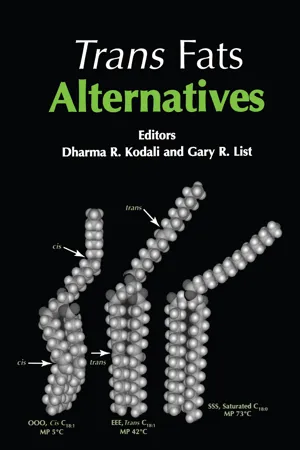 eBook - PDF
- Dharma R. Kodali, Gary R. List(Authors)
- 2019(Publication Date)
- AOCS Publishing(Publisher)
Chapter 3 Nutritional Considerations of Trans fatty Acids 1 J. Edward Hunter Department of Chemistry, University of Cincinnati, P.O. Box 210172, Cincinnati, OH 45221-0172; [email protected] Introduction In recent years, Trans fatty acids (TFA) in foods have received a lot of attention, both in the scientific literature and in the popular press. This attention has come largely from reports that high levels of TFA in the diet, compared to high levels of cis fatty acids, have resulted in unfavorable effects on both LDL-cholesterol, the so-called bad cholesterol, and HDL-cholesterol, the good cholesterol. In response to these reports, many health professional organizations have recommended reduced con-sumption of foods containing TFA, and in July 2003, the U.S. Food and Drug Administration (FDA) issued regulations requiring the labeling of TFA on packaged foods on or before January 1, 2006. In addition, many food manufacturers who have used partially hydrogenated oils in their products have developed or are considering ways to reduce or eliminate TFA from these products. This chapter will cover the following topics: (i) the occurrence of TFA in the U.S. food supply; (ii) three controlled dietary trials relevant to effects of dietary TFA on blood lipid parameters; (iii) a collective look at these and other clinical tri-als; and (iv) dietary recommendations regarding trans and saturated fatty acids by various health professional organizations. The focus will be on TFA in relation to coronary heart disease (CHD) because most of the recent literature on TFA con-cerns this area of interest. Figure 3.1 compares structural formulas of the cis fatty acid, oleic acid, with its trans isomer, elaidic acid. In the cis form, the hydrogen atoms are on the same side of the double bond. eBook - ePub
- Alankar Shrivastava(Author)
- 2018(Publication Date)
- Bentham Science Publishers(Publisher)
Trans Fat Analysis in Some FoodsSyed Tufail Hussain Sherazi,1 , *Sarfaraz Ahmed Mahesar1,Aftab Ahmed Kandhro2,Sirajuddin11 National Centre of Excellence in Analytical Chemistry, University of Sindh, Jamshoro-76080, Pakistan2 Dr. M.A. Kazi Institute of Chemistry, University of Sindh, Jamshoro-76080, PakistanAbstract
There are three macro components of foods namely protein, carbohydrates and lipids. Lipids include fats and oils which are very important components for the human diet and considered to be concentrated sources of energy. Major classes of fats and oils are vegetables oils, marine oils and animal fats. Naturally, in vegetable oils all fatty acids are in cis form. But through industrial processing, especially during hydrogenation process, artificial trans fats are developed and considered to be very dangerous for human health. According to the Food & Drug Administration (FDA), trans fat is supposed to be unwanted fat and in the diet it should be as minimum as possible. Therefore, trans fat labeling is mandatory in all foods in which fats and oils are involved. For the trans fat, labeling on food products requires adequate analytical methods. Therefore, the present review will cover brief outline of analytical techniques used for the analysis of trans fat.Keywords: Analytical techniques, Food, Oils and fats, Trans fat.* Corresponding author Syed Tufail Hussain Sherazi: National Centre of Excellence in Analytical Chemistry, University of Sindh, Jamshoro-76080, Pakistan; Tel: +92-229213429; Fax: +92-229213430; E-mail: [email protected]INTRODUCTION
The characteristics of oils and fats depend upon the type and proportion of fatty acids (FAs). The nutritional performance of FAs is greatly influenced by the chain length of carbons, presence of double bonds, location of double bonds, cis-trans isomers and position of the FAs on the glycerol molecule [1 , 2 ]. Each type of fatty acid has its own role on the health of consumers. Numerous studies have been conducted on the positive and negative effects of FAs present in the fats and oils [3 eBook - ePub
- Dharma R. Kodali(Author)
- 2014(Publication Date)
- Academic Press and AOCS Press(Publisher)
4Nutritional Aspects of Trans Fatty Acids
Ingeborg A. Brouwer, Department of Health Sciences and the EMGO Institute for Health Care Research, Faculty of Earth and Life Sciences, VU University, Amsterdam, The NetherlandsAnne J. Wanders, Division of Human Nutrition, Wageningen University, Wageningen, The NetherlandsIntroduction
Most naturally occurring unsaturated fatty acids have their double bonds in the cis configuration. This cis configuration makes the molecule bend at the place of that double bond. Trans fatty acids (TFAs) are unsaturated fatty acids with at least one double bond in the trans configuration instead of the cis configuration. The double bond in the trans configuration gives the molecule a straighter shape. The straighter shape of the molecules allows them to pack better in solid state. This leads to transformation of oils into semisolid fats (Figure 4.1 ). There are two sources of TFAs: industrial and ruminant. In this chapter we look at the nutritional aspects of TFAs from various sources. We will only discuss studies in human subjects.Figure 4.1 Structures of cis - and trans fatty acids.Adapted from Brouwer, Wanders et al. (2010) .Elaidic acid (9-trans -C18:1) is a typical industrial TFA, produced by partial hydrogenation of vegetable oil. Vaccenic acid (11-trans -C18:1) is the predominant TFA in milk and meat from ruminant animals, although small amounts are also found in industrially hydrogenated fats. The 9,11 isomer of conjugated linoleic acid, or CLA (9-cis , 11-trans -C18:2), is found almost exclusively in ruminant fat; industrial production of CLA yields a mixture of 9,11 and 10,12 isomers. Oleic acid (9-cis -C18:1) is the predominant cis -unsaturated fatty acid in the diet. The location of the trans bond(s) in trans isomers of α-linolenic acid is not known precisely; for this figure it has been assigned arbitrarily to the 12 or omega-6 location. The same holds for the trans bonds in the trans eBook - PDF
Food Safety Chemistry
Toxicant Occurrence, Analysis and Mitigation
- Liangli (Lucy) Yu, Shuo Wang, Bao-Guo Sun, Liangli (Lucy) Yu, Shuo Wang, Bao-Guo Sun(Authors)
- 2014(Publication Date)
- CRC Press(Publisher)
133 Trans fatty Acids Hongyan Li, Casimir C. Akoh, Jing Li, Huan Rao, and Zeyuan Deng 8.1 INTRODUCTION Saturated fatty acids (SFA) are solid at room temperature. Unsaturated fatty acids in nature are less tightly packed because of the cis configuration of the double bonds and they, generally, are liquids or oils at room temperature (Risérus, 2006). Trans fatty acids (TFA) consist of at least one isolated, nonconjugated, double bond in the trans geometric configuration. However, it excludes conjugated fatty acids such as 8 CONTENTS 8.1 Introduction .................................................................................................. 133 8.2 Formation and Occurrence ........................................................................... 135 8.2.1 Hydrogenation of Oils ....................................................................... 135 8.2.2 Natural Digestion of Ruminant Animals .......................................... 137 8.2.3 Levels of Trans fatty Acids in Foods ............................................... 137 8.3 Analytical Methods ...................................................................................... 139 8.3.1 Sample Preparation and Extraction .................................................. 139 8.3.2 Gas Chromatography ........................................................................ 140 8.3.3 Silver Ion Chromatography ............................................................... 140 8.3.4 Fourier Transform Infrared Spectroscopy ........................................ 141 8.3.5 Capillary Electrophoresis ................................................................. 141 8.4 Evidence of Health Implications ................................................................... 142 8.4.1 Cardiovascular Health ...................................................................... 142 8.4.1.1 Lipid Effects .......................................................................
Index pages curate the most relevant extracts from our library of academic textbooks. They’ve been created using an in-house natural language model (NLM), each adding context and meaning to key research topics.

