Geography

Environmental Determinism
Environmental determinism is a geographical theory that suggests that human behavior and societal development are primarily shaped by the physical environment. This perspective argues that climate, topography, and natural resources dictate cultural and economic practices. While influential in the past, environmental determinism has been widely criticized for oversimplifying the complex interactions between humans and their environment.
Written by Perlego with AI-assistance
Related key terms
1 of 5

12 Key excerpts on "Environmental Determinism"
- H. Wiarda(Author)
- 2010(Publication Date)
- Palgrave Macmillan(Publisher)
Historical Contexts of Environmental and Geographic Determinism From the late nineteenth century to the 1930s, human geography was dominated by what is known as environmentalism. This field was concerned with documenting the “influence of the natural envi- ronmental on human geographies and, in particular, civilizations.” Environmental Determinism, however, is the notion that the envi- ronment controls or determines the course of human action. Keith Buchanan describes “the old environmentalist approach as the belief that the natural environment firmly molded man and his activities, a belief that in its extreme form postulated an inevitable, almost fatalistic, relationship between man and environment.” 1 A student of the German scholar Friedrich Ratzel in the 1890s, Ellen Churchill Semple is also widely interpreted as having introduced Ratzelian ideas into the mainstream of the subdiscipline of U.S. geog- raphy. 2 She dominated the environmentalist period of the discipline in the early twentieth century and trained a large number of those who became leaders of the profession during the period between the two world wars. 3 She was exploring some major ideas, and her theories served significant sociopolitical interests. In her work she has argued that the physical environment, rather than social conditions, determines culture, defining geography as the “scientific investigation of the physical conditions of historical events.” 4 Another prominent environmental determinist, William Morris Davis, found that “a rela- tion between an element of inorganic control and one of organic response” stated in terms of a “causal or explanatory relationship” was the “most definite, if not the only, unifying principle that I can find in geography.” 5 Shortly thereafter, Gordon R. eBook - PDF
- John A Agnew, David N Livingstone, John A Agnew, David N Livingstone, SAGE Publications Ltd(Authors)
- 2011(Publication Date)
- SAGE Publications Ltd(Publisher)
27 Environmental Determinism D a v i d N . L i v i n g s t o n e DIMENSIONS While Environmental Determinism can con-veniently be described as the claim that human activities are controlled by the envi-ronment, such definitional clarity masks his-torical complexity. Sometimes the behaviour in question is attributed to the configuration of topographic features like rivers, moun-tains, valleys, deserts, plains, and so on; sometimes climatic conditions are identified as the critical explanans ; sometimes the local character of soil is taken to be the critical determining environmental factor. And of course even these causal explanations may be more finely tuned – the role of a tropical sun, or long-term climatic change, or persistent drought may be called upon to explain one aspect or another of human culture. At the same time, the range of human phe-nomena – at markedly different scales – over which the environment is purported to exert determining influence is no less diverse. Some have ascribed various medical condi-tions to environmental causes; others have brought the human psyche and its states within its explanatory arc. Others, not least geographers, have found in the earth’s sur-face topography the determining cause of patterns of human settlement; still others have connected economic growth and down-turn to weather patterns. The development of science has also been attributed to environ-mental factors in general and in particular to geographical conditions in those locations where the need for hydrological management fostered the development of hydraulic engi-neering. The list could easily be elaborated: racial characteristics, cultural collapse, witch-hunting, suicidal behaviour, senses of national identity, legislative systems, business fluctu-ations, moral standards – all these, and many more, have been put down to environmental influences of one sort or another. eBook - PDF
- Charles A. Reed(Author)
- 2011(Publication Date)
- De Gruyter Mouton(Publisher)
Clearly, environment can be conceived in many different ways. The causal viewpoint required by the idea of envi-ronmental determinism — some combination of immediate environmen-tal conditions necessary and sufficient to produce a given phenomenon — in the present case becomes not merely a logical but also a geographical concept. One of the implied premises of traditional Environmental Determinism holds that the environmental conditions presiding over human destiny or character are those conditions that are not man-made. Nature dominates mankind. Since physical rather than some kind of mental causality is almost always contemplated — even if supposedly it operates through physical effects upon mentalities — the relevant environment must be physical. But more particularly, physical environment in this context emphatically does not include everything in the spatial, sensory, or dynam-ic fields that is physical; it carries the implication of the natural elements alone, and so in effect becomes the natural environment as against what I have called (Wagner 1960) the artificial environment. Further-more, according to this theory, even if the natural environment does at times allegedly affect mentalities, it operates primarily in a directly phys-ical and not a symbolic fashion. Whatever Environmental Determinism offers, it is not a theory of perception. The factors of the natural environment that have figured in the argu-ments of the environmental determinists include particularly spatial prop-erties — e.g. contiguity; concentration or dispersion; climatic features, especially the seasonal march of temperature and rainfall; soil and min-eral resources; and general surface configuration. At its simplest, Environmental Determinism attempts to find an explan-atory correlation between the areal patterns of physical and those of cul-tural geography. eBook - ePub
- Carolyn Gallaher, Carl T Dahlman, Mary Gilmartin, Alison Mountz, Peter Shirlow(Authors)
- 2009(Publication Date)
- SAGE Publications Ltd(Publisher)
In many ways this change in focus reflects changes in the world around us. When the Cold War ended in 1989 there was uncertainty not only about what would happen to formerly communist states, but also what would happen to the balance of power between states. The emergence of globalization also brought new political actors to the fore, including international organizations, social movements, non-governmental organizations and warlords, among many others. How this mix of old and new actors and the changing relations of power between them will play out is yet to be seen, but political geography will be there to document, analyse and ultimately theorize them.Political Geography through Time
The development of modern political geography was intimately connected with the colonial project (Peet 1985). These connections are readily apparent in the subdiscipline’s two most formative schools of thought – Environmental Determinism and geopolitics. While these approaches initially made the discipline of Geography popular in and out of the academy, they would eventually be debunked, leaving political geography fighting for its survival. A brief introduction to each is provided here. Geopolitics, which has witnessed a resurgence of interest under the label ‘critical geopolitics’, is also discussed in Chapter 7 .Environmental Determinism
Environmental Determinism was developed in the mid-nineteenth century purportedly to explain the discrepancies in standards of living between European colonizers and their colonial subjects. Environmental determinists were influenced by social Darwinism, although most preferred to draw from Lamarckian rather than Darwinian versions of evolution (Livingstone 1992).1 Proponents of the theory, including Friedrich Ratzel, Ellen Churchill Semple and Ellsworth Huntington, posited that climate and topography determined the relative development of a society, and its prospects for future development. Temperate climates were seen as invigorating whereas tropical and arctic climates were deemed to stunt human development. Geographers also postulated that river valleys produced vibrant societies while mountainous environments inhibited them.For much of the early twentieth century, especially in the United States, Environmental Determinism dominated the entire discipline. Even as the approach was becoming a meta-narrative of the field, scholars in other disciplines were subjecting it to withering criticism. The anthropologist Franz Boas labelled the theory simplistic and reductionist because it failed to explain how vastly different cultures could emerge in the same environments (Livingstone 1992). Eventually, geographers would abandon the theory as well. One of the first to do so was Carl Sauer who adopted culture, rather than environment (alone), as the key explanatory variable in human differentiation across space (Livingstone 1992). Half a century later, geographers would describe the discipline’s fixation with geographic determinism as an imperialist impulse (Peet 1985; Smith 1987). eBook - ePub
The Behavioural Environment
Essays in Reflection, Application and Re-evaluation
- F.W. Boal, D.N. Livingstone(Authors)
- 2003(Publication Date)
- Routledge(Publisher)
The idea that the environment must be understood in terms of the way people perceived it was a major step forward in human geography. It recognized that it was people’s understanding of environment, not environment itself, that shaped their actions, but it did not elaborate on a means of determining the meaning of the environment itself in the broader context of a society’s priorities and visions of order. A human geography dedicated to investigating human activities or forms of life in their historical contexts seeks to establish a broader basis for understanding the character of human activities on the surface of the earth and their connections to the physical environment.Acknowledgement
I am grateful to my colleagues Jean Andrey, Roy Officer, and Peter Nash for their critical comments on an earlier draft of this chapter. The responsibility for the ideas expressed herein remains entirely mine.Notes
1 This integration of physical and human geography is typified in the work of such environmental determinists as Ellsworth Huntington, Griffith Taylor, and Ellen Churchill Semple.2 G.Tatham, ‘Environmentalism and possibilism’, in G.Taylor (ed.), Geography in the Twentieth Century, 3rd edn (Methuen, London, 1953), pp. 128–62.3 C.O.Sauer, ‘The morphology of landscape’, University of California Publications in Geography no. 2 (1925), University of California, Berkeley, pp. 19–54; J.K.Wright, ‘Terrae incognitae: the place of the imagination in geography’, Annals of the Association of American Geographers, vol. 37 (1947), pp. 1–15; W.Kirk, ‘Historical geography and the concept of the behavioural environment’, Indian Geographical Journal, Silver Jubilee Volume (1952), pp. 152–60.4 Kirk, ‘Historical geography and the concept of the behavioural environment’, p. 159.5 For example, T.F.Saarinen, ‘Perception of the drought hazard on the Great Plains’, Research Paper no. 106 (1966), Department of Geography, University of Chicago; and P.Gould and R.White, Mental Maps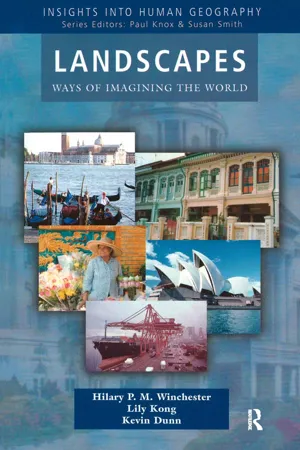 eBook - ePub
Landscapes
Ways of Imagining the World
- Hilary P.M. Winchester(Author)
- 2013(Publication Date)
- Routledge(Publisher)
In the primary state of development [of the geography of religion], the focus was on a one-sided presentation of religion as determined by its environment; environmental explanations were sought, appropriately or otherwise, to aid the understanding of the origin of religions and religious practices. In the second stage of antithesis, the geography of religion moved to a one-sided study of the moulding influence of religion on its environment, to the point of shaping the settlement and landscape…. the field has clearly entered a third stage of development — synthesis…. a synthetic approach that focuses on the reciprocal network of relations between religion and environment.In the following three sections, works within cultural geography and cognate disciplines are used to demonstrate the abovementioned shifts in the study of cultural landscapes. In sequence, these are, first, Environmental Determinism, then through the Berkeley School of cultural determinism, finally to the new cultural geographies.2.1 Environmental Determinism
In the earlier part of the twentieth century, geographers explored how different environments generated differing cultures. In these works, geographers would demonstrate how the environment (including landscapes) was an independent variable or agent that determined culture. As the environment varied, so would cultures. Perhaps the most well-known treatise on Environmental Determinism was Ellen Semple's Influences of Geographic Environment. Semple (1911 :1) made the argument plain: ‘Man [sic] is a product of the earth's surface.’ Similarly, one of the founders of Australian geography, Griffith Taylor (1940 :424–48), asserted that geography was able to demonstrate how humans were conditioned by their environment. Indeed, Griffith Taylor carried Environmental Determinism into the 1950s in Australia, long after the Berkeley School approach had diffused throughout North American geography.Climate was shown by geographers to have influenced the myths and rituals of religions. Ellen Semple (1911 :41) observed that in Eskimo culture, Hell was a place of extreme cold, whereas both Muslim and Christian sacred texts depict Hell as comprising fire and boiling water and Heaven as a garden. In the Qur'an, Heaven is described as a ‘Garden underneath which rivers flow’ (see V:85; XIII:35; XLVII:15). The climate of Hell for Christians is mostly an inferno, although the maps of Hell made by Dante, an Italian poet and commentator of the fourteenth century, also included sites of extreme cold (see Astarotte, 2001
- Roger Minshull(Author)
- 2014(Publication Date)
- Routledge(Publisher)
Geographers think they are able to show that the same cause is not followed by the same effect when they show two ‘identical’ natural regions with different types of land use. Martin insists that it is just the over-simplification of such geographers that makes two environments seem to be identical. The regularities which we do observe in the real world, however, could not happen if there were no determinism at all, so the conclusion Martin reaches, completely convincingly, is that determinism must exist, but the chain of cause and effect is very complicated indeed. No two places, no two times, no two groups of people are exactly alike. In any place, at any time the environment has been one of the factors in determining what man will do. In Martin’s view geography is the discipline which studies this set of factors. But because of the infinite variation of the factors and elements involved, the result of this deterministic cause and effect is unique in every case. ‘Geographers do not assert that the geographic environment is the only or even the most important determinant of human activity, they merely state that their particular business is to examine this group of determinants rather than others.’ 27 In agreeing wholeheartedly with Martin, the author would emphasise two points. First, the phrase too easily overlooked, that the influences which geographers study may be much less important in deciding human actions than other influences outside geography’s terms of reference. Second, the important lesson of this paper seems not that determinism is inevitable, but that its processes are so complex eBook - PDF
- Rodolfo B. Valdenarro(Author)
- 2019(Publication Date)
- Delve Publishing(Publisher)
The subject of geography is an umbrella encompassing many different topics—people, culture, politics, settlements, plants, landforms, and much more. What sets apart geography from other subjects is that it questions how and why things are distributed or arranged in particular ways on Earth’s surface. It also studies how human interaction impacts the world we inhabit. Human–environment geographers often interact with academics or professionals working in allied fields (e.g., hazards geographers with geologists and disaster relief specialists, or water resource geographers with hydrologists and watershed managers). Another field that supplements The Impact of Human on Environmental Geographies 207 environmental geography is cartography. Cartography is the study and practice of making maps and it helps in locating the variations that is across the surface of the earth. Satellite imaging also helps environmental geographers to analyze the relationship among different factors in a geographic space. Thus, environmental geography is an integrated field that studies the relationship between humans and the physical environment. Numerous subfields, like economic geography or geomorphology, cartography and geographic information system provide useful tools and techniques to establish the impact of the interaction between humans and physical geography. 10.1. ENVIRONMENTALISM Urbanization and industrialization across the globe have changed the landscape of the earth and affected nature in many ways. The environment is constantly under threat in terms of existence of flora and fauna, changes in weather patterns, depletion of natural resources and other related issues. This has led to the rise of environmentalism, i.e., a social movement for environmental protection and safeguarding the health of the environment. It focuses on fundamental environmental concerns as well as associated underlying social, political, and economic issues that have arisen as a result of human activity. eBook - PDF
The Origins of Agriculture
An Evolutionary Perspective
- David Rindos(Author)
- 2013(Publication Date)
- Academic Press(Publisher)
Hardesty (1977:2) has said, the rise of 'technological determinism' as espoused by Marxist social philosophy also contributed to its resurgence. Environmental de-terminism was a rebuttal to the antienvironmental position of Marxist writers. We may even go so far as to wonder if the equilibrium approach so favored in the 1950s and 1960s was in part a reading back into time of bourgeois concepts of government as rationalizing a capitalist economy in an effort to maintain economic stability. Environmentalism in its simplest form is Environmental Determinism, a doctrine claiming a strict causal link between environmental conditions and cultural action. It is in this rather primitive form that environmentalism was to enter the literature of agricultural origins in the writings of V. Gordon Childe. Childe (1925) has been justly credited (and, more recently, damned) for popularizing the concept of the Neolithic Revolution for the transition from food 14 1 Agriculture, Evolution, and Paradigms procurement to food production systems and the numerous developments in cultural history correlated with this shift. Childe's well-known riverine-oasis hypothesis holds that increasing aridity occurring in the early Neolithic placed people in intimate association with domesticatable plants and animals that were also forced to concentrate in limited areas in which water was available. En-forced concentration by the banks of streams and shrinking springs would entail an intensive search for means of nourishment. Animals and men would be herded together. . . . Such enforced juxtaposition might promote that sort of symbiosis between man and beast implied by the word domestication (Childe 1951:25). Of course, Childe was not the first to advance a climatic stimulus for domestica-tion; in fact, earlier workers anticipated him in most particulars. As early as 1908, Pumpelly was considering the influence of climate on culture. eBook - PDF
Behavior and Environment
Psychological and Geographical Approaches
- T. Garling, R.G. Golledge(Authors)
- 1993(Publication Date)
- North Holland(Publisher)
Such an emphasis on the objective environment is even more pro- nounced in geography (O'Riordan, 1973; Manners & Mikesell, 1974; Mitchell, 1984). Definitions of the Influence of the Environment on Behavior Different forms of Environmental Determinism have plagued geogra- phy in the past (Huntington, 1945; Taylor, 1951). Conceptualizing the in- fluence of the environment as causal was also particularly common in psychology before the cognitive breakthrough. Within the cognitive, information-processing approach, it is however generally assumed that people act on the basis of decisions they make. These decisions are in turn based on appraisals of acquired information. Thus, the relationship of the observed action or behavior to the environment is mediated by psycho- logical processes. It has been argued that decisions or intentions can be considered as (proximal) causes of actions in the same sense as physical phenomena are causally determined (Brand, 1984). In Chapter 11, Gkling and Garvill (like those psychologists cited in the chapter) draw on this philosophical standpoint. The analysis by Gkling and Garvill should be contrasted with that of geographers Hanson and Hanson (Chapter lo), who write on the same topic. They appear to assume nothing more than that the environment imposes constraints on feasible activities. Since these constraints are primarily of a physical or physiological nature, the authors are apparently cautious about not going beyond a physicalist conception of a cause-effect relationship. A similar difference between psychologists and geographers in willingness to give inferred psychological processes causal status in explanations is evident in Chapters 12 and 13. There are many examples of a more elaborate view in psychology where the individual and environment are interacting. Thus, actions due to the impact of the environment in turn affect the environment and modify 8 T. Curling and R. G. Golledge its impact, and so on.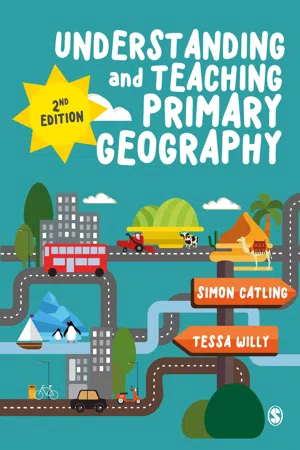 eBook - ePub
- Simon Catling, Tessa Willy, Author(Authors)
- 2018(Publication Date)
- SAGE Publications Ltd(Publisher)
environmental geography. These aspects of geography have a long history – for instance, when regional geography was a dominant approach in school geography in the first half of the twentieth century, regions were discussed in terms of their physical geography, including rivers, lakes, plains, mountains, valleys, ecology and geology, and their human geography, such as types of industry, products, trade, settlements, commerce and ways of life. However, they were rarely considered in terms of environmental geography – for instance, how people have changed the landscape over time, human impact on climate, extracting resources, deforestation and pollution. Understanding physical, human and environmental geography is important to understand our planet, our lives and their incontrovertible interrelationships. This is the focus of this chapter, but we begin by noting briefly the geological context in which we live.Living in a geological epoch
The interrelationship between the physical environment and human activities is argued to have become much greater in recent centuries. It is contended that humans have had such an impact on the natural environment that we should have a new name for the current geological time in which we live and that this name should be the Anthropocene (Hamilton et al., 2015; Goudie and Viles, 2016; Bonneuil and Fressoz, 2017). The term ‘Anthropocene’ is being used to identify a ‘new’ geological epoch (Schwägerl, 2014; McNeill and Engelke, 2014). Its purpose is to reinforce just how significant humans have become in affecting the physical environment of the Earth. We have done this, it is argued, through our actions, such as deforestation, energy extraction and generation, mobility and travel, urbanisation and industrial practices (Goudie, 2013; Holden, 2012; Whitehead, 2014; Goudie and Viles, 2016; Kress and Stine, 2017). Such developments have led to changes in our vegetation, land cover, oceans, atmosphere and climate, and weather systems and patterns. One impact is described in the term ‘climate change’ and debated in relation to the warming of the Earth’s atmospheric and ocean temperatures (Maslin, 2014). This is having the effect of heating our planet at a much faster rate than has hitherto happened, hence the use of the phrase ‘global warming’ (Maslin, 2014). The Earth’s climate has constantly changed; the difference today is that it is happening, in geological terms, very quickly, and that it appears already to be affecting our environments and lives very seriously through such events as higher temperatures and increased and heavier rainfall, resulting in such effects as the increased frequency and severity of storms, flooding, drought and wildfires (Core Writing Team et al
- Michael C. Williams(Author)
- 1995(Publication Date)
- Continuum(Publisher)
Chapter 17 Policy-making in Geographical and Environmental Education: The Research Context Nicholas H. Foskett Undertaking and interpreting research in geographical and environmental education necessitates some understanding of the context of the subject of the research. No educa-tional process is context-free in its existence, for it takes place in its own distinctive framework - a complex environment that has many dimensions. The individual geo-graphy lesson, for example, is shaped in no small way by both the location in which it is taught and the perspectives of the teacher working with a particular class. Some of these dimensions might be seen to reflect the operational environment of teaching, such as pupil numbers, the availability of resources, or the size and disposition of the teaching rooms used. Others are part of the philosophical environment, for they represent the interpretation of alternative perspectives on the nature and purpose of geographical and environmental education, or of education and training as a broad concept, often in the context of different ideological frameworks. These two dimensions are clearly entwined, and the relative importance and influence of each will vary from case to case. Much of the more influential research literature in recent years explores the role of these factors as individual influences; for example, the role of phenomenology (McEwen, 1986), the influence of the development of the concept of geography as a school subject (Goodson, 1983), or the role of ideology (Slater, 1992). Each of these elements, however, is only one component of a broader policy framework within which every aspect of education operates, and it is the significance of understanding policy-making and policy processes that is the focus of this chapter.
Index pages curate the most relevant extracts from our library of academic textbooks. They’ve been created using an in-house natural language model (NLM), each adding context and meaning to key research topics.

