History

Aztecs
The Aztecs were a Mesoamerican civilization that flourished in central Mexico from the 14th to the 16th century. They were known for their advanced agricultural practices, intricate social structure, and impressive architectural achievements, including the construction of the city of Tenochtitlan. The Aztecs also had a complex religious system and are often associated with human sacrifice.
Written by Perlego with AI-assistance
Related key terms
1 of 5
11 Key excerpts on "Aztecs"
- H. James Birx(Author)
- 2010(Publication Date)
- SAGE Publications, Inc(Publisher)
Aztecs Background The Aztecs were the last of the great civilizations to emerge in Mesoamerica in pre-Columbian times. Their precocious predecessors had developed intensive agricul-tural techniques, planned urban settlements, successful styles of statecraft, vast commercial networks, social hier-archies, warfare, and polytheistic religions with intense theatrical ceremonies. A hybrid culture, the Aztecs (or Mexica) were originally one of many nomadic groups that migrated south from the northern Mexican deserts from at least the 12th century CE; they settled in the Basin of Mexico and rapidly acquired the cultural attributes of the local peoples. In the year 1325 they established their city of Tenochtitlan, and by 1430 they had become sufficiently powerful to gain dominance within the Basin by forming an important military alliance with two neighboring city-states. They spent the next 90 years forging a conquest empire extending throughout much of central and into southern Mexico. Their political and military dominance abruptly terminated with the Spanish conquest in 1521. Theoretical Issues Complexity, City-States, and Urbanism As victims of the theory of unilineal evolution, the Aztecs were denied the status of “civilization” until well into the 20th century. Lacking iron tools and alphabetic writing, they were considered “barbarians” at a tribal level of social complexity, and their empire was viewed as a confederacy of tribes. However, by the mid-20th century, scholars were well on the way to revising this view, recognizing that Aztec life was highly specialized, intensely hierarchical, politically cen-tralized, and religiously complex (Bernal, 1980, pp. 143–144). This view has since been consistently reflected in a number of ethnographic-style studies of the Aztecs (e.g., Berdan, 2005; Clendinnen, 1991) as well as works with a greater emphasis on art history (e.g., Townsend, 2000) and archae-ology (e.g., Smith, 2003). No longer available |Learn more
Gardner's Art through the Ages
A Global History, Volume II
- Fred Kleiner(Author)
- 2015(Publication Date)
- Cengage Learning EMEA(Publisher)
Copyright 2016 Cengage Learning. All Rights Reserved. May not be copied, scanned, or duplicated, in whole or in part. Due to electronic rights, some third party content may be suppressed from the eBook and/or eChapter(s). Editorial review has deemed that any suppressed content does not materially affect the overall learning experience. Cengage Learning reserves the right to remove additional content at any time if subsequent rights restrictions require it. Mesoamerica 1085 Aztec The Aztecs were a Nahuatl-speaking people who left behind, in the Codex Mendoza and elsewhere, a history of their rise to power. Scholars have begun to question the accuracy of that Aztec account, however, and some think it is a mythic construct. According to the traditional history, the destruction of Toltec Tula about 1200 (see page 524) brought a century of anarchy to the Valley of Mexico, the vast highland valley 7,000 feet above sea level that is now home to sprawling Mexico City. Waves of northern invaders estab-lished warring city-states and wrought destruction in the valley. The Aztecs were the last of these conquerors. With astonishing rapidity, they transformed themselves within a few generations from migratory outcasts and serfs to mercenaries for local rulers and then to masters in their own right of the Valley of Mexico’s small kingdoms. They began to call themselves Mexica, and, fulfilling a legendary prophecy that they would build a city where they saw an eagle perched on a cactus with a serpent in its mouth, they settled on an island in Lake Texcoco. Their settlement grew into the magnificent city of Tenochtitlán, which in 1519 so amazed the Spaniards. Recognized by those they subdued as fierce in war and cruel in peace, the Aztecs indeed seemed to glory in battle and in military prowess. They radically changed the social and political situation in Mesoamerica. eBook - PDF
The Mexico Reader
History, Culture, Politics
- Gilbert M. Joseph, Timothy J. Henderson, Gilbert M. Joseph, Timothy J. Henderson(Authors)
- 2022(Publication Date)
- Duke University Press Books(Publisher)
In the jungles and mountains to the southeast, the Maya erected splendid city-states, created elaborate ceramics, studied the stars and planets, and developed a system of writing. By around CE 800–900, the classical civilizations entered into a decline that has still not been adequately explained. Subsequent cultures tended to be more frag- mented and bellicose than their predecessors, but they nevertheless achieved a high degree of sophistication. In central Mexico, the region of the largest populations and highest development, successive waves of chichimecas, or no- madic peoples, moved in from the north to enjoy the good life on the fertile central plateau. One such group was the Mexica, today commonly known as the Aztecs, who are easily the best-known of Mexico’s indigenous cultures. 60 Ancient Civilizations After migrating into the lake region of central Mexico in the mid-1200s, they endured years of tribulation before establishing what would become their awe-inspiring capital city of Tenochtitlán. By the mid-1400s, in alliance with other city-states of the region, the Aztecs launched a campaign of imperial domination that would win them a precarious control of much of central and southern Mexico. Mesoamerican cultures were complex and sophisticated, but they also earned a reputation for brutality. Readers will surely ponder the different foci and interdisciplinary perspectives on Aztec civilization that appear in the selections below by Clendinnen and Bustamante and Elizalde. Collec- tively the readings aim to provide readers with a brief introduction to the mythology, religious beliefs and practices, values, and enduring legacy of these cultures, which, while certainly subordinated, continue to resonate in modern Mexico. 61 The Origins of the Aztecs Anonymous Mesoamerican peoples believed that time moved cyclically.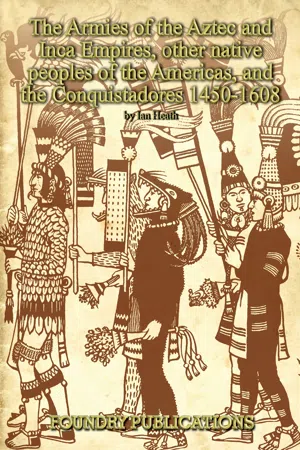 eBook - PDF
- Ian Heath(Author)
- 2009(Publication Date)
- Foundry(Publisher)
Mesoamerica c.1450–1600 THE Aztecs Though modern books tend to treat the so-called ‘Aztec Empire’ as if all of its people — especially those of the Valley of Mexico — shared the same origins, the Aztecs 15 were, in fact, just one of up to 40 Nahuatl-speaking Chichimec tribes which had migrated into Central Mexico in the 13th century, probably from the north-west, and subsequently overran the Toltec Empire. Other tribes involved in this migration included the following: Acolhua Huexotzinca Otomi Chalca Malinalca Tepaneca Cholulteca Matlatzinca Tlahuica Couixca Michoaca Tlaxcalteca Cuitlahuaca Mixtec Totonaca Culhua Nonoalca Xochimilca Most settled in the region where the principal town subsequently bore their name (the Cholulteca in Cholula, the Culhua in Culhuacan, the Xochimilca in Xochimilco, and so on). The most important of them — i.e. those which managed to retain their independence until the 16th century — are dealt with individually further on in this chapter. Early in the 14th century the Aztecs established the cities of Tenochtitlan and Tlatelolco on islands in Lake Texcoco in the Valley of Mexico, Tenochtitlan achieving ascendancy in 1428 by forming an alliance with the neighbouring city-state of Texcoco to overthrow the ruling Tepaneca people. Soon afterwards (1431) the city of Tlacopan (Tacuba) joined with Tenochtitlan and Texcoco to create the ‘Triple Alliance’, round which the so-called Aztec Empire grew. Expansion proceeded rapidly from the 1440s, with town after town being coerced or beaten into submission. Each subjugated community was permitted to retain its own ruler and gods, but was thereafter obliged to make regular payments of tribute to the storehouses of Tenochtitlan in order to maintain the empire’s administration, priesthood, and military potential; failure to do so brought swift and merciless retribution. eBook - PDF
The States of Mexico
A Reference Guide to History and Culture
- Peter Standish(Author)
- 2009(Publication Date)
- Greenwood(Publisher)
Meanwhile, another culture, that of the Toltecs, extended its own influence from their capital Tula in the central valley. In time, Toltec domi- nance gave way to migrants from the north. These migrants were speakers of the Nahua language, and from among them emerged the Aztec civiliza- tion, the most powerful civilization the invading Spaniards would encoun- ter in the early sixteenth century. The Aztecs had come to the central valley on a pilgrimage in search of a promised land, which according to legend they would be able to identify when they saw an eagle perched on a cactus and holding a snake in its mouth—hence the image at the center of the modern Mexican flag. The place the Aztecs found in the valley of Mexico and transformed into the center of their empire was a shallow lake, about seven feet deep on aver- age, which they called Texcoco. The Aztecs proceeded to reclaim parts of it for building and for cultivation: they made chinampas—reclaimed land—by placing stakes or reeds in the water in such a way as to fence off areas with basket-like structures, which they then filled with soil. In this way, they created land for what was to become a great city—one that in the early 1500s, when the Spaniards first saw it, was more populous than any in Europe, and was indeed one of the world’s largest, with perhaps 250,000 inhabitants. This was the city of Tenochtitl an, the Aztec capital, founded in 1325. The sight of it left the Spaniards awestruck: they were impressed by its scale, its structures, its orderliness, and its cleanliness. By the time the conquistadores arrived, Tenochtitl an was the center of a highly developed culture and a well-organized society; it was the political capital of an empire that the Aztecs had built by waging war on other In- dian peoples, bringing them into an uneasy federation where they paid tribute with taxes and human lives.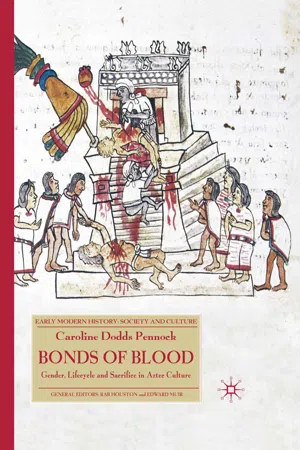 eBook - PDF
Bonds of Blood
Gender, Lifecycle, and Sacrifice in Aztec Culture
- Kenneth A. Loparo, Caroline Dodds Pennock(Authors)
- 2008(Publication Date)
- Palgrave Macmillan(Publisher)
By the sixteenth century, their great island capital of Tenochtitlan was the heart of a broad network of nearly 400 subject and allied cities from which the Aztecs drew regular and substantial tribute payments. 3 Not only wealth and goods flowed into the city but also great streams of 1 captives, tribute to fulfil the religious obligations of a society centred on human sacrifice. Ritual bloodshed was far more widely practised by the Aztecs than by any of the other indigenous peoples of the New World, and their brutal religious zeal was apparent in the awe-inspiring displays of violence which shaped the lives of the men and women of Tenochtitlan. In November 1519, the world of the Aztecs was devastated by the arrival of the largest European force yet seen in the New World. Led by Hernán Cortés, the Spanish conquistadors and their allies entered the Valley of Mexico and found themselves confronted with a culture for which their previous experiences had left them entirely unprepared. 4 Tenochtitlan was an astonishing sight for the Spanish invaders, and it both challenged and confirmed their ideals of civilization. The city seemed to them an ‘enchanted vision’ rising out of the lake. 5 A model of ordered architecture and activity, Tenochtitlan was probably the largest city any of the conquistadors had ever seen, with more than 200,000 people packed into 13 square kilometres of sophisticated urbanity. 6 The Spanish admired the stylish architecture, the vast and bustling marketplace, and the spotless, symmetrical streets. For the con- quistadors, accustomed to the dirty and cluttered nature of Spanish cities, the Aztec capital seemed a model of cleanliness and order. 7 Despite the undoubted sophistication of this vibrant culture, however, the horrifyingly alien custom of human sacrifice remained an unset- tling obstacle in the minds of the European observers. eBook - PDF
Ancient Oaxaca
The Monte Albán State
- Richard E. Blanton, Gary M. Feinman, Stephen A. Kowalewski, Linda M. Nicholas(Authors)
- 2022(Publication Date)
- Cambridge University Press(Publisher)
Mesoamerican Civilization in the Late Postclassic 17 governments, commercial sectors, and temple priesthoods. The organi- zation of the Aztec capital, Tenochtitlán, for example, allowed for the integration of immigrants – some from distant regions – into the popula- tion (Calnek 1978:317). In fact, the immigration of desired craft special- ists was encouraged. Several kinds of interregional institutions made possible the regulation of other categories of long-distance interaction. For example, the city of Tepeacac was conquered by the Aztecs and required to develop a new market in which long-distance traders could buy and sell the precious goods that were the cream of long-distance Mesoamerican commerce (Berdan 1980). The resources and finished products available here and in similar interregional markets included fine cotton cloth, semiprecious stones, tropical bird feathers, gold, silver, jaguar and ocelot skins, and cacao, among other goods. Long-distance trade required roads, institutions to ensure safe and secure passage, and human porters (tameme in Nahuatl). The Aztecs established garrisons to guard their borders and to control routes crucial to both military move- ment and commercial transactions (Smith 1996b). Additional outposts in conquered provinces served as sites of imperial tribute and tax collection. The Civilizational Tradition Although there were numerous local variations in religious belief and ritual, Mesoamerican peoples shared many fundamental concepts and practices of religion, cosmology, and ritual. Everywhere the cosmos was viewed as multilayered, with upper and lower worlds between which humans and supernatural beings moved; at death most persons traveled through the levels of the underworld. The lines of the cardinal directions were an additional dimension of cosmic spatial structure; their intersec- tion formed four quadrants that had color and other symbolic signifi- cance. eBook - PDF
- Victoria Kahn, Lorna Hutson(Authors)
- 1993(Publication Date)
- Yale University Press(Publisher)
Aztec Society The society which the Spaniards destroyed is best described in Jacques Soustelle’s obsessed little volume The Daily Life of the Aztecs . There was a league of three Indian states: Mexico, where the Aztecs lived, Texcoco, and the little kingdom of Tlacopan, clustering round the lake which is now the dust bowl where Mexico lies. The league was domi-nated by the city Tenochtitlán, which lay on the water like Venice, and was, in the opinion of those Spanish captains who had seen Rome and Constantinople, not less magnificent than those cities. From this capi-tal there was dispensed a peculiar economy. There was no monetary system, the land was nationalised, the emperor was the only capitalist, it was a welfare state, and the needs of the people in sickness and at times of fire and flood and famine were met by the state. This economy required a vast administrative personnel, and Tenochtitlán must have resembled a Washington that was all Pentagon and a London that was all Whitehall, though the comparison with Washington is the more apt, because the emperor was, like the president of the United States, also the commander-in-chief of the armed forces, as our monarchs are not. The society which he governed was split up into five classes, none of which was a leisure class. Everybody worked, nobody had any re-sources except their earned income, unless they had inherited what their parents had saved out of their income, but these sources were un-likely to be enough for them to live on, as the cost of the administrative machine meant that taxation was high. This is not at all unlike life in the United States and Britain as it has become since the Second World War or, at least, as it is becoming. True, the land is not nationalised, but all considerable properties are broken up by our death duties, and though fortunes are made out of real estate it is by development and not by mere acquisition. They had no monetary system, but that hardly seems to matter. No longer available |Learn more
Globalized Antiquity
Uses and Perceptions of the Past in South Asia, Mesoamerica, and Europe
- Manuel Baumbach, Wolfgang Gabbert, Maarten E.R.G.N. Jansen, Jamal Malik, Gabina Aurora Pérez Jiménez, Stefan Rebenich, Jakob Rösel, Jeremy A. Sabloff, Alain Schnapp, Ute Schüren, Daniel Marc Segesser, Clemens Six, Thomas Späth, Romila Thapar, Ute Schüren, Daniel M. Segesser, Thomas Späth(Authors)
- 2015(Publication Date)
- Reimer, Dietrich(Publisher)
Taking as a starting point the puzzling appearance of Postclassic Mixtec artifacts in a much earlier Zapotec tomb, this contri-bution offers a stimulating interpretation of the interrelatedness of the reuse of abandoned Classic sites, the creation concept, and the self-representation and legitimization of ruling elites. Such references provide royal lineages with a temporal depth reaching back into primordial moments or indicate new eras. Jansen points to the importance of ruptures and disjunctions as watersheds in the ordering of historical memory. Interestingly, some ideas in the historiography of the con-temporary Mixtec population basically conform to this scheme. The Aztecs (Nahuas) of Central Mexico, the Mixtecs and Zapotecs of the Oaxaca region (Southern Mexico), the Mayas of Eastern Mexico, Guatemala, Belize and Honduras, are among the better known peoples in the archaeology and indigenous history of Mesoamer-ica. By the time of the Spanish conquest in 1521, a multifaceted development over several thousand years had created an impressive cultural heritage. 1 The Formative, or Preclassic, Period saw the development of permanent architecture and writing in small settlements 1 For an archaeological overview, see, for example, E VANS 2013. 158 Maarten E.R.G.N. Jansen with stone monuments (approximately 1200 BCE –200 CE). The Classic Period demon-strates urbanism, advanced pictographic and hieroglyphic writing systems, and a flamboy-ant art style (approximately 200–900 CE); the Postclassic Period consists of a cultural revival after a major break from the eighth to the tenth centuries CE. During this Postclassic Peri-od – dominated by the Toltec and the Aztec Empires – there were several new artistic and technical achievements (such as metallurgy, introduced from Central- and South America). eBook - ePub
The Legacy of Mesoamerica
History and Culture of a Native American Civilization
- Robert M. Carmack, Janine L. Gasco, Gary H. Gossen, Robert M. Carmack, Janine L. Gasco, Gary H. Gossen(Authors)
- 2016(Publication Date)
- Routledge(Publisher)
A first step in seeing Mesoamerica as a world-system at the time of contact with Europe is to recognize that some of its component societies were dominant over others, and that as a result its diverse social units formed an integrated but stratified world. A second step is to understand that the Mesoamerican region was not under the political control of any single state, but instead it was an arena of competing political and economic (social) units. The most powerful Mesoamerican state at the time of Spanish contact was the Aztec empire, yet it controlled less than half of the territory in the Mesoamerican world. Furthermore, as already noted, other powerful, independent empires coexisted with the Aztecs. Mesoamerica at contact was tied together in important ways through economic bonds and thus constituted a “world economy” rather than a “world empire,” despite occasional claims by the Aztecs that they were rulers over the entire “civilized” world known to them.Students of Mesoamerica recognize that Central Mexico was the most influential area, or in world-system terms, the dominant core. As we have seen, however, the Mesoamerican world had other core zones in West Mexico, Oaxaca, Yucatan, and Guatemala. Adjacent to the core zones were located the socially dominated peripheral zones of Mesoamerica, in such regions as northwestern Mexico, northeastern Mexico, and southeastern Central America. The main semiperipheral zones of the Mesoamerican world-system can be identified primarily with zones specialized in trade and other commercial activities. These so-called semiperipheral zones functioned to bind the Mesoamerican world into a common economic system, largely by mediating between the unequal core and peripheral units. The most important semiperipheral unit in Mesoamerica at contact was probably Xicalanco on the Gulf Coast of southern Mexico, but other key semiperipheral units existed in northwest Mexico and along the Caribbean and Pacific coasts of Central America (Figure 3.1 eBook - ePub
Mexico and Its Religion
With Incidents of Travel in That Country During Parts of the Years 1851-52-53-54, and Historical Notices of Events Connected With Places Visited
- Robert Anderson Wilson(Author)
- 2007(Publication Date)
- Perlego(Publisher)
With this solution, the difficulty that occurred to Humboldt is in part removed, viz., that the allotted time—one hundred and seventy years—was too short a period in which to transform a tribe of North American Indians into a settled community. The remainder of the difficulty is explained by an event taking place in our own days. It is hardly thirty years since the Apache Indians began the systematic plunder of the northern states of Mexico, and now even these nomades begin to show the first glimmerings of civilization. Their captives teach them the use of much of the plunder they have brought to their own villages. Though their treatment of female captives is inhuman, yet it is not an uncommon thing for a captive to become a wife, and to introduce into her wigwam, and to inculcate upon the minds of her children, a few of the primary ideas of civilization. It is the commonly received notion that the Toltecs abandoned the table-land about the time of the arrival of the Aztecs, but continued to flourish in the region of the Gulf coast and in other parts of the hot country; that the vast ruins which abound in those regions were inhabited cities till within a few generations of the coming of the Spaniards; and that in Yucatan, the part most distant from Mexico, that civilization continued quite down to that period; that for a great portion of the one hundred and seventy years of their national existence, the Aztecs kept up predatory excursions into the Toltec region, and out of its dense population derived an inexhaustible supply of slaves and the plunder of civilization, included in which may have been the best wrought of the stone idols that are still preserved. So that the Aztec civilization resolves itself into the very ancient civilization of the Toltecs.PYRAMID OF PAPANTLA.We have removed to a greater antiquity, but have not got rid of the question of the origin of Mexican civilization. The year 600, named by Humboldt, may be considered as the time of their appearance on the table-land; out many of the ruins in the hot country might claim a thousand years earlier antiquity. These massive remains must have stood, abandoned as they are now, in the midst of the forest, for a long time before the Conquest, as their very existence was unknown to the Spaniards until near the close of the last century. The close resemblance between the apparently most ancient of these works, and those of the Egyptianss and other Eastern civilizations, does not involve the idea of a common origin or of intercourse, but only leads to the suggestion that the human race, in its progress, naturally follows the same path, whether upon the eastern or western continent, and that it is separated by a cycle of thousands of years from the civilization of our day. As a specimen of the works of the Toltecs, I insert a sketch of the pyramid of Papantla.
Index pages curate the most relevant extracts from our library of academic textbooks. They’ve been created using an in-house natural language model (NLM), each adding context and meaning to key research topics.

