History

William Lloyd Garrison
William Lloyd Garrison was a prominent American abolitionist and journalist who played a key role in the anti-slavery movement. He founded the influential newspaper "The Liberator" and was known for his uncompromising stance against slavery. Garrison's advocacy for immediate and complete emancipation made him a leading figure in the fight for abolition in the United States.
Written by Perlego with AI-assistance
Related key terms
1 of 5
11 Key excerpts on "William Lloyd Garrison"
 eBook - PDF
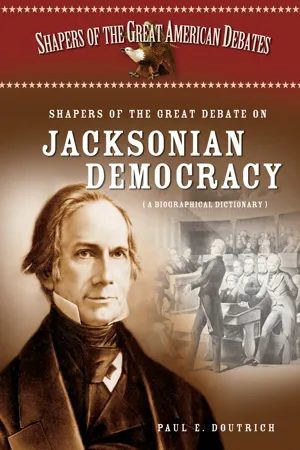
Shapers of the Great Debate on Jacksonian Democracy
A Biographical Dictionary
- Paul E. Doutrich(Author)
- 2004(Publication Date)
- Greenwood(Publisher)
WRITERS AND REFORMERS This page intentionally left blank William Lloyd Garrison (1805-1879) In an age of reform, William Lloyd Garrison was the era's preeminent social activist. In many ways, he was responsible for transforming an in- effective anti-slavery movement into an abolitionist crusade that dominated all other Jacksonian reform efforts. From a modest background with little formal education, Garrison apparently possessed few qualifications ex- pected of an influential leader. However, gripped by a profound religious belief and unbending commitment to rid American society of sin, he became a compelling and zealous advocate for change. A printer by trade, he used his vocation to force the nation to confront the slavery issue and in so doing he emerged as one of Jacksonian America's most powerful reformers. During his boyhood, Garrison developed the unbending religious beliefs and strong will that later characterized his crusading efforts. He was born on December 12, 1805. Seven years earlier his parents had migrated to Newburyport, Massachusetts, from Nova Scotia. His father worked as a seaman and eventually became a merchant ship pilot. By sailing under the American flag, he hoped to avoid growing hostilities between the British and the French. Ironically, in 1807 Jefferson's Embargo, which halted most American shipping activities, made it nearly impossible for the transplanted Canadian to ply his trade. Not long after, the elder Garrison, distraught and in debt, abandoned his family. William's mother, aided by the local Baptist Society, was able to sustain the family until a devastating fire swept through Newburyport and burned down the Garrison home. Afterward 176 Shapers of the Great Debate on Jacksonian Democracy five-year-old William was left with a family from the church while his mother, older brother, and two younger sisters moved to Lynn, thirty miles away, where Mrs.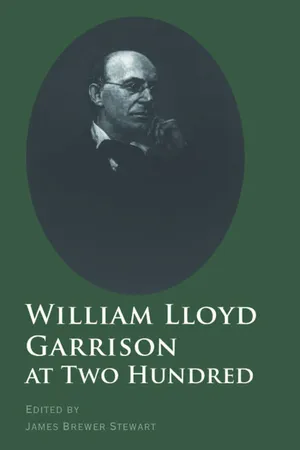 eBook - PDF
- James Brewer Stewart(Author)
- 2008(Publication Date)
- Yale University Press(Publisher)
1 1 William Lloyd Garrison at Two Hundred: His Radicalism and His Legacy for Our Time d a v i d w . b l i g h t What is man born for but to be a Reformer, a Re-maker of what man has made; a renouncer of lies; a restorer of truth and good, imitating that great Nature which embosoms us all, and which sleeps no moment on an old past, but every hour repairs herself, yielding us every morning a new day, and with every pulsation a new life? Let him renounce everything which is not true to him, and put all his practices back on their first thoughts, and do nothing for which he has not the whole world for his reason. —Ralph Waldo Emerson, ‘‘Man the Reformer,’’ 1841 William Lloyd Garrison is a storied, troubling, challenging, profoundly important, and controversial historical figure. Along with Frederick Douglass, there was no more significant American reformer in the nineteenth century. It was not always safe to be William Lloyd Garrison, in his hometown of Boston or anywhere in the United States. He was deeply loved and respected by his family and closest friends and followers. For many good reasons he was called Father Garrison by the beloved, turbulent, quarrelsome band known as the Garrisonians. And at home he was a fun-loving, kind husband and father who delighted in the household that Helen Benson Garrison, his wife, crafted for him. But in most of America he was vilified, hated, denounced—so much so that he was once nearly lynched as the most dangerous newspaper editor in the land, a role he often relished. eBook - ePub
Critics and Crusaders
Political Economy and the American Quest for Freedom
- Charles A. Madison(Author)
- 2018(Publication Date)
- Routledge(Publisher)
Early in 1866 a national testimonial was written by some of Garrison’s ardent admirers, signed by the leading men of the day, and presented to the public with the object of collecting the sum of fifty thousand dollars as a gift of the nation. These friends knew that their leader and his devoted wife had given no thought to providing for their old age. Two years later the couple were presented with a bank draft for $31,000. Garrison was particularly pleased to learn that the contributions had come from every part of the country and from all classes of society. A number of eminent Englishmen were equally glad to share in the testimonial, and they likewise exerted themselves to honor its recipient when he visited their country in 1867.On his return from Europe Garrison was urged to write the history of the anti-slavery movement. Willing though he was to undertake the task, he found himself too intimately connected with the subject to treat it objectively. He became instead a regular paid contributor to the New York Independent , and wrote some hundred articles on topics and problems of interest to him. Although he continued to write in behalf of the Negro, and although he favored such reforms as woman’s rights, prohibition, and free trade, he was no longer the apostolic crusader. The newer and more complex issues were outside his moral ken. The fire in his soul which had blazed for more than thirty-five years with such intensity as to make every utterance bright with passion, having no longer a congenial subject to seize upon, was reduced to a flicker. Unlike his comrade Wendell Phillips he preferred to assume that with the abolition of slavery the country had become relatively free of social ills—with the result that long before his death in 1879 he was almost forgotten.The Jubilee of Emancipation lifted William Lloyd Garrison to the pinnacle of popular esteem. Only Abraham Lincoln, after his martyrdom, was more admired by the mass of Americans. Then came the harsh period of Reconstruction, with the exploitation of the South, and of the country as a whole, by ruthless and greedy adventurers. It was during this period that Garrison’s reputation suffered an eclipse that has persisted to the present. The generation of the Gilded Age was only too eager to forget the struggle against slavery. Few of the sons of Abolitionists possessed the moral fervor of their fathers. Most of them were subconsciously sick of the Civil War and the causes that had brought it about. They interested themselves in making money, in exploiting a continent opened to them by a lax and lavish government. As a consequence, and especially after the South had resumed its legitimate part in the affairs of the nation, the man who was most responsible for the liberation of millions of Negro slaves came to be remembered, if at all, not for his inspired leadership but for his querulous fanaticism.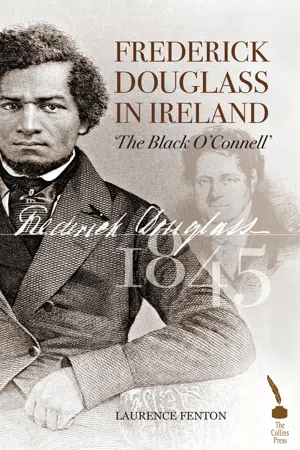 eBook - ePub
- Laurence Fenton(Author)
- 2014(Publication Date)
- The Collins Press(Publisher)
He wanted ‘to raise the moral tone of the country’ and at first put his energies into the burgeoning temperance movement. 10 Then, in 1829, he started work on the Baltimore-based Genius of Universal Emancipation, edited by the Quaker Lundy. (This was about the same time that the young Douglass was playing on the docks in Baltimore.) Inspired by Lundy, a thin, wispy man who had travelled on foot across much of America, quietly convincing many slaveholders to manumit their slaves, Garrison took the fateful decision to make anti-slavery his life’s work. More specifically, he made abolition his cause: the immediate – not gradual – emancipation of all slaves, without compensation for slave owners and without deportation of the freed people to Haiti or Africa, as proposed by other anti-slavery activists. Garrison quickly made a name for himself, printing graphic accounts of the murders of slaves and attacking other Baltimore papers for accepting advertisements for local slave auctions. He was convicted of libel for an article denouncing a wealthy merchant’s participation in the slave trade. Garrison refused to pay the fine of $50 (about three months’ pay) and was jailed for forty-nine days. ‘A few white victims must be sacrificed to open the eyes of this nation, and to show the tyranny of our laws,’ he declared, happily assuming the mantle of a martyr. ‘I am willing to be persecuted, imprisoned and bound for advocating African rights, and I should deserve to be a slave myself, if I shrunk from that duty or danger.’ 11 Still in his mid-twenties, Garrison moved to Boston, launching The Liberator on 1 January 1831. ‘I am aware that many object to the severity of my language, but is there not cause for severity?’ he asked in the paper’s first editorial, continuing: I will be as harsh as truth and as uncompromising as justice. On this subject, I do not wish to think or speak or write with moderation eBook - PDF
The Rise of Aggressive Abolitionism
Addresses to the Slaves
- Stanley Harrold(Author)
- 2014(Publication Date)
- The University Press of Kentucky(Publisher)
INTRODUCTION On three occasions during the early 1840s an American anti-slavery leader, speaking before a northern audience, claimed to address the Slaves of the United States. Each did so, however, in a highly tentative manner. On January 19, 1842, Gerrit Smith, the wealthy white philanthropist who led po-litical abolitionists in upstate New York, urged slaves to dis-regard state and federal law by escaping. But simultaneously he called on them to obey their masters and not use violent means. On May 31, 1843, William Lloyd Garrison, the most famous white abolitionist, proclaimed that in the name of the Declaration of Independence slaves might wade through their masters' blood if necessary to free themselves. But he added that it was too dangerous for northern abolitionists to go south to help them. On August 17, 1843, black abolition-ist Henry Highland Garnet, a Presbyterian clergyman, ad-vised faraway slaves that they had better die in confrontations with their oppressors than remain in bondage. But he then warned them against initiating revolt. 1 The period stretching from before the War for Independence to after the Civil War produced a huge and varied antisla-very literature that in turn has attracted the interest of an-thropologists, historians, literary scholars, and sociologists. There are essays, letters, slave narratives, novels, plays, po-etry, proceedings, and speeches. Much of this material first 1 2 The Rise of Aggressive Abolitionism appeared in antislavery newspapers. Some of it, such as Frederick Douglass's Narrative and Harriet Beecher Stowe's Uncle Toms Cabin, still enjoys a wide audience. The words with which Garrison initiated his weekly newspaper, the Lib-erator, in 1831 (I am in earnest—I will not equivocate—I will not excuse—I will not retreat a single inch—AND I WILL BE HEARD.) are among the more famous in Ameri-can history.
- David W. Bulla, Gregory A. Borchard, Kimberly Wilmot Voss(Authors)
- 2023(Publication Date)
54 Later, in the fall, the Waterford Chronicle in Ireland reported that Garrison wisely was absent from a meeting on abolition in New York. The purpose of the meeting was to resolve in favor of immediate emancipation of the slaves in the United States. The Chronicle article stated that Garrison’s “only crime” was trying to emulate British abolitionists like Wilberforce and Clarkson. If Garrison had appeared, he would have been “tarred and feathered.” The writer added: “Whatever opinion may be entertained as to the policy of the immediate abolition of slavery throughout America, a people who pride themselves on their free institutions might have at least heard with temper a proposal to relieve two millions of their fellow creatures from slavery.” 55 The Reading Mercury reported in November 1833 that Garrison had published in August a pamphlet entitled “An Appeal to the Friends of Negro Emancipation throughout Great Britain.” (The same story would appear in the Aris’s Birmingham Gazette, the Bath Gazette, and the Manchester Times. The Glasgow Emancipation Society would later reprint it.) In the pamphlet, Garrison appealed to the British sense of family and treating women well, detailing in contrast how slave masters broke up families, and how children were “ruthlessly torn from their [parents’] arms.” 56 The Mercury story included Garrison’s description of female slaves being placed onto scales and “sold like meat by the pound.” The Mercury noted that, due to the successes of abolitionists in England, “it appears the spirit of abolition is traversing the whole length and breadth of the United States.” 57 An influential British abolitionist was George Thompson, a native of Liverpool whose father had worked on a slave-trading ship. He joined the Anti- Slavery Society of London in 1831. Garrison met Thompson in Scotland, and they became friends. eBook - ePub
Abolitionist Twilights
History, Meaning, and the Fate of Racial Egalitarianism, 1865-1909
- Raymond James Krohn(Author)
- 2023(Publication Date)
- Fordham University Press(Publisher)
3 Antislavery VindicatedOliver Johnson and the Value of Abolitionism’s Grand Old PartyToward the end of a revised and expanded 1881 biography, Oliver Johnson declared that any open-minded student of abolitionism could not fail to see that William Lloyd Garrison’s “relation to it was like that of the North star to the slave in his flight from the Southern prison-house, and that the band he led was always at the battle’s front.” For the veteran abolitionist ruminating on a dear friend and fellow activist, whose death had occurred in 1879, the Liberator’s editor undoubtedly constituted a revelatory source of inspiration. In William Lloyd Garrison and His Times; or, Sketches of the Anti-Slavery Movement in America, and of the Man Who Was Its Founder and Moral Leader, Johnson paid tribute and personally testified to an epochal career. As the title suggests, the author also operated as a partisan historian. The book’s nearly five hundred pages demonstrate that despite dedicating the volume to antislavery advocates of every stripe, he had no intentions of celebrating all things abolitionism indiscriminately. Vindicating a departed comrade therefore structured the retrospective writer’s thoughts and formed a blueprint for the remainder of his public life.1Before embarking on a lengthy memorial, Johnson honored the living Garrison at an 1874 antislavery reunion in Chicago, where an attendee read his biographical portrait aloud. He also eulogized the deceased Garrison in the New-York Tribune and an 1879 pamphlet. The newspaper panegyric specifically resulted in more widespread reminiscing. At Whitelaw Reid’s editorial request, he produced a Tribune column that appeared on a weekly-to-biweekly basis over a seven-month span. Totaling twenty-one installments, “The Fall of Slavery. Recollections of an Abolitionist” established a groundwork for the larger undertaking, one that went beyond an extended obituary. Since the remembered Garrison represented the first American philanthropist “to unfurl the banner of IMMEDIATE AND UNCONDITIONAL EMANCIPATION, and to organize upon that principle a movement which, under God, proved mighty enough to accomplish its object,” he appropriately lay at the center of Johnson’s commemorative universe. To craft a fuller story of abolitionism, the memorialist featured a constellation of Garrisonian reformers, too.2 eBook - PDF
William Jay
Abolitionist and Anticolonialist
- Stephen Budney(Author)
- 2005(Publication Date)
- Praeger(Publisher)
"I Am an Abolitionist, and I Thank God I Am" And think you that this is the country, and this is the age, in which the republican maxim that the MAJORITY must govern, can be so long and barbarously reversed? Think you that the majority of the PEOPLE in the cotton states, cheered and encouraged as they will be by the sympathy of the world, and the example of the West Indies, will for- ever tamely submit to be beasts of burden for a few lordly planters? —William Jay to the nonslaveholders of the South, 1843 JLn 1840, the American Anti-Slavery Society (AASS) was torn asun- der, experiencing the "end of harmonious action" that Jay had pre- dicted. Historians have offered up myriad explanations as to what finally precipitated the fragmentation that had loomed, quite liter- ally, since the organization's inception. Undoubtedly the unconven- tional William Lloyd Garrison alienated many potential antislavery converts with his methods. There was also increasing dissatisfac- tion over the realization that Garrisonian philosophy remained an impediment to the greater political involvement proposed by many members outside of his Massachusetts circle. 1 There was also the "woman question." Portraying this element of the debate as the cynosure of the increasing factionalism within the society is 3 I 56 William Jay erroneous, but it certainly contributed to the process of the society's disintegration. Moving from the protofeminism of the moral reform movement, activist women had found that Garrison's willingness to include them, even granting them positions of authority within the society, provided a framework for the development of feminist thought. 2 Women advanced from auxiliary antislavery work to active partici- pation in the Massachusetts chapter of the society. For those in the immediate Garrison circle, the increasingly vocal—and socially vis- ible—involvement of the women was acceptable; those outside the circle found the trend unsettling to say the least. eBook - ePub
- Ronald Hamowy(Author)
- 2008(Publication Date)
- SAGE Publications, Inc(Publisher)
AA BOLITIONISMAbolitionism is the term used to describe the radical wing of the American antislavery movement during the 19th century. In the United States, the leading abolitionist was William Lloyd Garrison, a tenacious speaker, writer, organizer, and publisher who launched his influential periodical, The Liberator, in January 1831.Abolitionism is distinguished by its opposition to gradualism. Thomas Jefferson and other gradualists, although condemning slavery as a horrendous evil, believed it should be phased out over many years so as to lessen the harmful effects on southern agriculture. Moreover, many gradualists believed that African Americans could not be successfully assimilated into American society. They supported a policy known as colonization, which called for freed slaves to be transported to colonies overseas.Garrison and his followers, such as Wendell Phillips, were fierce critics not only of gradualism and colonization, but also of the racial prejudices that were endemic among many proponents of these schemes. They accordingly called for equal civil and political rights for African Americans.The significance of abolitionism in the history of libertarian thought lies in its stress on self-ownership. The right of the slave to himself, Garrison argued, is “paramount to every other claim.” Hence, utilitarian considerations, such as the impact that abolition might have on the southern economy, should not override the moral right of the slave to his or herself. This moral argument was essential to the call for immediate abolition. Abolitionists knew the eradication of slavery would take time, even under the best of circumstances, but they insisted that no pragmatic considerations should take precedence over the moral claim of self-ownership.This stress on self-ownership is illustrated by the label manstealer
- Dickson D. Bruce(Author)
- 2001(Publication Date)
- University of Virginia Press(Publisher)
41African Americans continued to encourage Garrison’s effort, and he continued to make clear how important that encouragement was to him. In the preface to a printing of what must have been the version of the address delivered in several places, he made clear that his remarks were being published at the request of his “colored brethren, in the various cities” where he had spoken. Whatever his motives, his effort to demonstrate black approval for his assuming the role of anticolonization spokesperson created the kind of discursive situation he and his supporters had hoped for, drawing on the resources of each to carry their message to a broader world.42No less revealing of this project was the way the Liberator became a primary outlet for the publication of African American statements on the subject. In April 1831 the resolutions of a Baltimore anticolonization meeting appeared in the paper, declaring the society to be “founded more in a selfish policy, than in the true principles of benevolence.” Garrison himself added editorially, “With such a knowledge of the feelings of the colored people—feelings which ought to be tenderly regarded—will really benevolent men continue to sustain this Society?” (2 April 1831). In October the address of a group in Rochester appeared, pointing out that “we do not consider Africa to be our home, any more than the present whites do England, Scotland, or Ireland” and declaring opposition to colonization and, significantly, declaring their intention “to do all in our power to support the Liberator, printed by Mr Garrison, and all other works in our behalf” (29 October 1831). eBook - ePub
Frederick Douglass
A Biography
- Charles W. (Charles Waddell) Chesnutt(Author)
- 2004(Publication Date)
- Perlego(Publisher)
Freeman, assailed Douglass fiercely, and charged him with treachery, inconsistency, ingratitude, and all the other crimes so easily imputed to one who changes his opinions. Garrison and Phillips and others of his former associates denounced him as a deserter, and attributed his change of heart to mercenary motives. Douglass seems to have borne himself with rare dignity and moderation in this trying period. He realized perfectly well that he was on the defensive, and that the burden devolved upon him to justify his change of front. This he seems to have attempted vigorously, but by argument rather than invective. Even during the height of the indignation against him Douglass disclaimed any desire to antagonize his former associates. He simply realized that there was more than one way to fight slavery,—which knew a dozen ways to maintain itself,—and had concluded to select the one that seemed most practical. He was quite willing that his former friends should go their own way. "No personal assaults," he wrote to George Thompson, the English abolitionist, who wrote to him for an explanation of the charges made against him, "shall ever lead me to forget that some, who in America have often made me the subject of personal abuse, are in their own way earnestly working for the abolition of slavery."In later years, when political action had resulted in abolition, some of these harsh judgments were modified, and Douglass and his earlier friends met in peace and harmony. The debt he owed to William Lloyd Garrison he ever delighted to acknowledge. His speech on the death of Garrison breathes in every word the love and honor in which he held him. In one of the last chapters of his Life and Times he makes a sweeping acknowledgment of his obligations to the men and women who rendered his career possible."It was my good fortune," he writes, "to get out of slavery at the right time, to be speedily brought in contact with that circle of highly cultivated men and women, banded together for the overthrow of slavery, of which William Lloyd Garrison was the acknowledged leader. To these friends, earnest, courageous, inflexible, ready to own me as a man and a brother, against all the scorn, contempt, and derision of a slavery-polluted atmosphere, I owe my success in life."VIII.
Events moved rapidly in the decade preceding the war. In 1850 the new Fugitive Slave Law brought discouragement to the hearts of the friends of liberty. Douglass's utterances during this period breathed the fiery indignation which he felt when the slave-driver's whip was heard cracking over the free States, and all citizens were ordered to aid in the enforcement of this inhuman statute when called upon. This law really defeated its own purpose. There were thousands of conservative Northern men, who, recognizing the constitutional guarantees of slavery and the difficulty of abolishing it unless the South should take the initiative, were content that it should be preserved intact so long as it remained a local institution. But when the attempt was made to make the North wash the South's dirty linen, and transform every man in the Northern States into a slave-catcher, it wrought a revulsion of feeling that aroused widespread sympathy for the slave and strengthened the cause of freedom amazingly. Thousands of escaped slaves were living in Northern communities. Some of them had acquired homes, had educated their children, and in some States had become citizens and voters. Already social pariahs, restricted generally to menial labor, bearing the burdens of poverty and prejudice, they now had thrust before them the spectre of the kidnapper, the slave-catcher with his affidavit, and the United States [Supreme] Court, which was made by this law the subservient tool of tyranny. This law gave Douglass and the other abolitionists a new text. It was a set-back to their cause; but they were not entirely disheartened, for they saw in it the desperate expedients by which it was sought to bolster up an institution already doomed by the advancing tide of civilization.
Index pages curate the most relevant extracts from our library of academic textbooks. They’ve been created using an in-house natural language model (NLM), each adding context and meaning to key research topics.

