What is Epic Poetry?

MA, English Literature (University College London)
Date Published: 10.12.2024,
Last Updated: 10.12.2024
Share this article
Introducing epic poetry
Epic poetry is characterized by its long length, grand language, and narratives in which mighty characters are involved in seismic (and often supernatural) events with crucial importance for the culture at large. The oldest epics grew out of a rich oral tradition, and form some of the earliest and most influential works of literature that survive today. Fittingly, then, the impact of epic poetry is truly epic in scale.
Many of us have preconceived notions of what “epic” means based on our modern cultural background — we may think of huge, sweeping, “epic” movies like Gladiator (Scott, 2000), for example.
In Classical Literature, Richard Rutherford explains that,
we all feel we know what ‘epic’ means. Hardly a week goes by without some claim that a new Hollywood blockbuster is epic in scope. (2008)
Richard Rutherford
we all feel we know what ‘epic’ means. Hardly a week goes by without some claim that a new Hollywood blockbuster is epic in scope. (2008)
Rutherford argues, however, that scale alone is not enough for a poem to be defined as epic: “we need to distinguish between epic form and epic spirit” (2008). In Rutherford’s view, the main characteristics of epic poetry are as follows:
- An epic is a “lengthy work, often extending to many thousands of lines,” and “almost universally composed in the metre which Homer used, a long and swiftly moving line known as the dactylic hexameter, and in a dignified, self-consciously elevated style.”
- “Certain formal features are particularly frequent in epic: an invocation of the inspiring Muse is one; others are the extended simile and the use of elaborate speeches.”
- Rather than solely focusing on individual lives, “the scope of the genre often embraces major events, events of historical or even cosmic import (the destruction of Troy, the foundation of Rome, the fall of the Roman Republic; in Milton, the Fall of Man).”
- “Both the length of the work and a large cast of characters make the reader conscious of the narrative as significant, an effect often reinforced by the involvement of supernatural powers.”
- “Epic records great events or great achievements, often involving great suffering: the characters are noble or at least exceptional.” (2008)
It is not just the length of the poems that makes them “epic”, then, but also the grand themes and subjects they deal with. In some ways, epic poetry’s expansive length is a natural result of the ambition and range of its subject matter.
In Epic, Paul Innes highlights the importance of epic poetry’s oral origins:
[…] it should not be forgotten that the epic developed out of a communal impetus to cultural memory before it became a written form. The verbal and performative elements play off against the literary in different ways for different cultures [...]. (2013)
Paul Innes
[…] it should not be forgotten that the epic developed out of a communal impetus to cultural memory before it became a written form. The verbal and performative elements play off against the literary in different ways for different cultures [...]. (2013)
Homer’s epic poems are a key example of this: Arising out of a rich and long oral tradition of myth and legend, Homer gave these ancient stories a definitive shape and authority with his written versions of them. Although they did not originate with Homer, the stories of the Iliad and the Odyssey are now inextricably identified with his written versions of them purely because they are the only surviving forms. Epic poetry becomes the written embodiment of cultural memory and is foundational to a culture’s very identity:
Its cultural importance was such that entire societies could be defined by and through it. Ancient Greece produced Homer’s Iliad and Odyssey; Rome had Virgil and the Aeneid. In the Judaeo-Christian tradition, the first five books of the Old Testament could be considered to be an epic. Later books that deal with the establishment of the Kingdoms of Judea and Israel could additionally be defined as variants of historical epic. (Innes, 2013)
Innes highlights this cultural importance as a key characteristic of epic poetry’s identity:
The epic in this view is an identifiable literary form with a crucial cultural prominence. Its scope lends itself to grand narratives that incorporate various myths of origin intermingled with memories of historical events and personages. (2013)
We will explore the defining features and mechanisms of epic poetry further in the next section, focusing on some of the most famous works of epic poetry ever created.
Epic poetry: notable examples
The epic poetry that survives today constitutes a vast body of work — drawn from different cultures, and ages, but nevertheless sharing similar epic qualities.
Let’s zoom in, and take a look at just some of the most notable examples of “epic poetry” and what it is that actually makes them “epic.”
The Epic of Gilgamesh
One of the earliest surviving works of literature, The Epic of Gilgamesh is also the earliest surviving example of epic poetry. A Sumerian epic from ancient Mesopotamia, The Epic of Gilgamesh’s earliest oral stories are thought to date back to c. 2100 BCE. In The History of the Epic, Adeline Johns-Putra argues that
Gilgamesh contains that element that we perhaps most closely connect to epic – heroism. For Gilgamesh sets out, as so many subsequent epics do, a narrative of great and courageous deeds against the backdrop of watershed historical and even prehistorical events. (2006)
Adeline Johns-Putra
Gilgamesh contains that element that we perhaps most closely connect to epic – heroism. For Gilgamesh sets out, as so many subsequent epics do, a narrative of great and courageous deeds against the backdrop of watershed historical and even prehistorical events. (2006)
The story of Gilgamesh begins with his tyrannical rule over Uruk, and his titanic fight with Enkidu (a wild man, representing the natural world and created by the gods as an antithetical countermeasure to Gilgamesh). Enkidu and Gilgamesh then become close friends, embarking on a series of adventures together which anger the gods and eventually result in Enkidu’s death. Gilgamesh then seeks to discover the secret of immortality, before finally accepting his mortality at the poem’s end.
With the hero Gilgamesh’s struggle against supernatural forces and mortality itself, The Epic of Gilgamesh exhibits many of the classic hallmarks of epic poetry. It has left an indelible print on human culture, history, and religion — not least with its influence on the epics of Homer and even the Bible (scholars have noted many biblical parallels, such as the story of Adam and Eve and the great flood myth).
Homeric epics: the Iliad and the Odyssey
The Iliad and the Odyssey (both c. 8th century B.C.E.) are some of the earliest surviving written works from the civilization of ancient Greece. There are still many debates around the precise authorship of these poems: Homer is most commonly credited as the author of both works, but some scholars support the idea of multiple authors instead. Whatever the true circumstances of their conception may be, the Iliad and the Odyssey are the most famous and influential epic poems in history — it is difficult to overstate the titanic influence they have had on Western culture, in particular. As Richard Rutherford writes, “The special prestige of epic derives from its prominence at the earliest stages of the classical tradition”:
The Homeric poems stand at the fountain-head of classical literature, and although parodists or pedagogues might find fault with some aspects, in antiquity their rank was never seriously questioned. Aristophanes called Homer ‘divine’; others simply refer to him as ‘the poet’ — no confusion was possible. These poems were often compared with the Ocean surrounding the whole world, the source on which, in early geographic conceptions, all lesser rivers were dependent. Similarly epic could be seen as the source for other later genres, notably tragedy, comedy, and historiography[…]. (2008)
The Iliad depicts a great conflict between the Greeks and the Trojans that is set into motion after Helen (seemingly the most beautiful woman in the world) is taken to Troy by Paris, a Trojan prince. The long siege of Troy forms the backdrop of the plot, but the Iliad is about more than just a military conflict. Heroes and gods proliferate, and one of the most significant threads is centred around the need to convince Achilles, the great Greek hero, to actually take part in the conflict.
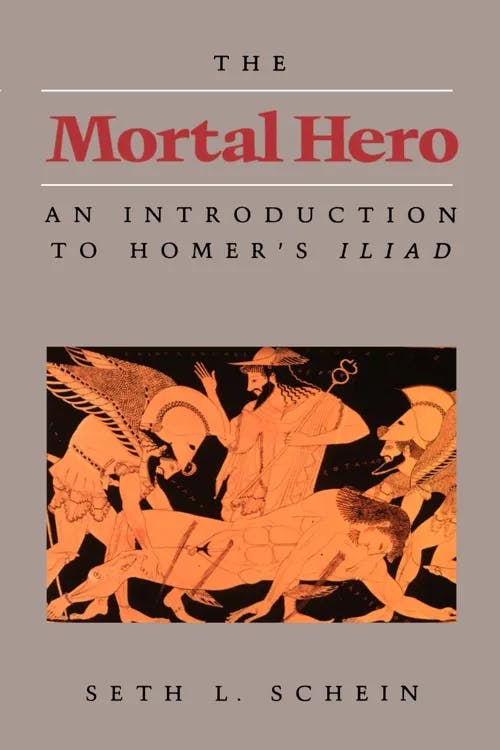
The Iliad stands as “the earliest example of Western literature, the first work in a long tradition of heroic narrative” (Seth L. Schein, The Mortal Hero, 2023). It is notoriously difficult, however, to identify precise dates for the Iliad’s composition and the oral stories it draws from. In his introduction to the Iliad, Peter Green writes
It seems safe enough to date the composition of the poem as we know it to a period after the introduction of an adapted Phoenician/Semitic alphabet to Greece in the late ninth or early eighth century B.C.E. Just how long after remains uncertain and much debated. However, we need to balance this conclusion against the equally certain fact that the main body of the Trojan War myth clearly long preceded the composition of the Iliad in its present form [...]. (2015)
Homer
It seems safe enough to date the composition of the poem as we know it to a period after the introduction of an adapted Phoenician/Semitic alphabet to Greece in the late ninth or early eighth century B.C.E. Just how long after remains uncertain and much debated. However, we need to balance this conclusion against the equally certain fact that the main body of the Trojan War myth clearly long preceded the composition of the Iliad in its present form [...]. (2015)
As with The Epic of Gilgamesh, it is always important to bear in mind the oral beginnings of these early epic poems — they draw on myths which had been told and retold, deconstructed and reconstructed, for generations. Green writes that
in one sense The Iliad does not stand, unprecedented, at the beginning of European literature as we know it, but comes at the very end (with the appearance in Greece of alphabetic writing ) of an age-old oral tradition, of which it displays the unmistakable influence throughout. (2015)
In The Mortal Hero (2023), Schein argues that the Iliad undercuts its own traditional representations, questioning the meaning of heroism, conflict, and mortality itself:
Its style, mythological content, and heroic themes and values are traditional, but it generates its distinctive meanings as an ironic meditation on these traditional themes and values. Through parallels, contrasts, and juxtapositions of characters and actions, a dramatic structure is created that forces us to consider critically the traditional heroic world depicted in the poem and the contradictions inherent in this kind of heroism. The overwhelming fact of life for the heroes of the Iliad is their mortality, which stands in contrast to the immortality of the gods. (2023)
Seth L. Schein
Its style, mythological content, and heroic themes and values are traditional, but it generates its distinctive meanings as an ironic meditation on these traditional themes and values. Through parallels, contrasts, and juxtapositions of characters and actions, a dramatic structure is created that forces us to consider critically the traditional heroic world depicted in the poem and the contradictions inherent in this kind of heroism. The overwhelming fact of life for the heroes of the Iliad is their mortality, which stands in contrast to the immortality of the gods. (2023)
Schein uses the hero Achilles and his journey as an example of this:
We see the central hero of the poem, Achilles, move toward disillusionment and death to reach a new clarity about human existence in the wider context of the eventual destruction of Troy and in an environment consisting almost entirely of war and death. This environment offers scope for various kinds and degrees of heroic achievement, but only at the cost of self-destruction and the destruction of others who live in the same environment and share the same values. (2023)
This ambiguity has perhaps contributed to the Iliad’s enduring popularity through the ages, and up to the present day:
Modern critics join those of antiquity in praising the Iliad’s unparalleled subtlety, depth, overall structure, emotional force, and universal appeal. Two and a half millennia later that appeal has lost none of its pristine force [...]. (Green, 2015)
In the 21st century, the Odyssey would undoubtedly be marketed as a sequel to the Iliad, as it depicts the long homeward journey of Odysseus after the war. Returning home and reuniting with his family is the underlying goal behind all the action. Many critics have argued that the Odyssey critiques the Iliad in various aspects, with its treatment of heroism and glory being just one example. While Achilles is happy to die for the glory of his legacy in the Iliad, in the Odyssey his spirit can be found espousing the opposite view altogether: he avows that he would rather live an inglorious life than embrace his death.
Odysseus is a different kind of epic hero to Achilles; renowned more for his cunning and wits than for his martial prowess. Famously, it is Odysseus who supposedly concocted the ploy of the Trojan Horse, which effectively won the war for the Greeks. In the Odyssey, he draws on his cunning to repeatedly escape sticky situations which others might fall prey to. One of the most famous examples is found with his triumph over the Cyclops Polyphemus: Odysseus, after previously telling Polyphemus that his name is “Nobody,” manages to get Polyphemus drunk and blind him. When Polyphemus is asked who has hurt him, he cries out “Nobody” — meaning that nobody comes to his aid, and Odysseus is able to escape.
With his war-winning, death-defying cunning, Odysseus reflects Eleazar M. Meletinsky’s profile of an archaic hero:
in archaic epics a heroic character becomes manifest in actions that have significance for the survival of the culture. There is usually an air of magic surrounding the hero, since magic and cunning are just as much part of the hero's repertoire as courage and physical strength. (The Poetics of Myth, 2013)
Eleazar M. Meletinsky
in archaic epics a heroic character becomes manifest in actions that have significance for the survival of the culture. There is usually an air of magic surrounding the hero, since magic and cunning are just as much part of the hero's repertoire as courage and physical strength. (The Poetics of Myth, 2013)
A library of epics
We have only scratched the surface of epic poetry with the examples above. For a fuller exploration, Perlego’s online library provides extensive coverage. A small selection can be found below:
- The Ramayana (c. 7th century BCE – 3rd century CE) by Valmiki
- Mahabharata (c. 3rd century BCE – 4th century CE) by Vyasa
- The Aeneid (c. 19 BCE) by Virgil
- Beowulf (c. 975–1025)
- The Divine Comedy (c. 1321) by Dante
- Paradise Lost (1667) by John Milton
- Paterson (1946–58) by William Carlos Williams
- Omeros (1990) by Derek Walcott
The legacy of epic poetry
As in all genres, the later writers reshape or rethink the tradition, reacting to and often fighting against the work of their predecessors. This is inevitable in any literary tradition but is perhaps especially conspicuous in epic […]. (Rutherford, 2008)
From its oral beginnings, epic poetry has evolved into a discrete genre of poetry with truly epic levels of variety. Spanning multiple millennia and continents, the story of epic poetry continues to be written today. One intriguing thread of epic influence is outlined here by Innes:
[Epic poetry] passes through various stages, with particularly critical resonance for English poetry as it accompanies the development of a nascent British Empire. Spenser and Milton both, in their own ways, seed their work with a peculiarly Protestant epic ethos. Recent modern writing such as Walcott’s Omeros and Atwood’s Penelopiad revisit this long history through their respective post-colonial and feminist intertextual retrospectives. (2013)
Paul Innes
[Epic poetry] passes through various stages, with particularly critical resonance for English poetry as it accompanies the development of a nascent British Empire. Spenser and Milton both, in their own ways, seed their work with a peculiarly Protestant epic ethos. Recent modern writing such as Walcott’s Omeros and Atwood’s Penelopiad revisit this long history through their respective post-colonial and feminist intertextual retrospectives. (2013)
Although contemporary epic poetry is no longer as common as it once was, the epic spirit and influence lives on in poetry and many other forms — including novels, films, TV, and even video games. There are countless examples of works in these mediums which bear striking similarities with the epic poems of old: from their grand scope and subject matter to the involvement of the supernatural, and the centrality of heroic figures who win mighty victories of decisive importance for their culture at large.
The ancestors of epic poetry can be found in the rise of the epic novel, for example, as well as the epic fantasy series which have enjoyed enormous popularity. These modern manifestations of the epic may have more in common with their ancient poetic progenitors than we might expect — as long as they are epic in both spirit and scale, that is: “Thus War and Peace or The Lord of the Rings can be said to have something of the epic scope or spirit, although their medium is narrative prose” (Rutherford, 2008). In the narratives we enjoy today, ancient epic traditions continue to live on.
Further reading on Perlego
- Poetics (c. 335 BCE) by Aristotle
- Structures of Epic Poetry (2019), edited by Christiane Reitz and Simone Finkmann
- Homer and Early Greek Epic (2019) by Margalit Finkelberg
- The Oral Epic (2021) by Karl Reichl
- The Renaissance Epic and the Oral Past (2012) by Anthony Welch
Epic poetry FAQs
What is epic poetry in simple terms?
What is epic poetry in simple terms?
What is an example of an epic poem?
What is an example of an epic poem?
What are the best books on epic poetry?
What are the best books on epic poetry?
Bibliography
Anonymous (2016) Beowulf. Simon & Schuster. Available at: https://www.perlego.com/book/779772
Dante (2018) The Divine Comedy. Alma Classics. Available at: https://www.perlego.com/book/1310114
Dutt, R. (2012) The Ramayana and Mahabharata Condensed into English Verse. Dover Publications. Available at: https://www.perlego.com/book/111579
Green, P. (2015) “Introduction,” in Homer, The Iliad. Translated by Peter Green. University of California Press. Available at: https://www.perlego.com/book/552616
Homer (2015) The Iliad. Translated by Peter Green. University of California Press. Available at: https://www.perlego.com/book/552616
Homer (2009) The Odyssey of Homer. Translated by Richmond Lattimore. HarperCollins e-books. Available at: https://www.perlego.com/book/594744
Innes, P. (2013) Epic. Routledge. Available at: https://www.perlego.com/book/1627275
Johns-Putra, A. (2006) The History of the Epic. Palgrave Macmillan. Available at: https://www.perlego.com/book/3498850
MacKendrick, P. et al. (2012) Classics in Translation, Volume I. University of Wisconsin Press. Available at: https://www.perlego.com/book/4386256
Meletinsky, E. (2013) The Poetics of Myth. Translated by Guy Lanoue and Alexandre Sadetsky. Routledge. Available at: https://www.perlego.com/book/1607949
Milton, J. (2014) Milton: Paradise Lost. 2nd edn. Edited by Alastair Fowler. Taylor and Francis. Available at: https://www.perlego.com/book/1555316/milton-paradise-lost-pdf
Mitchell, S. (2010) Gilgamesh. Atria Books. Available at: https://www.perlego.com/book/779950
Nohrnberg, J. (2014) Princeton Legacy Library. Princeton University Press. Available at: https://www.perlego.com/book/737529
Quint, D. (2021) Epic and Empire. Princeton University Press. Available at: https://www.perlego.com/book/1983518
Rutherford, R. (2008) Classical Literature. Wiley-Blackwell. Available at: https://www.perlego.com/book/2755266
Schein, S. (2023) The Mortal Hero. University of California Press. Available at: https://www.perlego.com/book/3905534
Vergil and Ruden, S. (2008) The Aeneid. Yale University Press. Available at: https://www.perlego.com/book/1161369
Walcott, D. (2024) Omeros. Editorial Anagrama. Available at: https://www.perlego.com/book/4377361
Williams, W. C. (2023) Paterson. Carcanet Classics. Available at: https://www.perlego.com/book/3841980
Filmography
Gladiator (2000) Directed by Ridley Scott. Universal Pictures.
MA, English Literature (University College London)
Andy Cain has an MA in English Literature from University College London, and a BA in English and Creative Writing from Royal Holloway, University of London. His particular research interests include science fiction, fantasy, and the philosophy of art. For his MA dissertation, he explored the presence of the sublime in Shakespeare’s plays.