What was the Trail of Tears?

PhD, English Literature (Lancaster University)
Date Published: 30.09.2024,
Last Updated: 30.09.2024
Share this article
Definition
The Trail of Tears describes the 800-mile journey Native Americans were forced to take when they were removed from their ancestral lands between 1838 and 1839. The Cherokee people took the harrowing journey from Georgia, Alabama, Tennessee, and North Carolina and relocated to lands west of the Mississippi (present-day Oklahoma). The exact number of natives who died on the march is unknown, as around 1,000-1500 people were unaccounted for. Julia Coates states that:
Today, the best estimates are that somewhere between 2,000 and 2,500 Cherokees died, either in the camps, on the march itself, or after arriving in the Indian Territory, but as a result of the conditions of the march. However, researchers also acknowledge that there are probably 1,000–1,500 people who simply could not be accounted for. [...] The loss of citizenry to the Cherokee Nation was indeed somewhere between 3,000 and 4,000 people, about 2,000 and 2,500 of which resulted from deaths. (Trail of Tears, 2014)
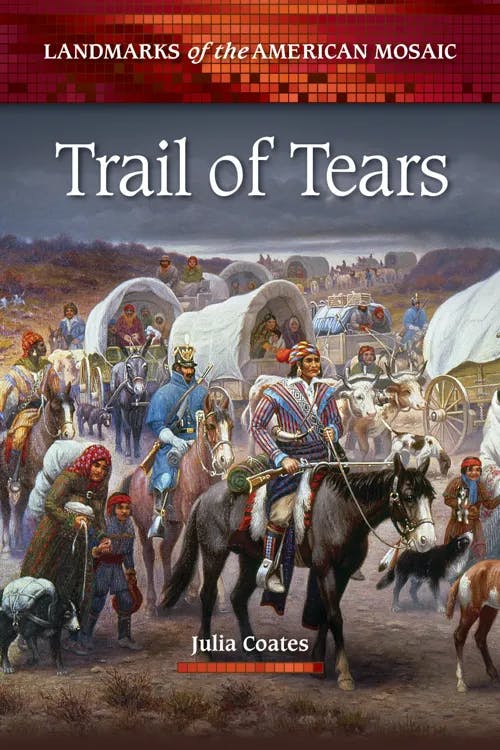
Julia Coates
Today, the best estimates are that somewhere between 2,000 and 2,500 Cherokees died, either in the camps, on the march itself, or after arriving in the Indian Territory, but as a result of the conditions of the march. However, researchers also acknowledge that there are probably 1,000–1,500 people who simply could not be accounted for. [...] The loss of citizenry to the Cherokee Nation was indeed somewhere between 3,000 and 4,000 people, about 2,000 and 2,500 of which resulted from deaths. (Trail of Tears, 2014)
The periods of removal in the 1800s resulted in the displacement of the five major tribes (known as the “Five Civilized Tribes”): the Cherokee, Choctaw, Chickasaw, Creek, and Seminole, as well as tribes in the Old Northwest. However, historians have tended to solely focus on the forced relocation of the Cherokee people:
[...] the Trail of Tears has overshadowed the removal experience of many other Native Americans with land originally located east of the Mississippi. For example, Indian nations of the Old Northwest—the present-day states of Ohio, Indiana, Illinois, Michigan, and Wisconsin—underwent removal on a smaller, but no less traumatic, scale, than the Southeastern Indians. Old Northwest removal history involves the Potawatomi, Delaware, Seneca, Cayuga, Miami, Shawnee, Wyandot, Odawa, and Ojibwe Indian nations. (Paul Jentz, Seven Myths of Native American History, 2018)
Paul Jentz
[...] the Trail of Tears has overshadowed the removal experience of many other Native Americans with land originally located east of the Mississippi. For example, Indian nations of the Old Northwest—the present-day states of Ohio, Indiana, Illinois, Michigan, and Wisconsin—underwent removal on a smaller, but no less traumatic, scale, than the Southeastern Indians. Old Northwest removal history involves the Potawatomi, Delaware, Seneca, Cayuga, Miami, Shawnee, Wyandot, Odawa, and Ojibwe Indian nations. (Paul Jentz, Seven Myths of Native American History, 2018)
While it is crucial to bring to light the histories of all Indigenous people, due to the scope of this guide, we will be focusing on the Trail of Tears which saw the displacement of primarily Cherokees. For further information on the displacement of other tribes, see Claudia Haake’s The State, Removal and Indigenous Peoples in the United States and Mexico, 1620-2000 (2007), Donna Martinez’s Documents of American Indian Removal (2018), and Jeffrey Ostler’s Surviving Genocide (2019).
A brief history of Cherokee relocation
Early native-US relations
Following the arrival of Christopher Columbus into the Americas in 1492, more and more European colonists began to explore looking to create permanent settlements. The first attempt at a colony by the English was in 1585 when 107 colonists landed and built a fort on the island. The colony was short-lived, with the settlement found mysteriously abandoned in 1590 (see David Stick, Roanoke Island, 2015). In 1607, the first permanent settlement, Jamestown, in North America was set up by the English, followed by the Plymouth colony in 1620.
The European colonists deemed their values, nation, and identity as superior to that of the Indigenous people. These Eurocentric beliefs served as ideological justification for imperialist expansion; they felt that Native Americans were “wasting” the land due to their lack of participation in capitalist enterprise. In American Indians and the Rhetoric of Removal and Allotment, Jason Edward Black writes,
Differences over views of land—for the British government, it was a site of production and commodification; for Natives, it was a space of spirituality and inheritance—led to conflict among the groups. (2015)
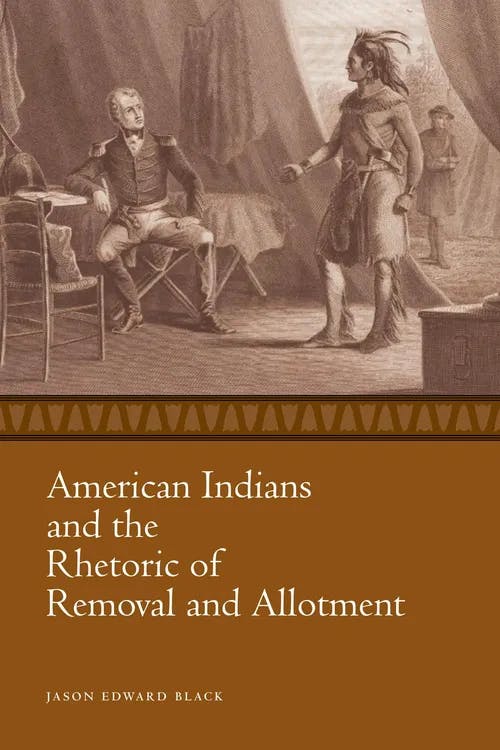
Jason Edward Black
Differences over views of land—for the British government, it was a site of production and commodification; for Natives, it was a space of spirituality and inheritance—led to conflict among the groups. (2015)
American settlers across the frontier believed their nation was destined to spread their values of democracy and system of capitalism throughout North America, extending their land in the process. To learn more, see our guide “What is American Exceptionalism?”
During colonization, around 95% of the Native American population died within the first 130 years of coming into contact with European colonists, either through conflict or exposure to disease (“Unlearning Columbus Day Myths,” National Museum of the Indian American).
Land cessions
In the nineteenth century, the United States continued to aggressively forge ahead with their westward expansion. Native American tribes were involved in numerous treaty negotiations for land, with increasing pressure to sign agreements. The impact of settler intrusion on ancestral land resulted in a lack of resources, further pressuring the natives to sell their land. In exchange for land, the natives were given either financial compensation, equipment, or reservations.
In 1803, the Louisiana Purchase allowed the US to purchase land west of the Mississippi River, paving the way for westward expansion (see Sanford Levinson and Bartholomew Sparrow, The Louisiana Purchase and American Expansion, 1803–1898, 2023). Colonial settlers began to move into these newly established territories, resulting in native populations gradually being pushed from their lands, leading to numerous conflicts, bloodshed, legal battles, and, eventually, forced removal.
Until recently, historians have been unable to precisely quantify to what extent Native Americans were dispossessed of their land. In 2021, Farrell et al released their groundbreaking study “Effects of land dispossession and forced migration on Indigenous peoples in North America” which revealed the extent of the loss:
Statistical analysis shows that aggregate land reduction was near total, with a 98.9% reduction in cumulative coextensive lands and a 93.9% reduction in noncoextensive lands. Further, 42.1% of tribes from the historical period have no federally- or state-recognized present-day tribal land base. (Science, 2021)
In addition to this, Farrell et al also found that, due to the land lost, “tribes’ present-day lands are on average more exposed to climate change hazards” and “have less positive economic mineral value” (2021).
The Georgia gold rush
When gold was discovered in Georgia in 1829, it drew thousands of miners to the region. However, as David Williams states,
Unfortunately for the native Cherokees, the gold fields lay on and adjacent to their land-land that Georgia claimed as its own. That claim went back to 1732, when Georgia was granted a colonial charter, and 1763, when the western boundary was fixed at the Mississippi River. But soon after the Yazoo land fraud in 1795, Georgia gave up title to what are today Alabama and Mississippi in exchange for a promise from the federal government to remove Indians occupying the state's remaining claims. (The Georgia Gold Rush, 2023)
David Williams
Unfortunately for the native Cherokees, the gold fields lay on and adjacent to their land-land that Georgia claimed as its own. That claim went back to 1732, when Georgia was granted a colonial charter, and 1763, when the western boundary was fixed at the Mississippi River. But soon after the Yazoo land fraud in 1795, Georgia gave up title to what are today Alabama and Mississippi in exchange for a promise from the federal government to remove Indians occupying the state's remaining claims. (The Georgia Gold Rush, 2023)
Though the agreement stated that the Indigenous peoples’ lands were to be "peaceably obtained on reasonable terms," the Creeks had been forcibly removed by 1826 as colonizers used the land for cotton. Now,
The state next turned its attention northward to the Cherokees. The Cherokee Nation had long recognized the threat from Georgia and assisted the Creeks in their struggle against removal. Now the Cherokees faced Georgia alone. This time the driving force behind removal would not be cotton, but gold. (Williams, 2023)
Native Americans described this as the “Great Intrusion.” As the newspaper the Cherokee Pheonix wrote in 1829
Our neighbors who regard no law and pay no respect to the laws of humanity are now reaping a plentiful harvest […] we are an abused people. (Quoted in Tim McNeese, Age of Jackson, 2020)
Tim McNeese
Our neighbors who regard no law and pay no respect to the laws of humanity are now reaping a plentiful harvest […] we are an abused people. (Quoted in Tim McNeese, Age of Jackson, 2020)
The Indian Removal Act
The Indian Removal Act was signed into law in May 1830 by President Andrew Jackson. The act authorized the president to negotiate the exchange of lands west of the Mississippi for Native American land. The act stated that the US would pay for relocation costs, provide financial support during the tribes’ first year of settling in the West, and compensate for individual losses. As Theda Perdue and Michael Green state,
The language of the act, in conformity with the principle of tribal sovereignty, stressed that removal was voluntary. [...] This pretense of voluntarism underscored the importance of the legislative harassment by the states. While neither the federal nor state governments could force the tribes to sign removal treaties, hostile and discriminatory state legislation could make life miserable for thousands of Indian people and drive them to the conclusion that their only hope was flight. That, in fact, is what happened. (The Columbia Guide to American Indians of the Southeast, 2005)
Theda Perdue and Michael Green
The language of the act, in conformity with the principle of tribal sovereignty, stressed that removal was voluntary. [...] This pretense of voluntarism underscored the importance of the legislative harassment by the states. While neither the federal nor state governments could force the tribes to sign removal treaties, hostile and discriminatory state legislation could make life miserable for thousands of Indian people and drive them to the conclusion that their only hope was flight. That, in fact, is what happened. (The Columbia Guide to American Indians of the Southeast, 2005)
The Cherokee Nation, led by Chief John Ross, fought for an injunction in the Supreme Court, which ultimately ruled in Cherokee Nation v Georgia (1831) that they did not have the jurisdiction to resolve this.
This was not the only time, however, the Cherokee Nation petitioned the Supreme Court. When Georgia raffled off large portions of Cherokee Land in land lotteries, the Cherokee people went to court again to protect their ancestral lands in the famous Worcester v Georgia case (1832). The Supreme Court ultimately ruled in the Cherokee's favor. This decision, however, was ignored by President Jackson who famously stated that “[Chief Justice] John Marshall has made his decision; now let him enforce it![...] Build a fire under them. When it gets hot enough, they’ll go.”” (Quoted in Deborah G. Lindsay, Behind Barbed Wire, 2020).
For more on the Cherokee’s legal battles, see Tim Garrison’s The Legal Ideology of Removal, 2010.
Other Native American tribes were impacted by the Indian Removal Act, with some moving voluntarily and others, such as the Seminole who fought against resettlement for seven years between 1835 and 1842, refusing to cede their land (see Joe Knetsch, Florida's Seminole Wars, 2003). After the defeat of the Creeks at the Battle of Horseshoe Bend (1814), where the Creeks were forced to give up over twenty million acres of their land, Jackson began his removal campaign in earnest (Lindsay, 2020).
The Treaty of New Echota
On December 29 1835, US officials and representatives of the Cherokee Nation met in New Echota in Georgia to sign a treaty that gave Cherokees $5 million and land in what is now Oklahoma in exchange for 7 million acres of their ancestral homeland. The treaty was ratified in March 1836, despite the majority of the Cherokees opposing the treaty and questioning its legality. This was viewed as treasonous by many Cherokee, including Ross, and would later result in the murder of some of the Treaty Party.
The removal of summer 1838/9
Between 1838 and 1839, under the supervision of Jackson’s successor President Martin Van Buren, thousands of Cherokees were rounded up and forced West. While some Cherokees left their land within a year of the Treaty of New Echota, with members of the Treaty Party departing in 1837, the majority of the Cherokees refused to yield their land. By May 1838, only 2,000 Cherokees had voluntarily relocated. As one witness observed,
“The Indians are perfectly still [...] peacefully working in their fields and gardens, awaiting the arrival of the appointed day, but resolutely refusing to recognize the unjust and unauthorized instrument of New Echota”. (Quoted in Andrew Denson, Monuments to Absence, 2017)
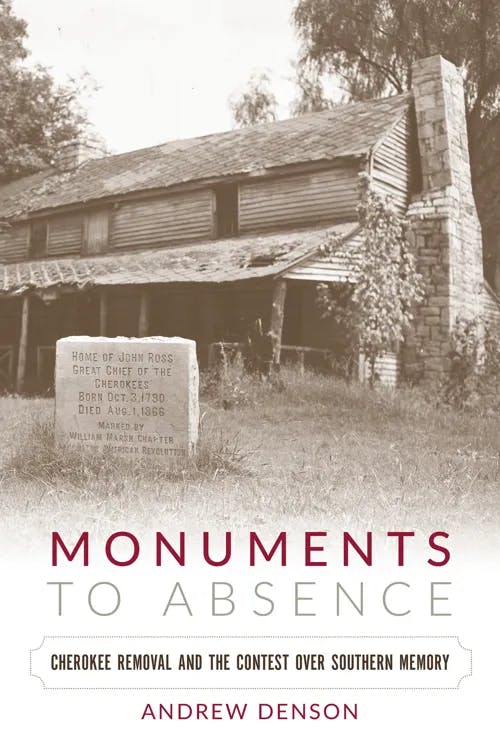
Andrew Denson
“The Indians are perfectly still [...] peacefully working in their fields and gardens, awaiting the arrival of the appointed day, but resolutely refusing to recognize the unjust and unauthorized instrument of New Echota”. (Quoted in Andrew Denson, Monuments to Absence, 2017)
As a result of this non-compliance, US government decided to remove the Cherokee people by force:
In the spring of 1838 Georgia and federal troops began to gather up Cherokee people in preparation for the trek west. Military units plucked people out of their homes and farms, often denying them time to pack a bag, and hauled them off, sometimes leaving uneaten supper on the table. The troops built holding camps throughout the nation to house the people until enough were gathered to make up a removal party. Many Cherokees languished throughout the summer in these stockades, suffering from exposure, bad water, and inadequate food. Much of the death toll attributed to the “Trail of Tears” occurred in these camps before the actual march. (Perdue and Green, 2005)
The federal troops had anticipated resistance and set up numerous forts and detainment camps throughout the Cherokee country, supervised by US Army troops and state militia with temporary federal authority
US soldiers began gathering Cherokees for relocation in May 1838, beginning with communities in Georgia:
Small units spread out from each of the forts, seizing Cherokees from their homes in the surrounding area. Typically, the soldiers held Cherokees at the local posts for several days before marching them to larger depots in southeastern Tennessee. In Georgia, this process proved very quick, and within three weeks military commanders reported their work in the state finished. Gathering Cherokees in other states took longer but followed a similar pattern. In North Carolina, for instance, federal troops and the state militia brought captured Cherokees to five small posts spread throughout the mountains and from there to Fort Butler, a somewhat larger installation in the present-day town of Murphy. From Fort Butler, soldiers marched the Cherokees over the Unicoi Turnpike to camps clustered near Fort Cass in present-day Charleston, Tennessee. (Denson, 2017)
Accounts of these camps are harrowing, with many Cherokees becoming ill due to exposure to the elements and overcrowded conditions, causing 353 deaths.
“The Trail Where We Cried”
Under the authority of General Winfield Scott, the Cherokee were organized into detachments to begin the long journey by foot (sometimes wagon), and boat from Tennessee to their new territories in Oklahoma. As Jentz explains,
Throughout 1838, the Cherokee left Georgia in groups numbering from several hundred to several thousand, covering most of the distance to Oklahoma in flatboats and riverboats. But they also walked hundreds of miles to their final destination, one never reached by about four thousand exiles. Measles, cholera, starvation, drowning, cold, and assorted accidents left nearly one-fourth of the total Cherokee population in graves scattered along the trail from Georgia to Oklahoma. (2018)
The Trail of Tears is often referred to by those who experienced it as “The Trail Where We Cried.”
The majority of Cherokees traveled on the “northern route”. Figure 1 below details the routes taken by the detachments. (For more information on the routes taken and major milestones, the interactive map at the US National Park Service website is a great resource).
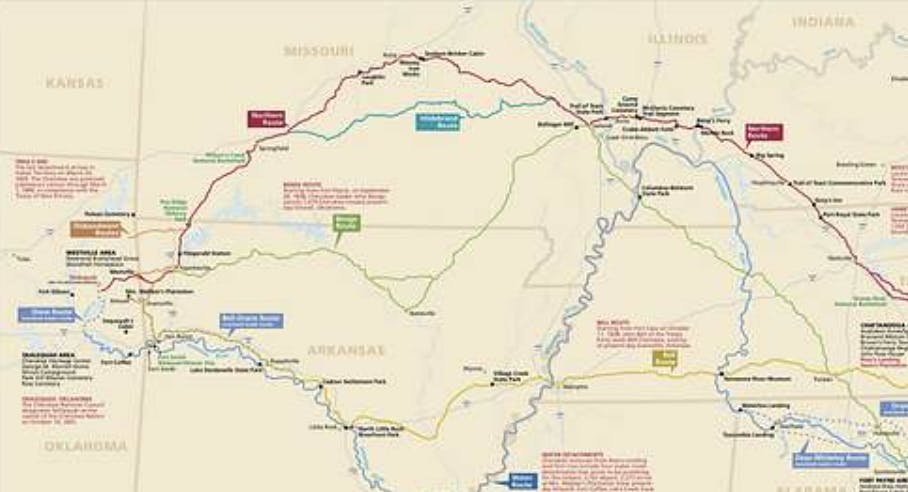
Fig. 1. US National Park Service Map, 2017.
As Coates explains, “Among the first to be taken, mostly from Georgia, were those regarded by the military as most intransigent and most prone to physical resistance”; this group were rounded up and taken to Gunter’s Landing and Ross’s Landing to be sent out by boat (2014). Around 2,800 were dispatched via boat to the “Indian Territory”, in three detachments, in the summer of 1838. The route followed the Tennessee River across Alabama, then traveled west on the Ohio River, before moving through the Arkansas River towards the new settlement.
The first water detachment resulted in no deaths and took three weeks. The second, however, took over seven weeks, with seventy migrant deaths due to overcrowding in the hot summer weather.
Cherokees hearing about poor conditions on the rivers requested their journey be postponed until after the hot weather had passed, to which Scott agreed. The period of drought left waters unnavigable, so it was decided that the journey would take place over land after the summer. However, this meant the Cherokees were now confined in camps with equally horrific conditions, with many people (particularly children) sick with whooping cough and dysentery.
Other detachments did not make the journey entirely by boat: two had to depart from the boats in Alabama and take a train, and another detachment had to walk 250 miles before boarding a boat in the town of Waterloo. The walking trail, however, also proved to be distressing and difficult, due to poor weather conditions, lack of resources and management, and the exhaustion of the long trail:
Inhabitants along the route, fearing disease from the captives, prevented the refugees from entering their towns, causing circumventions that added a great many miles to the already arduous journey. Crossing nine states and several major rivers, including the Mississippi, approximately four thousand of the 16,543 persons died. Most of the victims perished from accidents, exposure, hunger, and diseases such as cholera, dysentery, typhus, and whooping cough—typical contributing factors in a march of such magnitude and hardship. (2020)
Deborah G. Lindsay
Inhabitants along the route, fearing disease from the captives, prevented the refugees from entering their towns, causing circumventions that added a great many miles to the already arduous journey. Crossing nine states and several major rivers, including the Mississippi, approximately four thousand of the 16,543 persons died. Most of the victims perished from accidents, exposure, hunger, and diseases such as cholera, dysentery, typhus, and whooping cough—typical contributing factors in a march of such magnitude and hardship. (2020)
Lindsay goes on to add that other fatalities were caused due to the Cherokees not being allowed to bring personal belongings; being unable to bring sufficient food, clothing, and blankets, resulted in many deaths. Elizabeth “Quatie” Ross, for example, the wife of the leader Ross died after she gave up her blanket to a sick child.
As an eyewitness account of a detachment in Kentucky wrote in 1838,
The sick and feeble were carried in wagons […] even aged females, apparently nearly ready to drop into the grave, were traveling with heavy burdens attached to the back, on the sometimes frozen ground, and sometimes muddy streets, with no covering for the feet except what nature had given them.[...] We learned from the inhabitants on the road where the Indians passed, that they buried fourteen or fifteen at every stopping place, and they make a journey of ten miles per day only on an average. (cited in “A Native of Maine, traveling in the Western Country,” New York Observer)
For more on the real-life stories on the trail, Rick Thomas’s interactive map “Trail of Tears - Recollections” (2022) brings to life the archive “Family Stories from the Trail of Tears” from the Sequoyah Research Center.
Arrival in the West
When the Cherokees arrived in the winter of 1838-39, their struggles were far from over. Previous settlers, Cherokees who had moved voluntarily around 20 years earlier, had long established their own government. When Chief Ross arrived with the recently displaced Cherokees, known as the Cherokee Nation, he asserted that it was “only legitimate government for all Cherokees and that the western lands had been given to the Cherokee Nation by treaty” (Robert J. Conley, The Cherokee Nation, 2005).
There were further conflicts between the new settlers and members of the Treaty Party (those who signed the Treaty of New Echota), as many felt betrayed by the treaty. This conflict was exacerbated on June 22 1839, when Mayor Ridge, John Ridge, and Elias Ridge were murdered in retaliation for the roles they had played in signing the treaty. (To learn more about the political aftermath of the Cherokee relocation, see William G. McLoughlin, After the Trail of Tears, 2014).
In addition to political tension, there were many other challenges for the new Cherokees in the region, including sourcing adequate food:
Cherokees had always been productive farmers, but the emigrants needed time to learn how to work the new land. Under the Treaty of New Echota, the United States promised to provide Cherokees subsistence for a year, but the supplies often proved insufficient. Dishonest contractors delivered spoiled grain and meat, or they overstated the amount of food provided. Many Cherokees still lived in tents and other temporary shelters and lacked the means of preserving fresh food. (Denson, 2017)
Despite these hardships, the Cherokees rebuilt their community and restored their economy, establishing new schools (the Cherokee Male and Female Seminaries) and creating the newspaper the Cherokee Advocate (the Phoenix had been shut down by the Georgia Guard) which published in both Cherokee and English languages.
The legacy of the trail of tears
This era of displacement resulted in tens of thousands of Native Americans being forcibly removed from their land and thousands of deaths due to exposure, starvation, and disease. Moreover, by being removed from their ancestral lands, many Indigenous people experienced a loss of cultural identity. The Trail of Tears is symbolic of the injustice and oppression faced by the Native Americans. In 1987, the Trail of Tears was designated a National Historic Trail by Congress and is run by the National Park Service. In 2020, the Supreme Court recognized that nearly half of Oklahoma's land is Native American land, and in 2021, the First Americas Museum opened to celebrate the culture and heritage of Indigenous people. Though these acknowledgements do not in any way compensate for the trauma faced by the dispossessed, they remind us of historical and racial injustices whilst promoting efforts towards reconciliation and restoration of Indigenous rights.
Further reading on Perlego
African Cherokees in Indian Territory:” From Chattel to Citizens (2009) by Celia E. Naylor
Bury My Heart at Wounded Knee (2012) by Dee Brown
The New Trail of Tears: How Washington Is Destroying American Indians (2016) by Naomi Schaefer Riley
Ties That Bind (2015) by Tiya Miles
Voices From the Trail of Tears (2013) by Vicki Rozema
Trail of Tears FAQs
What was the Trail of Tears in simple terms?
What was the Trail of Tears in simple terms?
What was the Indian Removal Act?
What was the Indian Removal Act?
What was the impact of the Trail of Tears?
What was the impact of the Trail of Tears?
Bibliography
Black, J. E. (2015) American Indians and the Rhetoric of Removal and Allotment. University Press of Mississippi. Available at:
https://www.perlego.com/book/561964/american-indians-and-the-rhetoric-of-removal-and-allotment
Coates, J. (2014) Trail of Tears. Greenwood. Available at:
https://www.perlego.com/book/4165217/trail-of-tears
Conley, R. J. (2005) The Cherokee Nation: A History. University of New Mexico Press. Available at:
https://www.perlego.com/book/1699461/the-cherokee-nation-a-history
Denson, A. (2017) Monuments to Absence: Cherokee Removal and the Contest over Southern Memory. University of North Carolina Press. Available at:
Farrell, J. et al (2021) “Effects of land dispossession and forced migration on Indigenous peoples in North America,” Science, 374(6567). Available at: https://www.science.org/doi/10.1126/science.abe4943
Garrison, T. (2010) The Legal Ideology of Removal: The Southern Judiciary and the Sovereignty of Native American Nations. University of Georgia Press.
Gonzales, C. M. (2020) Native American Roots: Relationality and Indigenous Regeneration Under Empire, 1770–1859. Routledge. Available at: https://www.perlego.com/book/1628961
Haake, C. (2007) The State, Removal and Indigenous Peoples in the United States and Mexico, 1620-2000. Routledge. Available at:
https://www.perlego.com/book/1710147/the-state-removal-and-indigenous-peoples-in-the-united-states-and-mexico-16202000
Jentz, P. (2018) Seven Myths of Native American History. Hackett Publishing Company, Inc. Available at:
https://www.perlego.com/book/3898916/seven-myths-of-native-american-history
Knetsch, J. (2003) Florida's Seminole Wars, 1817-1858. Arcadia Publishing. Available at:
https://www.perlego.com/book/3013111/floridas-seminole-wars-18171858
Levinson, S. and Sparrow, B. (2023) The Louisiana Purchase and American Expansion, 1803–1898. Stackpole Books. Available at:
https://www.perlego.com/book/4176287/the-louisiana-purchase-and-american-expansion-18031898
Lindsay, D. G. (2020) Behind Barbed Wire: A History of Concentration Camps from the Reconcentrados to the Nazi System 1896-1945. Universal Publishers. Available at:
Martinez, D. (2018) Documents of American Indian Removal. ABC CLIO. Available at:
https://www.perlego.com/book/4183157/documents-of-american-indian-removal
McLoughlin, W. G. (2014) After the Trail of Tears: The Cherokees' Struggle for Sovereignty, 1839-1880. The University of North Carolina Press. Available at:
McNeese, T. (2020) The Age of Jackson: President for the Common Man. Chelsea House. Available at:
https://www.perlego.com/book/3769070/the-age-of-jackson-president-for-the-common-man
National Archives (2022) Dawes Records of the Five Civilized Tribes: Cherokee, Chickasaw, Choctaw, Creek, and Seminole Tribes in Oklahoma. Available at:
New York Observer (1839) “A Native of Maine, traveling in the Western Country.” Available at:
https://www.intimeandplace.org/cherokee/images/trail/nativeofmaine.html
Ostler, J. (2019) Surviving Genocide: Native Nations and the United States from the American Revolution to Bleeding Kansas. Yale University Press. Available at:
Perdue, T. and Green, M. (2005) The Columbia Guide to American Indians of the Southeast. Columbia University Press. Available at:
https://www.perlego.com/book/775582/the-columbia-guide-to-american-indians-of-the-southeast
Rozema, V. (2013) Voices From the Trail of Tears. Blair. Available at:
https://www.perlego.com/book/3198694/voices-from-the-trail-of-tears
Stick, D. (2015) Roanoke Island: The Beginnings of English America. The University of North Carolina Press. Available at:
https://www.perlego.com/book/539120/roanoke-island-the-beginnings-of-english-america
Williams, D. (2023) The Georgia Gold Rush: Twenty-Niners, Cherokees, and Gold Fever. University of South Carolina Press. Available at:
https://www.perlego.com/book/3828811/the-georgia-gold-rush-twentyniners-cherokees-and-gold-fever
PhD, English Literature (Lancaster University)
Sophie Raine has a PhD from Lancaster University. Her work focuses on penny dreadfuls and urban spaces. Her previous publications have been featured in VPFA (2019; 2022) and the Palgrave Handbook for Steam Age Gothic (2021) and her co-edited collection Penny Dreadfuls and the Gothic was released in 2023 with University of Wales Press.