History

Tin Pan Alley
Tin Pan Alley was a famous music publishing district in Manhattan, New York City, during the late 19th and early 20th centuries. It was the center of American popular music publishing and songwriting, producing many iconic songs that became part of the American music canon. The term "Tin Pan Alley" is also used to refer to the style of music created in this era.
Written by Perlego with AI-assistance
Related key terms
1 of 5
11 Key excerpts on "Tin Pan Alley"
 eBook - PDF
America's Musical Pulse
Popular Music in Twentieth-Century Society
- Kenneth J. Bindas(Author)
- 1992(Publication Date)
- Praeger(Publisher)
In those years Tin Pan Alley came to define not only this business but also the style of popular music being produced and even the historical time period itself. Having such complex and significant context allows Tin Pan Alley to serve as a barometer of change in American musical and business life as the nation shifted to its modern age. The rise of Tin Pan Alley both reflected and was influenced by the his- torical time in which it developed. Several trends emerged in the last decades of the nineteenth century that propelled American industry, including the music trades, into big business, trends that were primarily a response to expanding urban markets. These currents, which continued into the twen- tieth century, changed forever American ways of business, as well as Amer- ican culture. The development of Tin Pan Alley must be seen in this context. Cities were growing rapidly as rural populations migrated to urban areas and as immigration from abroad continued. Transportation im- proved considerably with the motorcar, railroads, and city streetcars. Technological innovations allowed mass production, and an increasing 114 Economics railroad network aided the mass distribution of consumer goods to a growing national market. To control this process more efficiently, Amer- ican business adopted the corporation structure and vastly increased cap- ital, efficiency, and production. To limit disastrous competition and stabilize production and marketing, business consolidated; industry com- bined, integrated, and diversified. One result was huge companies and al- most monopolistic control. Accompanying this move toward monopoly capitalism were the trends toward a wider dispersal of ownership among many small stockholders, the increasing separation of ownership and management, and the rise of a class of professional managers and salaried experts who governed the operation of a company by order of an executive committee. eBook - PDF
Jazz
The First 100 Years
- Henry Martin, Keith Waters(Authors)
- 2015(Publication Date)
- Cengage Learning EMEA(Publisher)
with the growing forces of the mass media, which were centered in New York, particularly Tin Pan Alley, the heart of the U.S. song-publishing and sheet music business. Tin Pan Alley is the collective name applied to the major New York City sheet music publishers. Tin Pan Alley flourished from the late 1800s until the mid- twentieth century. A song plugger was someone who performed a song, usually at a music store, to encourage people to buy the sheet music. From roughly 1921 to 1928, the Harlem Renais- sance was a period of outstanding artistic activity among African Americans. The movement was cen- tered in Harlem in New York City. Tin Pan Alley Tin Pan Alley began to flourish in the late nineteenth century and experienced major growth through pro- moting ragtime. In the early 1920s, its popular songs provided many of the vehicles for jazz performance, a legacy that continued for decades. Tin Pan Alley pio- neered mass-marketing and aggressive sales techniques in the popular-music industry, techniques that still define the business today. The district eventually con- solidated on West Twenty-eighth Street in Manhattan. As part of their sales strategy, Tin Pan Alley promoters actively plugged songs by hiring pianists to play, sing, and hawk the latest tunes at the publishers’ offices. Customers would wander down the street, in and out of the pub- lishing offices, in search of the sheet music for songs that caught their ears. In the days before air conditioning, publishing companies kept the windows and doors open during the warm months, and the sounds of all the song pluggers playing simultaneously on upright pianos led to a street cacophony that sounded like the banging of tin pans. Many musicians—from George Gershwin to Fletcher Henderson—got their start as song pluggers, playing and singing the constant stream of newly written popular songs that flowed from Tin Pan Alley.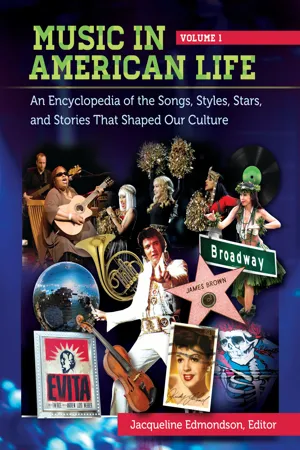 eBook - ePub
Music in American Life
An Encyclopedia of the Songs, Styles, Stars, and Stories That Shaped Our Culture [4 volumes]
- Jacqueline Edmondson(Author)
- 2013(Publication Date)
- Greenwood(Publisher)
Tin Pan Alley, the ever-hustling songwriting and publishing business on West 28th Street between Fifth and Sixth Avenues, was located within walking distance of many of New York’s most active theaters. Tin Pan Alley had been flourishing since the late nineteenth century, generating hit songs of the day through publication of sheet music to satisfy Americans’ intense demand to have pianos in their homes and a steady stream of new popular songs to play on them (Furia 1992). Musicians known as song pluggers were employed by Tin Pan Alley producers to travel to stores, restaurants, beaches, parks, and street corners, performing the newest songs in hopes of attracting the attention of New York listeners and, eventually, the American public at large. The neighborhood theaters of Broadway provided a logical and eventually lucrative venue for finding new audiences for new songs. But despite the geographical proximity between Broadway and Tin Pan Alley, a full cross-fertilization between the two was slow in coming. With the exception of New York vaudeville houses and lower-class variety theaters, during the first decade of the new century Tin Pan Alley neither placed many of its own original songs in the musicals and operettas of Broadway nor culled many songs from New York’s legitimate theaters to market as sheet music hits. Unlike the songs from operettas or musicals written in the operetta tradition, Tin Pan Alley songs of the early 1900s were based on straightforward formulas. Melodies were almost invariably built on a strict thirty-two-bar chorus—the hook or “money part” of the song that would draw family and friends around the living room piano for an evening of celebration and sing-a-long home entertainment (Furia 1992). Lyrical themes of Tin Pin Alley tunes were no less restrictive than their chorus structures and thus of little use to operetta, with its multiple characters, varying moods, and intersecting plotlines.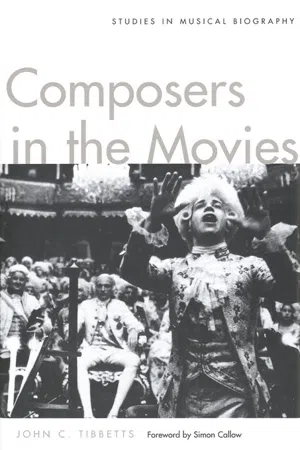 eBook - PDF
Composers in the Movies
Studies in Musical Biography
- John C. Tibbetts(Author)
- 2008(Publication Date)
By 1900 many publishers had relocated uptown to Twenty-Eighth Street, near Fifth Avenue. Dubbed ‘‘Tin Pan Alley’’ by the composer Monroe H. Rosenfeld, the area came to represent the music 106 The New Tin Pan Alley publishing industry in general. Music historian Charles Hamm, in his classic Yesterdays: Popular Song in America, notes, ‘‘By 1900 control of the popular-song industry by these new publishers was virtually complete, and it was a rare song that achieved mass sales and nationwide popularity after being published elsewhere.’’ π The term stuck, even though subsequent centralized locations kept moving uptown, toward West Forty-Second Street and, eventually, to Fifth-Sixth Street (where the Great White Way is still to be found). Both industries were shaped and dominated by a multiethnic and predomi-nantly first-generation immigrant community located primarily in lower Man-hattan. ∫ And both developed efficient systems for the mass production and distribution of their products—in the instance of Tin Pan Alley, in the powerful publishing houses; and in Hollywood, in the monolithic movie studios— vertically integrated structures controlling movies’ production, distribution, and exhibition, organized by men like Adolph Zukor, Louis B. Mayer, Darryl F. Zanuck, and William Fox. Inevitably, these two industries developed a syner-gistic relationship, each depending upon, and exploiting, the other. Warner Bros., for example, took control of Witmarks, MGM bought into the Robbins Music Corporation, RKO obtained Leo Feist, and Paramount established its own Famous Music Corporation. By the dawn of the talking picture, it has been estimated that 90 percent of America’s most popular songs were film-related. eBook - PDF
Adventures of a Jazz Age Lawyer
Nathan Burkan and the Making of American Popular Culture
- Gary A. Rosen(Author)
- 2020(Publication Date)
- University of California Press(Publisher)
The geographical Tin Pan Alley, a cluster of publishing offices on West 28th and 29th Streets, between Broadway and Sixth Avenue, was short-lived. The Witmark firm’s brief tenancy there, from 1893 to 1903, roughly demarks the beginning and end of the otherwise nondescript neighborhood’s reign as the epicenter of the popular music business. The Tin Pan Alley business model, however, endured until the late 1920s, when the Witmarks and many of their competitors were swal-lowed up by Hollywood studios hungry for musical content after the introduction of synchronized sound. Tin Pan Alley songs should not be confused with the standards of the vaunted Great American Songbook which, for the most part, came along later. Conformity and simplicity were valued over originality and artistry on Tin Pan Alley. The target consumers were modestly skilled home musicians, often self-taught, who played the parlor piano and sang barbershop harmonies for their own amusement. The financial rewards for the creators of these ditties were meager, an up-front payment of a few dollars or a running royalty of a penny or two per Tin Pan Alley | 37 copy. Harry von Tilzer (“Bird in a Gilded Cage”), Charles K. Harris (“After the Ball”), and Paul Dresser (“On the Banks of the Wabash”) all made their names as Tin Pan Alley songwriters—but they made their real money as music publishers. Even the best Tin Pan Alley songs were harmonically simple, easy to learn and remember, and required no great vocal or instrumental sophis-tication to perform satisfactorily. Songs that readily lent themselves to social singing, whether sober or drunken, were the most durable. Perhaps the Tin Pan Alley song most frequently performed today, and one repre-sentative of the genre, is the 1908 waltz “Take Me Out to the Ballgame.” “Sweet Adeline” and “When Irish Eyes Are Smiling” were among the biggest Witmark hits of the early 1900s. Tin Pan Alley churned out such numbers by the hundreds each year. eBook - ePub
Music Cultures in the United States
An Introduction
- Ellen Koskoff(Author)
- 2005(Publication Date)
- Routledge(Publisher)
Those Manhattan-based publishing companies chat collectively came to be known as Tin Pan Alley made use of popular entertainers who performed their material in return for above- or under-the-table compensation, a practice that came to be known as pay for play or Payola. Pictures of performers were displayed on the covers of sheet music, or firms would offer them the exclusive right to perform a particular composition in their acts. On other occasions, a performer would receive credit and compensation as one of a song’s writers even if he or she had no formal musical skills whatsoever. Professional marketers, known in the industry as song pluggers, hawked their clients’ wares (sometimes written by the pluggers themselves) through a variety of means that included public performance in music stores or planting individuals in theaters who "requested" predetermined material by popular performers. Tin Pan Alley A nickname given to the area of New York City where many music publishers had their offices during the early decades of the twentieth century; more generally; the popular music produced by these publishers Pay for Play (Payola) The practice of paying performers to sing particular songs to generate popular interest in them Song pluggers Professional marketers employed by music publishers to promote songs, either by performing them in music stores or by encouraging popular entertainers to include them in their performances Even rhe new technology of motion pictures was employed for promotional ends. Illustrated reproductions of song lyrics, reproduced on slides, were offered to theater owners free of charge during the first decade of the century. This led to the advent of the public "sing-along," and publishers frequently commissioned songs written exclusively for this format. Whatever the means of merchandising, music was becoming a more and more profitable commercial commodity, a fact underscored by the rising costs of promotion eBook - PDF
Selling Sounds
The Commercial Revolution in American Music
- David Suisman(Author)
- 2009(Publication Date)
- Harvard University Press(Publisher)
The Song Factories Although the social relations of Tin Pan Alley informed the development of the music industry to a great degree, its operations and organizational struc-ture derived from the general principles of capitalist enterprise. Armed with the logic of production for profit, industry after industry and sector after sec-tor followed the path of specialization and division of labor. 49 If this was so for the railroads, steel manufacturing, and the chemical and banking indus-tries, it was also so for the systematized commercial production of songs. By 1910 the New York Times characterized Tin Pan Alley as a group of “popular song factories,” and elsewhere it concluded, “Songs may be properly classed with the staples, and are manufactured, advertised, and distributed in much the same manner as ordinary commodities.” 50 The goods themselves fell into a few general categories—parlor ballads, novelty numbers, show songs, dance songs—all produced more or less the same way. No matter how catchy or clever individual songs were, the business from which they issued rested on rational calculation to yield standardized products and to reduce uncer-tainty and fluctuation in supply and demand. In Tin Pan Alley, publishers, composers, lyricists, arrangers, pluggers, cover illustrators, and others each served a distinct, defined role. Every as-pect of songwriting, publishing, and promoting was broken down into ele-mental, specialized parts. At the top of the hierarchy stood the publisher, who embodied and administered the growing managerial ethos in the busi-ness. His position entailed a variety of complex responsibilities: purchasing songs, helping writers refine ideas, deciding which songs to issue, and des- selling sounds R 42 S ignating where and how a song should be exploited. Although a successful song necessarily depended on able songwriting, it was the publisher, not the writer, who stood at the center of Tin Pan Alley’s operations. eBook - PDF
Segregating Sound
Inventing Folk and Pop Music in the Age of Jim Crow
- Karl Hagstrom Miller, Ronald Radano, Josh Kun, Ronald Radano, Josh Kun(Authors)
- 2010(Publication Date)
- Duke University Press Books(Publisher)
From soap, clothing, and canned goods to beauty aids, tools, and musical instruments: mail order catalogues from New York and Chicago firms opened a new world of consumer goods. The number of southern general stores sky-rocketed in the late nineteenth century, averaging 144 merchants per county in 1900. General stores tantalized with their eclectic array of items available 26 chapter one for cash or credit. New access to goods helped many southerners feel a part of national trends in fashion, literature, and music. ∏ Among the goods stu≈ng southern general stores was sheet music, the product of an industry that was reaching a new level of consolidation and sophistication. Beginning with the founding of the T. B. Harms publishing house in 1881, New York became the center of popular music publishing in the United States. By the turn of the century almost every major publishing house in the country was located on or near Manhattan’s 28th Street, later dubbed Tin Pan Alley. The city’s publishers perfected the mass production of songs. Earlier publishers had been comparatively unorganized, featuring a di√used list of various styles, surviving o√ loopholes in copyright law, or signing individual compositions in a business model akin to today’s book publishing industry. Tin Pan Alley changed the game. Firms specializing in popular songs developed compositional and lyrical formulas based on past hits. Most paid a flat rate of ten to twenty-five dollars per song to sta√ or freelance composers to write specifically for the company. They thus often owned the tune before it was even written. Tin Pan Alley publishers issued thousands of titles in the hopes that a few would score with the nation’s public. π Tin Pan Alley firms also systematized the process of promoting songs through popular stage performers and musical comedy actors. eBook - ePub
Lost in Music
Culture, Style and the Musical Event
- Avron Levine White(Author)
- 2016(Publication Date)
- Routledge(Publisher)
Davey had commercial reasons for treating lyrics as formula writing, but his argument is common among academics too. In the 1950s and 1960s, for example, the tiny field of the sociology of popular music was dominated by analyses of song words. Sociologists concentrated on songs (rather than singers or audiences) because they could be studied with a familiar cultural research method, content analysis, and as they mostly lacked the ability to distinguish songs in musical terms, sociologists, by default, had to measure trends by reference to lyrics. It was through their words that hit records were taken to make their social mark.The focus on lyrics didn’t just reflect musical ignorance. Until the mid-1960s British and American popular music was dominated by Tin Pan Alley. Tin Pan Alley’s values derived from its origins as a publishing centre and the ‘bland, universal, well-made song’ (Whitcomb’s description) remained central to its organisation even after rock ‘n’ roll.2 In concentrating on pop’s lyrical themes in this period, sociologists were reflecting the way in which the songs were themselves packaged and sold. Most of these songs did, musically, sound the same; most lyrics did seem to follow measurable rules; most songwriters did operate as ‘small businessmen engaged in composing, writing or publishing music’ rather than as ‘creative composers’.3 Etzkorn, one of the few sociologists to research lyricists not lyrics, discovered in 1963 thatThe composing activity of songwriters would seem to be constrained by their orientation towards the expectations of significant ‘judges’ in executive positions in the music business whose critical standards are based on traditional musical cliches. In their endeavour to emulate the norms of successful reference groups, songwriters (even with a variety of backgrounds) will produce compositions virtually homogeneous in form and structure, thereby strengthening the formal rigidity of popular music.4And this simply confirmed what analysts anyway took for granted – that it was possible to read back from lyrics to the social forces that produced them. Content analysisThe first systematic analyst of pop song words, J.G. Peatman, was influenced by Adorno’s strictures on ‘radio music’ and so stressed pop’s lyrical standardisation: all successful pop songs were about romantic love; all could be classified under one of three headings – the ‘happy in love’ song, the ‘frustrated in love’ song, and the ‘novelty song with sex interest’.5 eBook - ePub
Taking Popular Music Seriously
Selected Essays
- Simon Frith(Author)
- 2017(Publication Date)
- Routledge(Publisher)
Davey had commercial reasons for treating lyrics as formula writing, but his argument is common among academics too. In the 1950s and 1960s, for example, the tiny field of the sociology of popular music was dominated by analyses of song words. Sociologists concentrated on songs (rather than singers or audiences) because they could be studied with a familiar cultural research method, content analysis, and as they mostly lacked the ability to distinguish songs in musical terms, sociologists, by default, had to measure trends by reference to lyrics. It was through their words that hit records were taken to make their social mark.The focus on lyrics didn’t just reflect musical ignorance. Until the mid-1960s British and American popular music was dominated by Tin Pan Alley. Tin Pan Alley’s values derived from its origins as a publishing centre and the ‘bland, universal, well-made song’ (Whitcomb’s description) remained central to its organisation even after rock ‘n’ roll.2 In concentrating on pop’s lyrical themes in this period, sociologists were reflecting the way in which the songs were themselves packaged and sold. Most of these songs did, musically, sound the same; most lyrics did seem to follow measurable rules; most songwriters did operate as ‘small businessmen engaged in composing, writing or publishing music’ rather than as ‘creative composers’.3 Etzkorn, one of the few sociologists to research lyricists not lyrics, discovered in 1963 thatThe composing activity of songwriters would seem to be constrained by their orientation towards the expectations of significant ‘judges’ in executive positions in the music business whose critical standards are based on traditional musical clichés. In their endeavour to emulate the norms of successful reference groups, songwriters (even with a variety of backgrounds) will produce compositions virtually homogeneous in form and structure, thereby strengthening the formal rigidity of popular music.4And this simply confirmed what analysts anyway took for granted – that it was possible to read back from lyrics to the social forces that produced them.Content analysis
The first systematic analyst of pop song words, J.G. Peatman, was influenced by Adorno’s strictures on ‘radio music’ and so stressed pop’s lyrical standardisation: all successful pop songs were about romantic love; all could be classified under one of three headings the ‘happy in love’ song, the ‘frustrated in love’ song, and the ‘novelty song with sex interest’.5 eBook - ePub
- Michael Saffle(Author)
- 2012(Publication Date)
- Routledge(Publisher)
4 The serious grind of writing, plugging, and publishing songs along the Alley is reduced to the following scrap of dialogue:QUESTION: What’s happening on Tin Pan Alley? ANSWER: The same old grind: Irving Berlin is still ringing the bell with every number. QUESTION: Is Anna Held still packing them in at the Casino? ANSWER: Yes, dear; and the Statue of Liberty is still packing them in at Bedloe’s Island!As for the nuts and bolts of songwriting, the process apparently consisted merely of the composer accidentally stumbling upon a few musical notes that, in a furious montage of images, he instantly transforms into a full-fledged show number, replete with sumptuous strings, blaring brass, and high-stepping chorines. Success was simply a matter of determination and grit: “When you have something and you know you have it, nothing can keep you down,” explains Harrigan.Apart from an occasional word of praise about the staging and performance of the musical numbers, most critics were appalled. A sampling of contemporary critical responses indicates the nature of their displeasure: The New Yorker complained about the “exasperating cliches” and the “foolish attempts to inject synthetic melodrama” into the life of Jerome Kern.5 Time lamented Swanee River’s superficial treatment of the creative urge: “In pictures about composers a vacant look, head noddings and rhythmic hand flourishes denote musical inspiration.”6 And in the New York Times Bosley Crowther’s complaints about Rhapsody in Blue sum up the whole sad business: “There is never any true clarification of what makes [Gershwin] run, no interior grasp of his nature, no dramatic continuity to his life. The whole thing unfolds in fleeting episodes, with characters viewing the genius with anxiety or awe, and the progression is not helped by many obvious and telescoping cuts.”7
Index pages curate the most relevant extracts from our library of academic textbooks. They’ve been created using an in-house natural language model (NLM), each adding context and meaning to key research topics.

