History

Ku Klux Klan
The Ku Klux Klan (KKK) is a white supremacist organization that was founded in the United States in 1865. The group has a long history of violence and intimidation against African Americans, as well as other minority groups. Despite being outlawed at various times throughout its history, the KKK continues to exist in various forms today.
Written by Perlego with AI-assistance
Related key terms
1 of 5
11 Key excerpts on "Ku Klux Klan"
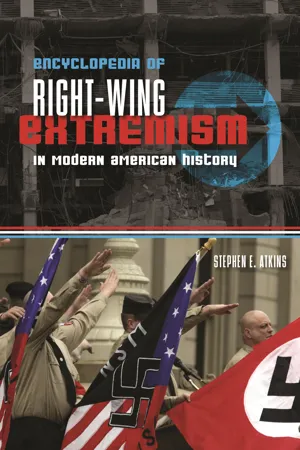
- Stephen E. Atkins(Author)
- 2011(Publication Date)
- ABC-CLIO(Publisher)
This caused the resurgence of white supremacy in the late 20th century that continues to this day. 3 1 Ku Klux Klan Movements Early Ku Klux Klan Movement The oldest and most widespread white supremacist movement in the United States is the Ku Klux Klan (KKK). Six veterans of the Confederate Army founded the Ku Klux Klan on December 24, 1866, in Pulaski, Tennessee. 8 Tennessee was the only border state that had joined the Confederacy, and even then, its citizens were divided over sup- porting it. Pulaski was a town of slightly fewer than 3,000 inhabitants in a slave-holding county, and blacks made up nearly half the population. 9 These six veterans returned home after the war during a period of social upheaval. They were restless and look- ing for excitement, so they formed the Ku Klux Klan, originally as a social club: „This is an institution of chivalry, humanity, mercy and patriotism; embodying in its genius and its principles all that is chivalric in conduct, noble in sentiment, generous in man- hood and patriot in purpose.‰ 10 They selected the name Ku Klux Klan from the Greek word kuklos (circle). A distinctive wardrobe was also picked: the white robes and hood served to represent ghosts of Confederate soldiers. Its founders also established a hier- archy with exalted names: Imperial Wizard (chief) to Ghouls (members). Membership was to remain secret. At first, the KKK remained a glorified social club, but it had strong racist overtones from the beginning. Its „pranks were directed exclusively on blacks to keep them in their place.‰ 11 With the influx of more Confederate veterans, it soon developed into a politi- cal force in the South. At first, the national headquarters of the Klan remained at Pulaski. Shortly after its founding, the Klan began to expand mostly by word of mouth, and Klan dens began to form both in towns and in rural settings. 12 As the Klan expanded, there were instances of uncontrolled conduct by Klansmen. eBook - ePub
Female Terrorism and Militancy
Agency, Utility, and Organization
- Cindy D. Ness(Author)
- 2007(Publication Date)
- Routledge(Publisher)
Most White-supremacist groups in the immediate postbellum period directed their violence at racial minority groups, but the ultimate target of their actions was the state apparatus imposed on the defeated southern states during the Reconstruction era. The quintessential White-supremacist organization of this time – the Ku Klux Klan – emerged in the rural south in the aftermath of the Civil War, inflicting horrific violence on newly emancipated African Americans and their White, especially northern, allies. Organized as loose gangs of White marauders, the first Klan may have had a chaotic organizational structure, but its goals and efforts were focused and clear – to dismantle the Reconstructionist state and restore one based on White supremacism. Women played no direct role in this Klan. Indeed, its mob-like exercise of racial terrorism on behalf of traditional southern prerogatives of White and masculine authority left no opening for the participation of White women except as symbols for White men of their now-lost privileges and lessened ability to protect “their” women against feared retaliation by former slaves (Blee 1991).Racial terrorism in the early twentieth century
The first wave of the KKK collapsed in the late nineteenth century, but its legacy of mob-directed racialized violence continued into the first decades of the twentieth century through extra-legal lynchings and racially biased use of capital punishment to execute African Americans.8 The re-emergence of the Klan in the late 1910s (a Klan that flourished through the 1920s) substituted political organization for mob rule, enlisting millions of White, native-born Protestants in a crusade of racism, xenophobia, anti-Catholicism, and anti-Semitism that included contestation of electoral office in some states. The violence of this second Klan also took a new form, mixing traditional forms of racial terrorism with efforts to instill fear through its size and political clout and create financial devastation among those it deemed its enemies (Blee 1991).The targets of lynchings, racially biased capital punishment, and the 1920s Klan were mostly members of racial, ethnic, and religious minority groups; they also constituted its primary enemies. The racial terror of lynching and racially biased capital punishment both depended on state support, either overtly or covertly. Similarly, for the second Klan, located primarily in the north, east, and western regions rather than the south, the state was not an enemy; instead, it was a vehicle through which White supremacists could enact their agendas. Rather than attack the state, in this period organized racism was explicitly xenophobic and nationalist, embracing the state through an agenda they characterized, in the Klan’s term, as “100% American.” eBook - PDF
- Paul Hainsworth(Author)
- 2016(Publication Date)
- Bloomsbury Academic(Publisher)
However, before looking at the present, it would perhaps be useful to plot the history of one of the most successful right-wing extremist organizations in the Western world: the Ku Klux Klan. After this we shall examine the activities of the more respectable, though equally influential 'radical right'. The ideology and organizational strength of the contemporary extreme right will then be looked at in some detail, to be followed by a discussion of the most potent right-wing force on the American political scene today: the David Duke phenomenon. Finally, an attempt will be made to assess what the future holds for right-wing extremism in the United States. The Historical Origins of the Ku Klux Klan One aspect of what has been termed American exceptionalism was the persistence of the institution of slavery, that peculiarly pre-capitalist social form adapted to capitalist purposes following the development of tobacco-growing in Virginia during the seventeeth century, and cotton in the states south of the Mason-Dixon line. Tragically, the abolition of slavery left the South economically shredded and morally bruised and its white inhabitants determined to reassert their dominance over the newly emancipated black population. The Ku Klux Klan was to be a key instrument in this process of reassertion (Trelease, 1972). The original Klan was not some quaint, rather oddly-dressed group of nightriders standing on the edge of southern society, even less the romantic defenders of a misunderstood oppressed civilization portrayed in D.W. Griffith's 'rampantly racist' film Birth of a Nation (Wright, 1976, p. 28). Rather it was an organized conspiracy whose primary objective was to restore white supremacy after the Civil War (Horn, 1969). eBook - PDF
The Politics of the Extreme Right
From the Margins to the Mainstream
- Paul Hainsworth(Author)
- 2016(Publication Date)
- Bloomsbury Academic(Publisher)
One, which straddles the boundary between radical right and the extreme right, is the Patriot movement - of which the Militias are a part. Another is National Socialism. A third, which we shall now go on to discuss in some historical detail, is the oldest and best-known form of the extreme right: the Ku Klux Klan. Born out of the calamity of the American Civil War, it has persisted over time and even today forms an important core of the violent right in the United States. 288 THE EXTREME RIGHT IN THE UNITED STATES The origins of the Ku Klux Klan One aspect of what has been termed American exceptionalism was the persistence of the institution of slavery, that peculiarly pre-capitalist social form adapted to capitalist purposes following the development of tobacco-growing in Virginia during the seventeenth century, and cotton in the states south of the Mason-Dixon line. Tragically, the abolition of slavery left the South economically shredded and morally bruised, and its white inhabitants determined to reassert their dominance over the newly emancipated black population. The Ku Klux Klan was to be a key instrument in this process of reassertion (Trelease, 1972). The original Klan was not simply some quaint, rather oddly dressed group of nightriders standing on the edge of southern society - even less the romantic defenders of a misunderstood oppressed civilization portrayed in D. W. Griffith's 'rampantly racist' film Birth of a Nation (Wright, 1976: 28). Rather, it was an organized conspiracy whose primary objective was to restore white supremacy after the Civil War (Horn, 1939). First established in 1865 when six ex-confederate soldiers met in their home town of Pulaski, Tennessee, the aims of the Klan were never in doubt: to force reforming northerners out of the Confederacy and to destroy every vestige of nascent black political power in the southern states. The ideology of the Klan was explicitly supremacist. eBook - PDF
The Reconstruction Era
Primary Documents on Events from 1865 to 1877
- Donna L. Dickerson(Author)
- 2003(Publication Date)
- Greenwood(Publisher)
C H A P T E R 19 Violence and the Ku Klux Klan, 1867-72 he Ku Klux Klan was founded in 1866 in Pulaski, Tennessee, by a group of young ex-Confederate officers opposed to Reconstruction, in general, and blacks, specifically. Initially, the Klan was a quasi- military band of vigilantes. But it quickly took on the trappings of other pop- ular secret organizations and thereby gained not only a wider audience but also a more broad mission—to be an avenging, yet invisible, angel for the Democratic Party. With its night meetings, secret oaths, white robes, and mysterious rituals, the Klan attracted men from all stations of life, but par- ticularly from the rural and poorer educated segments. In less than a year, more than 200 local Klans had organized in Ten- nessee, and dozens were appearing in neighboring states. A national con- vention of the Klan was held in Nashville in 1867, at which time the organization became known as the "Invisible Empire of the South." The convention elected General Nathan Bedford Forrest as grand wizard, sup- ported by a complex hierarchy that rivaled any government. Under Forrest's influence and leadership, the Klan spread quickly. In the summer of 1867, blacks throughout the South were preparing for their first elections. The Union League, an unofficial educational arm of the Republican Party, spent months organizing the black vote, and by election time more than a half million blacks had registered. When it was apparent that the black voters were not lining up behind the Democratic ballot box, white supremacists launched a counterrevolution. But despite the intimida- tion and violence, black voter turnout throughout the South was strong. New constitutions were approved, black and white delegates were elected to state legislatures, and the business of Reconstruction began to move forward. But, seething below the surface was an undisguised hatred of the new "black and tan" governments. Throughout the presidential campaign T 251 eBook - PDF
Fatal Violence
Case Studies and Analysis of Emerging Forms
- Ronald M. Holmes, Stephen T. Holmes(Authors)
- 2010(Publication Date)
- Routledge(Publisher)
Th e Hells Angels, for example, is slowly emerging as a signi fi cant group that com-mits all kinds of crimes including hate crimes. We will keep a close watch on their development. Let us now move into a discussion of the KKK and the skinheads. SEx UAl -ORIEn TATIOn B IAS 59 percent antimale gay bias 24.8 percent antihomosexual bias 12.6 percent antilesbian bias Source : FBI, 2007. Hate Groups ◾ 149 The KKK: An Introduction to Two Centuries of Hate Hate crimes became highly organized in the United States on a spring evening in 1865 in Pulaski, Tennessee, when a small group of six former Confederate soldiers met in the home of one of the men to start a campaign of hatred that would last to the present day. Th e Civil War had just ended, and looters and criminals besieged the South. Carpetbaggers became an economic blight on the fi nancial health of the South. Th e South was in a state of social disorganization and mass confusion. In two short years, the Klan adopted a more hierarchal mode of operation. Th is design was akin to the military model that most of its members were used to as former members of the Confederate army. Brian A. Scates was elected as leader and president of the organization. Th e Klan dogma, the Prescripts, was introduced. Th e dogma of the early Klan insisted upon white supremacists’ beliefs (Ku Klux Klan, 2009). Th e KKK started with a mission of achieving white supremacy. Th e members of the Klan went on a rampage against freed slaves and blacks, white Republicans, and other groups including Jews, Catholics, and gays. Th eir acts were composed of various forms of violence including murder, burning houses, and leaving the bodies of their victims on the roads (Du Bois, 1998). To hide their identities while committing their violent acts, Klan members often wore masks and robes. Many were active in their communities, and the apparel was one manner in which to hide their identity. eBook - ePub
The Politics of Losing
Trump, the Klan, and the Mainstreaming of Resentment
- Rory McVeigh, Kevin Estep(Authors)
- 2019(Publication Date)
- Columbia University Press(Publisher)
By comparing Trump’s rise with that of the Klan we do not mean to equate the two, or exaggerate the extremism of Trump or the people who voted for him. Each time the Klan erupted, it attracted huge followings, drawing in members and supporters who were, in many ways, quite ordinary. On a Saturday night, a Klansman might light a cross and march down Main Street in full hooded regalia. And on Sunday morning he might go to church and picnic with his family in the afternoon. Our comparisons help us explore when and how white nationalist movements emerge, but also how their goals enter the mainstream. We look at the Klan of the 1920s because it was the most effective in attracting broad support, spreading farther and faster than the others. Its growth surprised its contemporaries and still puzzles us today. Understanding it will crack the code of Trump’s own surprising rise to power. But first, we revisit all the Klans of the past.THE RECONSTRUCTION KLANThe first Ku Klux Klan emerged as Southerners dealt with the devastation of the Civil War. Historians estimate that six hundred thousand Americans died in the war, which also destroyed the South’s transportation infrastructure, property, and local economy.1 The Southern elite, in particular, faced the challenge of rebuilding their fortunes—fortunes made through property ownership and slave labor.2 They worried about the economic consequences of emancipation, and feared violent retribution from former slaves and, worse, a coming political revolution that could seize their land.3 Before the Klan came into being, white Southerners already anticipated black threats to institutional white supremacy—and reacted with violence.4This violence was itself an extension of practices developed before the war, when “night riders” patrolled the countryside to capture escaped slaves and intimidate those who might be contemplating escape.5 Slaves were geographically concentrated. A relatively small proportion of Southerners owned the vast majority of slaves, who worked primarily in cotton-growing regions of the Deep South. To ward off rebellion, slave owners would sometimes don white sheets, pretending to be ghosts, in an effort to scare slaves into submission.6 Folklorist Gladys-Marie Fry writes that whites in the South were terrified of the prospects of slave uprisings: “Slaves posed a constant threat, a storm cloud that could erupt at any moment into a hurricane of disaster.”7In 1865, in Pulaski, Tennessee, six Confederate war veterans founded the Ku Klux Klan. It’s not clear how they came up with the name. Two of the original members would later claim that it was meaningless but sounded mysterious.8 These first Klansmen were relatively prosperous and styled themselves as intellectuals: Frank McCord was the editor of the local newspaper; Calvin Jones, John Lester, and Richard Reed were attorneys; James Crowe was a cotton broker; and John Kennedy, it appears, was a well-off farmer, though not a plantation owner.9 Historical accounts say that the men started the group, at first, to relieve boredom. They staged plays and concerts in Pulaski:10 McCord played the fiddle, and Jones played the guitar.11 Some evidence suggests that they were part of the minstrel tradition, performing locally under the name of the “Midnight Rangers.”12 eBook - ePub
- Henry P. (Henry Peck) Fry(Author)
- 2010(Publication Date)
- Perlego(Publisher)
A careful investigation of the history of the original movement shows that it was divided into three separate and distinct periods. It was first organized as a secret society for the amusement of its members, without any serious attempt to act as a “regulator” of social and political affairs; it was then transformed into a great political-military movement, enforced law and order, drove the negro and the carpetbagger out of politics, and was then ordered disbanded; and lastly it attempted in unorganized fashion, without the authority of its former leaders, to rule many communities, and an enormous number of acts of violence were committed either by it or in its name.There were several different organizations which sprang into existence in the South during the reconstruction periods, each one operating along the same general lines but bearing different names. There were the Ku Klux Klan, the White Brotherhood, the Pale Faces, the Constitutional Union Guards, and the Knights of the White Camelia, which was larger than any of them. In the latter days of the reconstruction, when acts of lawlessness in the South were so bad that an investigation was held by Congress, the general name of Ku Klux was applied to all extra-legal Southern movements. As this narrative deals only with the Ku Klux Klan, a discussion of the other movements is unnecessary.The Ku Klux Klan was organized in Pulaski, Tenn., in May, 1866. Several young men who had served in the Confederate Army, having returned to their homes, found themselves suffering from the inactivity and reaction that followed army life. There was nothing to do in which to relieve it. There was but little work to do, and but few had capital to engage in new mercantile or professional pursuits. The amusements and diversions of normal society were lacking, and to meet this situation, it was decided to form a secret society merely for the purpose of burlesque and fun-making. After the society was organized, and a name was sought, one of the members suggested the word “kukloi” from the Greek word “Kuklos eBook - PDF
Another Kind of War
The Nature and History of Terrorism
- John A. Lynn(Author)
- 2019(Publication Date)
- Yale University Press(Publisher)
This second Klan claimed a membership in the millions across the United States during the 1920s under the banner of “100 percent Americanism.” This new avatar of intolerance varied from state to state, but it was above all a political, social, and religious movement of White Protestant Americans. The final decades of the nineteenth century and the early decades of the twentieth intensified na-tivist sentiment—a perception by those native-born Americans of north-ern European and Protestant descent that “their” America was threat-ened by the immigration of eastern and southern Europeans, Jews, and Catholics. The new Klan directed its enmity against all these, while still demeaning and attacking African-Americans. So extensive was its mem-bership that the new Klan put wealth and political power in the hands of its leadership, and this opened the door to corruption. The second Klan, unlike the first was and the third would be, was not clandestine, but boldly open. In a sense it was a creation of the dark side of popular culture. Fittingly, while the social and racial antagonism that white knights 91 fueled the resurgence of the Klan was piled high and dangerously flam-mable, the spark that set it alight was surprisingly superficial: D. W. Grif-fith’s movie The Birth of a Nation , released in February 1915. Technically, it ranks as a cinematic masterstroke, but socially it must be condemned as virulent. Griffith based his plot on the Thomas Dixon novel The Clansman (1905), a racist work that includes the line: “For a thick-lipped, flat nosed, spindle-shanked Negro, exuding his nauseating animal odor, to shout in derision over the hearth and homes of White men and women is an atrocity too monstrous for belief.” 19 The film portrayed a chivalrous Ku Klux Klan saving Whites in the South from the evils of Reconstruction and its Black henchmen. Its plot deals in stereotypes of ignorant and violent Blacks, driven by the desire for sexual dominance over White women. eBook - PDF
No There There
Race, Class, and Political Community in Oakland
- Chris Rhomberg(Author)
- 2004(Publication Date)
- University of California Press(Publisher)
The insistence on separation of church and state, though perhaps less transparent, may reflect fears of Catholic social and political power in the machine. But the demands for Americanization, free public schools, and “free speech; free press; one language; and one flag” perhaps best capture the Klan’s ideal of a homogeneous cultural community of citizens of a white republic. 34 “If you believe in a Government of the people, for the people, and by the people,” the flyer listed as one of its conditions—with little doubt about who constituted the “people”—“Then you are eligible to join the Knights of the Ku Klux Klan.” Locally, the Klan functioned as a semiofficial vigilante group, accompa-The Making of a White Middle Class / 59 nying federal agents on prohibition raids, and as a secret fraternal society, in an era when fraternal societies were a common vehicle of grassroots polit-ical organization. 35 In 1923, Klan No. 9 Kligrapp (secretary) Ed L. Arnest and Exalted Cyclops (president) Leon C. Francis ran for city commissioner and school board member,respectively.Both candidates received the endorsement of The Crusader, and Francis was endorsed by the Christian Citizens’ League, of which he was a member. 36 Despite crowded fields in both races, Arnest won 9 percent and Francis 18 percent of the vote in the primaries. 37 The next summer, organizers planned a statewide convention in Oak-land and secured a parade permit from the city for the Fourth of July. Cit-ing the threat of violence, however, Commissioner Frank Colbourn later re-voked the permit. Hundreds of Klan members and supporters protested at a city council hearing, but Colbourn remained firm. The convention and pa-rade were relocated to the nearby city of Richmond, where a reported three thousand Klansmen marched on July 4, followed by an evening initiation ceremony in the El Cerrito hills. 38 As late as October 1924, the Oakland Klan continued to grow, holding group initiations of fifty or more recruits. eBook - ePub
The Birth of Modern America, 1914 - 1945
Paradox and Disillusionment
- John McClymer(Author)
- 2021(Publication Date)
- Wiley-Blackwell(Publisher)
Comparisons of the first and second Klans yield a great many differences as well. The first Klan sought to put newly freed blacks back in “their place,” i.e., to restore white supremacy. The second, while also hostile to African Americans who tried to live as first‐class citizens, defined “white supremacy” to mean the ascendancy of “Nordic Americans” over all others. The members of the first Klan were overwhelmingly Protestant, but anti‐Catholicism formed no part of their movement. Nor did anti‐Semitism. Nor did nativism. The first Klan fixated entirely upon the immediate issues of Reconstruction. Moreover, while local klaverns of the second Klan did engage in “night riding” and other forms of vigilante activity, this was not the sole focus of the KKK of the 1920s. In fact, Imperial Wizard Evans and other Klan leaders sought, at least publicly, to distance the organization from the “invisible government” actions of the immediate postwar years and to insist upon the Klan’s reverence for established legal authority. The first Klan, in short, was a paramilitary organization; the second was not. Still another important difference is the second Klan’s insistence upon “Americanism.” The first was an organization of white Southern males. The second attracted support from all sections and from women.Some in the 1920s suggested a different historical comparison, the Know Nothing movement of the 1850s. Writing in the North American Review of January 1924, William Starr Myers noted that the Klan, “with the possible exception of masks, robes, and other like paraphernalia,…is an almost complete replica of the old Know Nothing movement of the ‘fifties of the last century.”The Know Nothing party…spread over the eastern and northern sections of the country, with Grand Councils, Superior Councils, Subordinate Councils, and all the other hierarchy of a well thought out and clear cut organization. It had a grip, pass words, secret signs, and much of the ritual that has proved so attractive to the average American citizen, whether the object of an organization be fraternal, social, political, or religious. It was organized in opposition to the naturalization of foreign immigrants, then first coming to the United States in large numbers, and also opposed to the activities and spread of the Roman Catholic Church.Unlike the Klan, the Know Nothings, aka the Native American Party, were not necessarily hostile to African Americans. In fact, in states like Massachusetts, the Know Nothings vehemently denounced the Kansas‐Nebraska Act and the Fugitive Slave Law. In Worcester, a center of Know Nothingism, the party swept the 1854 municipal elections as its newspaper, the Daily Evening Journal
Index pages curate the most relevant extracts from our library of academic textbooks. They’ve been created using an in-house natural language model (NLM), each adding context and meaning to key research topics.

